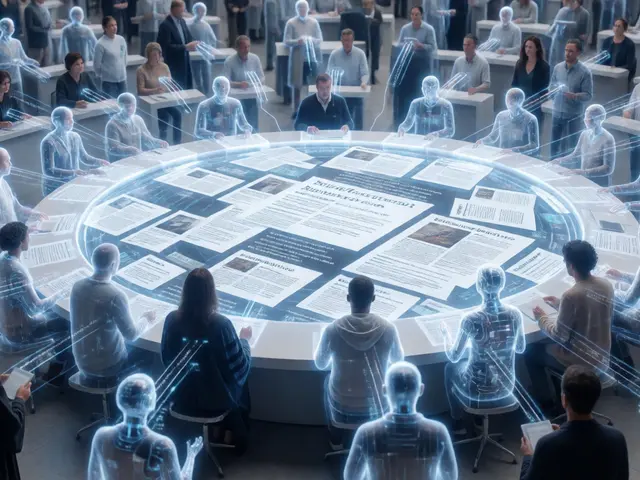
Imagine you are researching a historical figure for a school project. You type their name into two different sources: the classic Wikipedia is a free online encyclopedia that allows anyone to edit articles and a modern Large Language Model (LLM) is an artificial intelligence system trained on vast amounts of text data to generate human-like responses. Both give you an answer. But are they telling you the same truth? More importantly, are they hiding the same blind spots?
In 2026, we are no longer asking if AI can write like a human. We are asking if it can think fairly. As users migrate from clicking links to chatting with bots, the nature of information retrieval has shifted dramatically. This shift brings a new set of risks. While Wikipedia suffers from human editorial bias, AI-generated encyclopedias suffer from statistical bias. Understanding these differences is not just an academic exercise; it is essential for anyone who relies on digital knowledge.
The Human Mirror: How Wikipedia Reflects Its Editors
Wikipedia is often praised as the ultimate neutral source, but neutrality is a myth when your workforce is predominantly male, white, and Western. The platform operates on a model of crowd-sourced editing, which means its content reflects the demographics and interests of its contributors. If most editors live in Europe or North America, articles about European history will be richer, more detailed, and potentially more biased toward local perspectives than articles about African or Southeast Asian history.
This phenomenon is known as Systematic Bias is a consistent pattern of deviation from the truth due to structural factors in data collection or reporting. In Wikipedia’s case, systematic bias manifests in several ways:
- Coverage Gaps: Topics related to technology and science have far more articles than topics related to arts, culture, or indigenous histories.
- Tone Disparities: Studies have shown that biographies of men often highlight achievements and leadership, while biographies of women frequently focus on personal life, appearance, or family roles.
- Vandalism and Reversion Speed: Controversial edits to popular pages are reverted quickly, but obscure pages may remain vandalized or biased for years because fewer eyes watch them.
However, Wikipedia has a defense mechanism: transparency. Every edit is logged. You can click "View History" and see exactly who changed what and why. This audit trail allows researchers and readers to detect bias patterns over time. The bias in Wikipedia is visible, documented, and subject to community debate. It is a messy, human process, but it is open to scrutiny.
The Black Box: Statistical Bias in AI Encyclopedias
Now consider an AI-generated encyclopedia. When you ask an LLM for information, it does not retrieve facts from a database. Instead, it predicts the next likely word in a sequence based on patterns learned during training. These models are trained on massive datasets that include much of the internet-including Wikipedia, news sites, books, and forums. Consequently, AI inherits the biases present in its training data.
But there is a crucial difference. AI does not just copy bias; it amplifies and distorts it through Probabilistic Generation is the process by which AI models select outputs based on calculated likelihoods rather than factual verification. Because LLMs aim to produce fluent, coherent text, they may prioritize socially dominant narratives simply because those narratives appear more frequently in their training data.
For example, if an AI is asked to describe "a CEO," it might default to masculine pronouns or stereotypical traits associated with male leadership, not because it holds a belief, but because those associations are statistically stronger in its training corpus. Unlike Wikipedia, where you can see the editor’s rationale, AI provides no explanation for why it chose one phrasing over another. This lack of transparency makes AI bias harder to detect and correct.
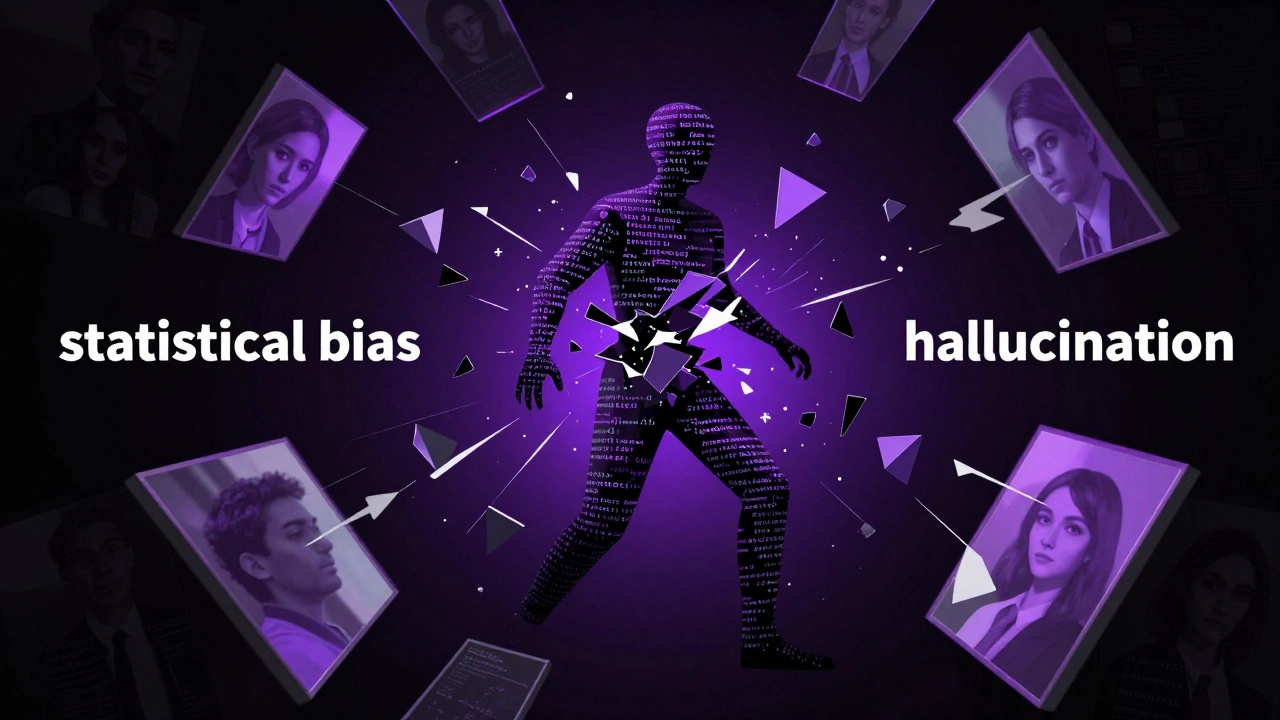
Moreover, AI models can exhibit Hallucination is the generation of plausible-sounding but factually incorrect information by AI systems. A hallucinated fact might sound authoritative and neutral, yet be entirely fabricated. When combined with existing societal biases, hallucinations can create misleading narratives that reinforce stereotypes under the guise of objectivity.
Key Differences in Bias Manifestation
To understand how these two sources differ, we need to look at specific dimensions of bias. Below is a comparison table that highlights the core distinctions between Wikipedia and AI-generated encyclopedias.
| Bias Dimension | Wikipedia | AI-Generated Encyclopedias |
|---|---|---|
| Source of Bias | Human editors’ demographics and viewpoints | Training data distribution and algorithmic weighting |
| Transparency | High: Edit history and talk pages are public | Low: Internal reasoning is opaque (black box) |
| Consistency | Variable: Depends on editor activity and consensus | High: Same prompt yields similar outputs across sessions |
| Correction Mechanism | Community-driven edits and discussions | Requires retraining or fine-tuning by developers |
| Type of Error | Omission, tone imbalance, vandalism | Hallucination, stereotype reinforcement, fluency bias |
Notice the trade-off. Wikipedia offers accountability but lacks consistency. An article might be well-written today and poorly sourced tomorrow. AI offers consistency and speed but lacks accountability. If an AI gives you wrong or biased information, you cannot easily trace back to the source of the error. This fundamental difference shapes how we should use each tool.
Gender and Representation: A Case Study
Let’s look at a concrete example: gender representation in biographical entries. Research has long documented that Wikipedia has fewer articles about women than men, and those that exist often contain less neutral language. For instance, female politicians might be described as "assertive" or "emotional," while male counterparts are called "decisive" or "passionate." These subtle linguistic choices reflect deep-seated cultural biases among editors.
When AI models are trained on this data, they learn these associations. If you ask an LLM to write a biography of a fictional female scientist, it might inadvertently include phrases about her work-life balance or appearance-details rarely included in male scientists’ profiles. This is not malicious intent; it is statistical mirroring. The AI replicates the patterns it sees most often.
However, recent advancements in Fine-Tuning is the process of adjusting pre-trained AI models using specialized datasets to improve performance or reduce bias have allowed developers to mitigate some of these issues. By curating balanced training sets and applying safety filters, companies can reduce overtly biased outputs. Yet, subtle biases persist because they are embedded in the structure of language itself.
In contrast, Wikipedia communities have launched initiatives like WikiProject Women in Red to address coverage gaps. These efforts rely on volunteer mobilization and targeted campaigns. While slower than AI updates, they foster genuine engagement and education. The result is a gradual improvement in representation, driven by diverse voices rather than algorithmic adjustments.
Geographic and Cultural Blind Spots
Bias is not limited to gender. Geographic and cultural disparities also play a significant role. Wikipedia’s English-language version dominates global traffic, but its content heavily favors Anglophone perspectives. Articles about events in India, Nigeria, or Brazil may lack depth compared to equivalent topics in the United States or Europe. This creates a form of epistemic inequality, where certain cultures are seen as more "important" or "worthy" of documentation.
AI models face similar challenges. Most large language models are developed by tech companies in Silicon Valley or Beijing, leading to a concentration of resources around English, Mandarin, and other major languages. Smaller languages and dialects receive less attention, resulting in poorer quality outputs or complete omission. When an AI generates content about a non-Western topic, it may rely on secondary sources written in English, introducing layers of interpretation and potential distortion.
Furthermore, AI tends to generalize across cultures. It might apply Western norms of professionalism or success to contexts where they do not fit. For example, describing traditional communal living arrangements as "inefficient" because they deviate from individualistic economic models. Such judgments stem from the implicit values encoded in the training data, not from explicit programming.

Verification and Trust: Who Do You Believe?
In an era of misinformation, trust is currency. Users need to know whether the information they consume is reliable. With Wikipedia, trust comes from verifiability. Every claim should ideally cite a reputable source. Readers can check references, assess credibility, and form their own opinions. Even if an article contains bias, the presence of citations allows for critical evaluation.
With AI-generated encyclopedias, verification is much harder. LLMs do not provide inline citations by default. Some platforms now offer reference links, but these are often generated post-hoc and may not accurately reflect the model’s reasoning process. Without clear sourcing, users must take the AI’s output on faith. This shifts the burden of truth-seeking from the provider to the consumer.
Consider this scenario: You ask an AI to summarize a controversial political event. It produces a concise, balanced-sounding paragraph. But did it consult primary sources? Did it weigh conflicting accounts equally? Or did it smooth over contradictions to maintain coherence? Unlike Wikipedia, where debates are recorded publicly, AI decisions happen behind closed doors. This opacity undermines trust, especially for high-stakes topics.
To combat this, experts recommend using AI as a starting point, not a final destination. Use it to generate drafts or explore ideas, then verify key claims against established sources like peer-reviewed journals, official reports, or curated databases. Treat AI as a research assistant, not an authority.
Mitigating Bias: Strategies for Users and Developers
So, what can we do about these biases? Both users and developers have roles to play in creating fairer knowledge ecosystems.
For users, the first step is awareness. Recognize that all information sources carry bias. Ask questions: Who created this content? What perspective is missing? Are there alternative viewpoints? Cross-reference multiple sources, including those outside your usual bubble. Engage critically with both Wikipedia and AI outputs.
For developers, reducing bias requires proactive measures. This includes diversifying training data, auditing models for discriminatory patterns, and implementing feedback loops that allow users to report problematic outputs. Transparency reports detailing model limitations and known biases can build user confidence. Additionally, investing in multilingual capabilities ensures broader cultural representation.
Collaboration between communities and technologists is essential. Wikipedia editors can contribute to refining AI training sets, ensuring that nuanced, verified knowledge informs future generations of models. Meanwhile, AI tools can assist editors by identifying gaps, suggesting improvements, or translating content into underrepresented languages. Together, they can create a more inclusive and accurate informational landscape.
The Future of Knowledge: Hybrid Approaches
As we move further into 2026, the line between human-edited and AI-generated content continues to blur. Many platforms now integrate both approaches, using AI to draft initial versions and humans to review and refine them. This hybrid model leverages the strengths of each: AI’s speed and scalability, combined with human judgment and ethical oversight.
Imagine a world where every Wikipedia article has an AI-generated summary that updates in real-time, flagged with confidence scores and bias indicators. Readers could toggle between raw human-edited text and AI-curated summaries, choosing the level of detail and perspective they prefer. Such innovations promise greater accessibility without sacrificing accuracy.
Yet, challenges remain. Ensuring equitable access to these technologies, protecting intellectual property rights, and maintaining editorial independence are ongoing concerns. Policymakers, educators, and citizens must engage in dialogue to shape responsible standards for digital knowledge production.
Ultimately, the goal is not to eliminate bias entirely-an impossible task-but to manage it transparently and inclusively. By understanding how Wikipedia and AI encyclopedias differ in their bias patterns, we become better equipped to navigate the complex terrain of modern information. We learn to question, verify, and appreciate the diverse voices that enrich our collective understanding.
Is Wikipedia more biased than AI encyclopedias?
Not necessarily. Wikipedia’s bias is visible and correctable through community action, whereas AI bias is often hidden within algorithms and harder to address. Both have flaws, but Wikipedia offers greater transparency and accountability.
Can AI ever be completely unbiased?
Complete neutrality is unlikely because AI learns from human-generated data, which inherently contains biases. However, continuous refinement, diverse training sets, and robust oversight can significantly reduce harmful distortions.
How can I spot bias in AI-generated content?
Look for overgeneralizations, stereotypical language, or omissions of minority perspectives. Compare AI outputs with trusted sources and check for citations. Be skeptical of overly polished or emotionally charged statements without evidence.
Why does Wikipedia have fewer articles about women?
Historically, fewer women were featured in notable publications, and fewer women participated as editors. Initiatives like WikiProject Women in Red aim to close this gap by encouraging contributions focused on female figures.
Should I trust AI summaries for academic work?
Use AI summaries as a starting point only. Always verify facts with primary sources and consult textbooks or scholarly articles for rigorous analysis. AI can introduce errors or oversimplifications that compromise academic integrity.
What is hallucination in AI models?
Hallucination occurs when an AI generates false or nonsensical information that sounds credible. It happens because the model prioritizes linguistic fluency over factual accuracy, especially when uncertain about a topic.
How do developers reduce bias in AI training data?
Developers use techniques like debiasing algorithms, diverse dataset curation, and regular audits to identify and mitigate skewed representations. Collaboration with subject matter experts helps ensure cultural sensitivity and accuracy.
Can Wikipedia editors collaborate with AI developers?
Yes. Partnerships between Wikimedia Foundation and tech firms enable shared resources for improving content quality. Editors can help label data, while developers provide tools to enhance editing efficiency and reach.