Imagine you find a dusty diary from 1920 that mentions a local mayor’s secret habit. You rush to update the mayor’s Wikipedia page with this juicy detail. Within minutes, an editor deletes it. Why? Because you just committed one of the most common sins in Wikipedia editing: using a primary source to make a new claim without a reliable secondary source to back it up.
This is the core tension for every editor who wants to add fresh information to Wikipedia, the free online encyclopedia. The platform relies on Primary Sources, original materials created at the time of an event by participants or witnesses like letters, diaries, and raw data sets. But Wikipedia has a strict rule against Original Research, publishing new theories, ideas, or unpublished material. Navigating this line requires understanding not just what a primary source is, but how to use it correctly.
The Golden Rule: Verifiability vs. Synthesis
To understand why your edit might get reverted, you need to look at two specific policies: WP:V (Verifiability) and WP:NOR (No Original Research). These are often confused, but they serve different purposes.
Verifiability asks: "Can a reader check this fact?" If you say, "The building was red," and you link to a photo of the building, that is verifiable. The photo is a primary source. It shows the reality directly.
No Original Research asks: "Did you interpret this fact yourself?" If you look at that same photo and write, "The building was painted red to attract tourists," you are now analyzing the intent behind the color. Unless a historian or architect has already written that analysis in a book or article, you are doing original research. You are synthesizing information that hasn't been published elsewhere.
The key takeaway is simple: Primary sources are great for stating facts. They are terrible for making arguments or interpretations unless those interpretations are widely accepted and uncontroversial.
When Can You Use Primary Sources?
It’s not all bad news. You don’t have to avoid primary sources entirely. In fact, they are essential for certain types of articles. Here is where they shine:
- Direct Quotations: If a president says something controversial, you can quote them directly. Their speech transcript is a primary source. You are reporting what they said, not interpreting their hidden meaning.
- Raw Data and Statistics: Census data, election results, and scientific measurements are primary sources. You can list these numbers in an infobox or table. However, you cannot draw new conclusions from them. For example, if census data shows a population drop, you can state the drop. You cannot write, "This proves the city is failing," unless a secondary source makes that connection.
- Artistic and Literary Works: When writing about a poem, song, or painting, the work itself is the primary source. You can describe the plot, lyrics, or visual elements. But again, critical analysis must come from critics, scholars, or reviewers (secondary sources).
- Uncontroversial Facts: If a primary source contains a simple, indisputable fact-like the date of a birth or the ingredients in a recipe-you can use it. The danger zone starts when you start connecting dots that others haven't connected yet.
The Danger Zone: Analysis and Synthesis
Where editors stumble is in the gray area between reporting and analyzing. Let’s look at a concrete example. Suppose you are editing an article about a company’s financial report. The annual report is a primary source.
You see that profits dropped by 10% while marketing spend increased by 20%. It seems obvious that the marketing campaign failed. But if you write, "The marketing campaign caused the profit drop," you are engaging in synthesis. Maybe the economy crashed. Maybe supply chains broke. Without a secondary source (like a business journal article) explicitly linking the marketing spend to the profit loss, your statement is original research.
Another common pitfall is using multiple primary sources to build a narrative. If you read five different tweets from a politician and combine them to argue that they changed their stance on climate change, you are creating a new argument. Wikipedia does not want your argument; it wants a citation to a journalist or analyst who has already made that argument.
Secondary Sources: The Safety Net
If primary sources are the bricks, Secondary Sources, materials that analyze, interpret, or summarize primary sources are the mortar. They hold the structure together. Reliable secondary sources include:
- Books published by academic presses
- Articles in reputable newspapers (e.g., The New York Times, The Guardian)
- Scholarly journals
- Documentaries produced by major networks
When you use a secondary source, you are borrowing someone else’s interpretation. This protects you from accusations of original research because you are not creating the idea; you are reporting that the idea exists in the public discourse.
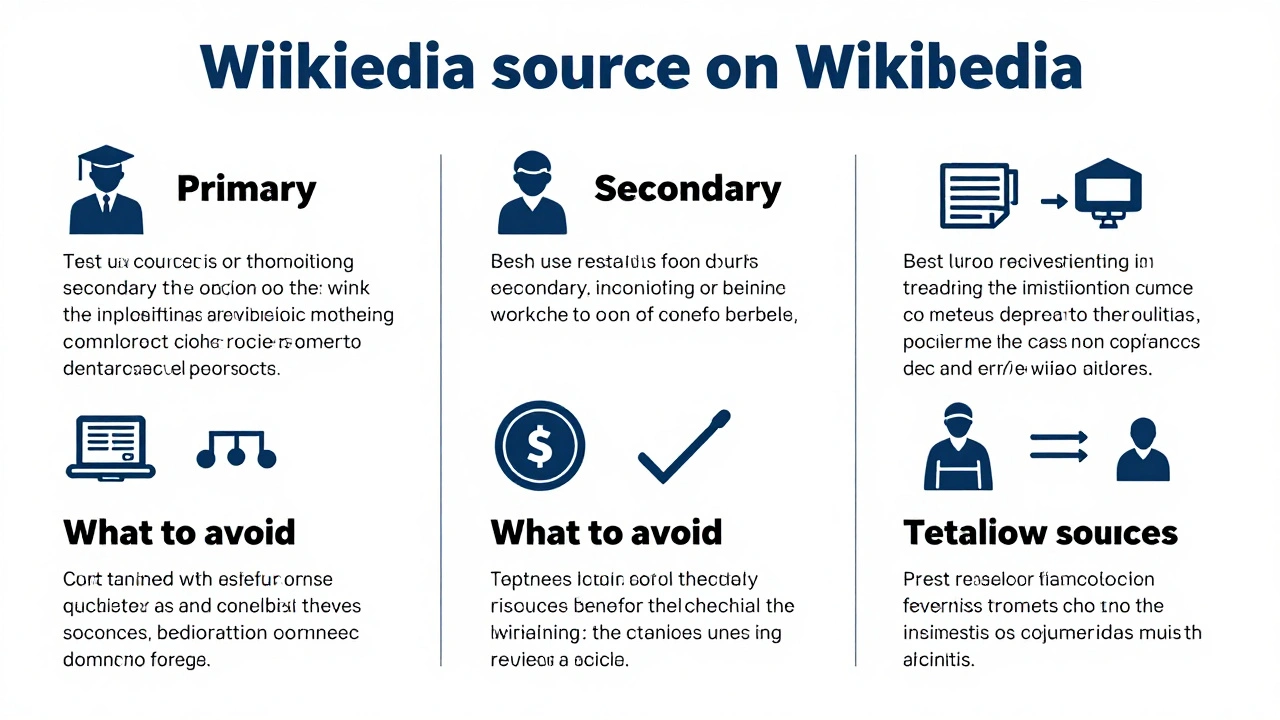
| Source Type | Best Used For | Avoid Using For | Example |
|---|---|---|---|
| Primary | Facts, quotes, raw data | Analysis, interpretation, context | A court transcript |
| Secondary | Context, significance, biography | Nothing (generally safe) | A law review article analyzing the case |
| Tertiary | Background info, summaries | Detailed claims or disputes | An encyclopedia entry about the judge |
Handling Controversy and Disputed Facts
Things get tricky when the primary source is disputed. Imagine a celebrity posts a selfie claiming they invented a new dance move. The post is a primary source. Can you add this to their Wikipedia page as a factual claim? No. Because it is self-promotional and unverified by independent observers.
In cases of controversy, Wikipedia relies heavily on secondary sources to establish consensus. If only one newspaper reports the dance invention, it might be notable. If fifty newspapers and dance experts analyze it, it becomes part of the cultural record. Your job is to reflect that coverage, not to decide if the dance is cool or not.
Also, be wary of "close enough" sources. A press release from a company is a primary source. A blog post quoting the press release is still essentially a primary source repackaged. You need a source that adds value through journalism or scholarship.
Practical Steps for Editors
Before you hit "Publish changes," run your edit through this mental checklist:
- Identify the source type: Is it a direct observation (primary) or an analysis (secondary)?
- Check for interpretation: Am I saying *what* happened, or am I explaining *why* it matters? If it’s the latter, do I have a secondary source?
- Look for synthesis: Am I combining three separate facts to create a new conclusion? If yes, stop. Find a source that has already combined them.
- Verify reliability: Is the primary source trustworthy? A personal blog is less reliable than a government census.
If you are stuck, ask yourself: "Would a stranger reading my sentence think I’m adding my own opinion?" If the answer is yes, you need more backing.
Common Mistakes to Avoid
Even experienced editors slip up. Here are the most frequent errors:
- Over-relying on social media: Tweets and Instagram posts are primary sources. They are useful for showing what someone said, but rarely sufficient for establishing biographical details or career milestones unless covered by secondary media.
- Ignoring the "Significance" test: Just because a fact is true doesn’t mean it belongs on Wikipedia. Primary sources often contain trivial details. Secondary sources help filter out the noise by highlighting what is significant.
- Using tertiary sources as primary: Don’t cite a dictionary definition to prove a complex historical event. Dictionaries are tertiary sources meant for general overviews, not detailed evidence.
Remember, Wikipedia is not a place for new knowledge. It is a mirror reflecting existing knowledge. Primary sources provide the glass, but secondary sources provide the reflection. Use both wisely, and your edits will stand the test of time.
Can I use a tweet as a source on Wikipedia?
Yes, but with limits. A tweet is a primary source. You can use it to quote exactly what someone said or to show they posted an image. However, you should not use a tweet to establish facts about the world (e.g., "The sky is green") unless that claim is supported by other reliable sources. Tweets are also generally not suitable for establishing notability or biographical details unless they are widely reported in secondary media.
What is the difference between a primary and secondary source?
A primary source is an original document or physical object which was written or created during the time under study. Examples include diaries, speeches, manuscripts, letters, interviews, records, photographs, audio/video recordings, artifacts, creative works, or data. A secondary source interprets, analyzes, or summarizes primary sources. Examples include textbooks, scholarly articles, reviews, and documentaries.
Why does Wikipedia prohibit original research?
Wikipedia prohibits original research to maintain neutrality and reliability. If editors could publish their own theories or analyses, the encyclopedia would become a collection of personal opinions rather than a summary of established knowledge. By requiring citations to published, reliable sources, Wikipedia ensures that all content is verifiable and reflects consensus among experts.
Can I use a government website as a primary source?
Yes, government websites are often excellent primary sources for official statistics, laws, and regulations. For example, you can use the U.S. Census Bureau website to cite population figures. However, if you are discussing the political implications of those figures, you need a secondary source like a news article or academic paper to provide that analysis.
How do I know if a source is reliable?
Reliability depends on the topic. Generally, peer-reviewed academic journals and major news outlets are considered reliable. Self-published sources like blogs, Twitter accounts, and personal websites are usually not reliable. Wikipedia has specific guidelines for different topics (e.g., medicine, politics) that outline which sources are acceptable. Always check the "Reliable Sources" noticeboard for guidance on specific publications.