For years, the little colored boxes on the side of Wikipedia pages have been the silent judges of quality. You’ve seen them: "Featured Article," "Good Article," or the dreaded "Stub." But if you’ve noticed that these labels feel a bit stale lately, you aren’t imagining things. The Wikimedia Foundation and the global editor community are currently navigating significant shifts in how they assess content. These aren't just cosmetic tweaks; they represent a fundamental rethink of what constitutes "quality" in an encyclopedia that now hosts over 60 million articles.
The old system, built largely in the early 2000s, was designed for a much smaller project. It relied heavily on manual reviews by volunteer editors who spent hours scrutinizing citations and prose. Today, with AI tools generating text at lightning speed and new readers arriving from every corner of the globe, those methods are struggling to keep up. The core problem is simple: we have more content than we have reviewers, and the definition of a "good" article has evolved beyond just having enough words.
The Shift From Manual Review to Hybrid Assessment
Historically, Wikipedia content assessment was a purely human endeavor. An editor would read an article, check its references against reliable sources, and assign it a grade based on a rigid set of criteria. This process, while thorough, was incredibly slow. A single WikiProject might only review a handful of articles per month. The bottleneck wasn't lack of effort; it was the sheer volume of information.
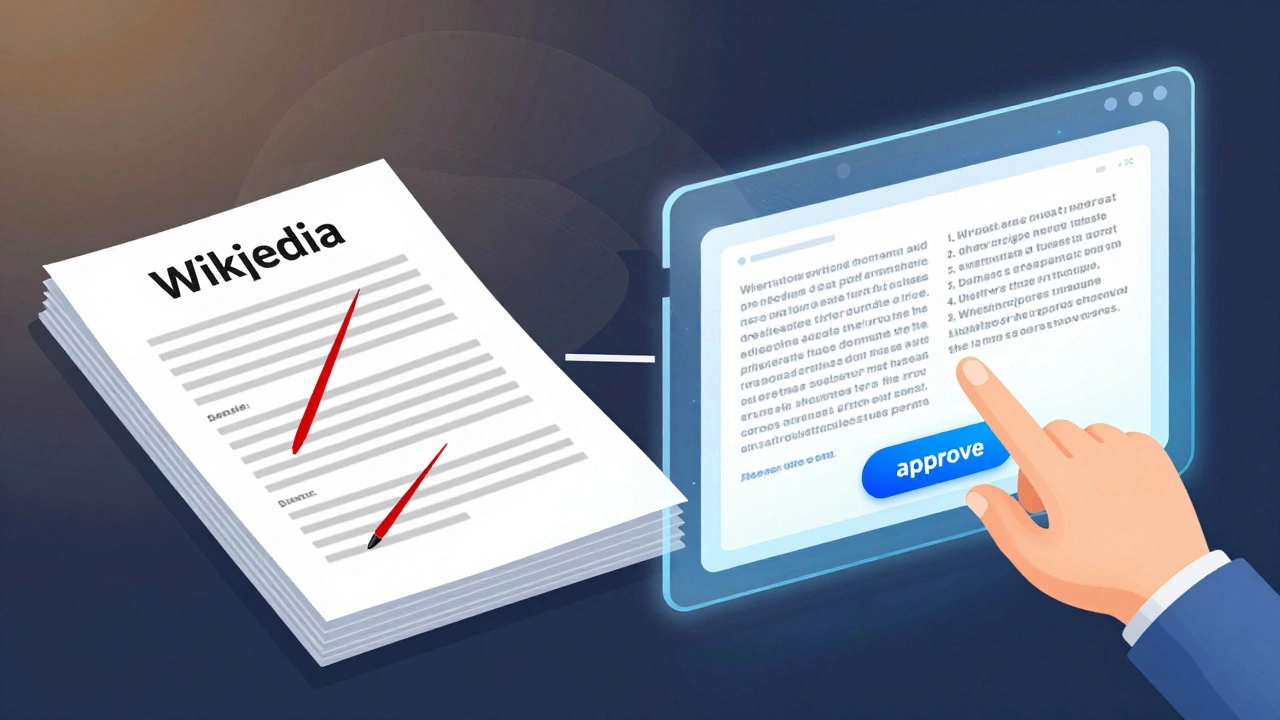
The new approach introduces a hybrid model. Instead of relying solely on human eyes for the initial pass, the community is integrating automated tools that scan for structural completeness, citation density, and neutrality markers. Think of it like a spellchecker but for encyclopedic standards. These tools flag potential issues-like missing citations in key claims or biased language-allowing human editors to focus on nuanced judgment calls rather than basic compliance checks. This shift doesn't replace humans; it amplifies their ability to spot subtle problems that algorithms miss, such as logical fallacies or contextual bias.
This change addresses a critical pain point: the backlog. Millions of articles sit unassessed because no one has had the time to look at them. By automating the "low-hanging fruit" of assessment, the community can prioritize high-impact topics like health, politics, and science, where accuracy matters most. It’s a pragmatic move driven by necessity, not a desire to cut corners.
Redefining Quality: Beyond Word Count and Citations
One of the most controversial aspects of the updated criteria is the de-emphasis on length. In the past, a common heuristic was that longer articles were better. If an article had 10,000 words and fifty citations, it often slid into the "B-Class" category regardless of readability. The new standards argue that clarity trumps comprehensiveness. An article that explains a complex concept in 500 clear, well-sourced sentences is now valued higher than a 5,000-word wall of text that confuses the reader.
| Criteria Aspect | Traditional Focus (Pre-2024) | Updated Focus (2026 Standards) |
|---|---|---|
| Length | Longer is generally better | Concise and comprehensive; no minimum word count |
| Citations | Quantity of references | Quality and reliability of sources; diverse viewpoints |
| Structure | Presence of standard sections | Logical flow and navigability for diverse audiences |
| Tone | Neutral point of view (NPOV) compliance | Accessibility and engagement without sacrificing neutrality |
| Assessment Method | Manual review by WikiProjects | Hybrid: Automated flags + Human final judgment |
This redefinition also places a heavier burden on source diversity. Previously, citing three major newspapers might have been enough. Now, the criteria explicitly require representation from different geographic regions and ideological perspectives to ensure true neutrality. For example, an article about a political event in Asia must include credible sources from Asian media outlets, not just Western interpretations. This prevents the "echo chamber" effect where Wikipedia inadvertently mirrors the biases of its largest editorial base.
The Role of WikiProjects in the New Era
WikiProjects are the backbone of Wikipedia's governance. These are groups of volunteers dedicated to specific topics, like "WikiProject Medicine" or "WikiProject History." Under the old system, they acted as gatekeepers, deciding which articles got promoted. With the new criteria, their role is shifting from gatekeepers to mentors.
Instead of spending weeks debating whether an article meets a vague "A-Class" standard, WikiProject leaders are now using data dashboards provided by the foundation. These dashboards highlight articles that are frequently viewed but poorly rated, allowing projects to target improvements where they matter most. A WikiProject focused on Technology, for instance, might see that thousands of people are reading about a new smartphone chip, but the article is still marked as a "Start" class. They can then rally editors to improve that specific page quickly.
This data-driven approach makes participation less intimidating for new editors. In the past, joining a WikiProject meant learning a dense set of bureaucratic rules. Now, new contributors can see exactly what needs fixing: "Add a citation here," "Expand this section," or "Improve the lead paragraph." It turns abstract policy into actionable tasks. This democratization of improvement helps sustain the volunteer workforce, which has faced retention challenges in recent years.
Impact on Featured Articles and Good Articles
The gold standards of Wikipedia-the Featured Articles (FA) and Good Articles (GA)-are undergoing the most scrutiny. These labels carry prestige, and editors often work tirelessly to achieve them. The concern among long-time contributors is that lowering the barrier to entry might dilute the value of these badges. However, the new criteria aim to tighten, not loosen, the definition of excellence.
To earn a Featured Article status today, an article must demonstrate "prose polish" that appeals to a general audience, not just experts. This means avoiding jargon unless it is clearly defined. It also requires a balanced structure that guides the reader through the topic logically. More importantly, the review process for FAs now includes a mandatory check for "global perspective." An article about Shakespeare, for example, must adequately cover his influence in non-Western literary traditions, supported by academic sources from those regions.
For Good Articles, the change is more about stability. GAs are meant to be solid, reliable entries that don't need constant maintenance. The new criteria emphasize "maintenance sustainability." If an article relies on obscure sources that are hard to verify, it might be downgraded even if it is factually correct. The goal is to create a tier of articles that any editor, anywhere, can trust and update without fear of breaking the consensus. This reduces the "edit wars" that often plague high-profile topics.

Challenges and Community Pushback
No policy change happens without friction. Some veteran editors argue that the reliance on automated tools risks introducing algorithmic bias. If the AI training data is skewed toward English-language norms, it might penalize articles written by non-native speakers or those covering topics prevalent in other cultures. There have been heated discussions on Wikipedia's talk pages about whether these tools are "gaming" the system by rewarding formulaic writing over genuine insight.
Another point of contention is the speed of implementation. While the technical infrastructure for hybrid assessment is ready, the cultural shift takes time. Many WikiProjects are still using old rubrics out of habit. Bridging this gap requires extensive training and documentation. The Wikimedia Foundation has launched workshops and webinars to help editors adapt, but resistance remains strong in communities that value tradition over efficiency.
Furthermore, there is the issue of enforcement. Who decides when an article truly meets the new standards? The decentralized nature of Wikipedia means there is no central authority. Decisions are made by consensus, which can be slow and messy. The new criteria attempt to provide clearer guidelines to reduce ambiguity, but human interpretation will always play a role. This tension between standardization and community autonomy is the central challenge of the current reform.
What This Means for Readers and Contributors
If you are a casual reader, these changes mean that the articles you encounter are likely to be more accessible and globally representative. You’ll see fewer walls of text and more clear explanations. You’ll also notice that articles on niche topics are improving faster because the assessment tools help identify gaps more efficiently. The credibility of Wikipedia as a primary reference point strengthens when the underlying quality control adapts to modern realities.
For contributors, the landscape is both easier and harder. It’s easier because you get clearer feedback on what to fix. It’s harder because the bar for nuance and global perspective is higher. You can’t just copy-paste from a single source anymore. You need to synthesize information from multiple viewpoints. This encourages deeper engagement with the subject matter, fostering a more thoughtful editing culture.
The evolution of Wikipedia’s content assessment criteria is not just a technical update; it’s a reflection of the platform’s maturity. As the world’s largest knowledge base, it must balance scale with quality, automation with humanity, and global reach with local relevance. These changes are imperfect, but they are necessary steps to ensure that Wikipedia remains a trustworthy resource in an age of information overload.
Why is Wikipedia changing its content assessment criteria?
The changes are driven by the need to handle the massive scale of Wikipedia's content. The old manual review system couldn't keep up with the millions of articles, leading to large backlogs. Additionally, the definition of quality needed to evolve to prioritize clarity, global perspective, and source diversity over mere length and citation counts.
Will AI replace human editors in assessing Wikipedia articles?
No, AI will not replace human editors. The new model is hybrid. Automated tools handle initial scans for structural issues and citation density, but human editors make the final judgment calls on nuance, bias, and overall quality. The goal is to assist humans, not replace them.
How do the new criteria affect Featured Articles?
Featured Articles now face stricter requirements regarding global perspective and prose accessibility. They must include diverse sources from different regions and avoid jargon. The focus is on creating articles that are not just comprehensive but also understandable and unbiased to a worldwide audience.
What is the role of WikiProjects under the new system?
WikiProjects are shifting from being gatekeepers to mentors. They use data dashboards to identify high-traffic articles that need improvement and guide new editors with specific, actionable tasks. This makes participation more accessible and targets efforts where they have the most impact.
Are there concerns about bias in the new assessment tools?
Yes, some editors worry that automated tools trained on existing data might reinforce Western or English-language biases. The community is actively working to mitigate this by ensuring the algorithms are audited and that human reviewers pay extra attention to global perspective and cultural nuance.