Imagine you are trying to figure out who won a close local election. You open your favorite newspaper and read a detailed analysis of the campaign promises. Then, you switch to Wikipedia is a free online encyclopedia that relies on volunteer editors to maintain neutral points of view. The article there is dry, factual, and cites sources from both sides. Which one feels more trustworthy? This isn't just about preference; it's about how we consume truth in an age of information overload. By comparing the narrative arc of professional newsrooms with the collaborative, often chaotic, edit histories of Wikipedia, we can see two very different models of public record.
The core difference lies in intent. A newsroom aims to inform, analyze, and sometimes persuade. A Wikipedia editor aims to document, verify, and remain neutral. When these two collide during a high-stakes election, the results are fascinating. We aren't just looking at *what* was said, but *how* it was recorded over time. One side tells a story; the other builds a database. Understanding this distinction helps us become smarter consumers of information, whether we are voting, researching, or just curious about how consensus forms in the digital age.
The Narrative Engine: How Newsrooms Frame Elections
News Journalism is the practice of gathering, reporting, and analyzing current events for public consumption. In the context of elections, journalism operates as a narrative engine. It doesn't just list facts; it connects them into a story. Why did Candidate A win? What were the key turning points? Who made the gaffe that cost them the race? These questions require interpretation. Journalists use interviews, polls, and expert commentary to build a picture that makes sense to the reader.
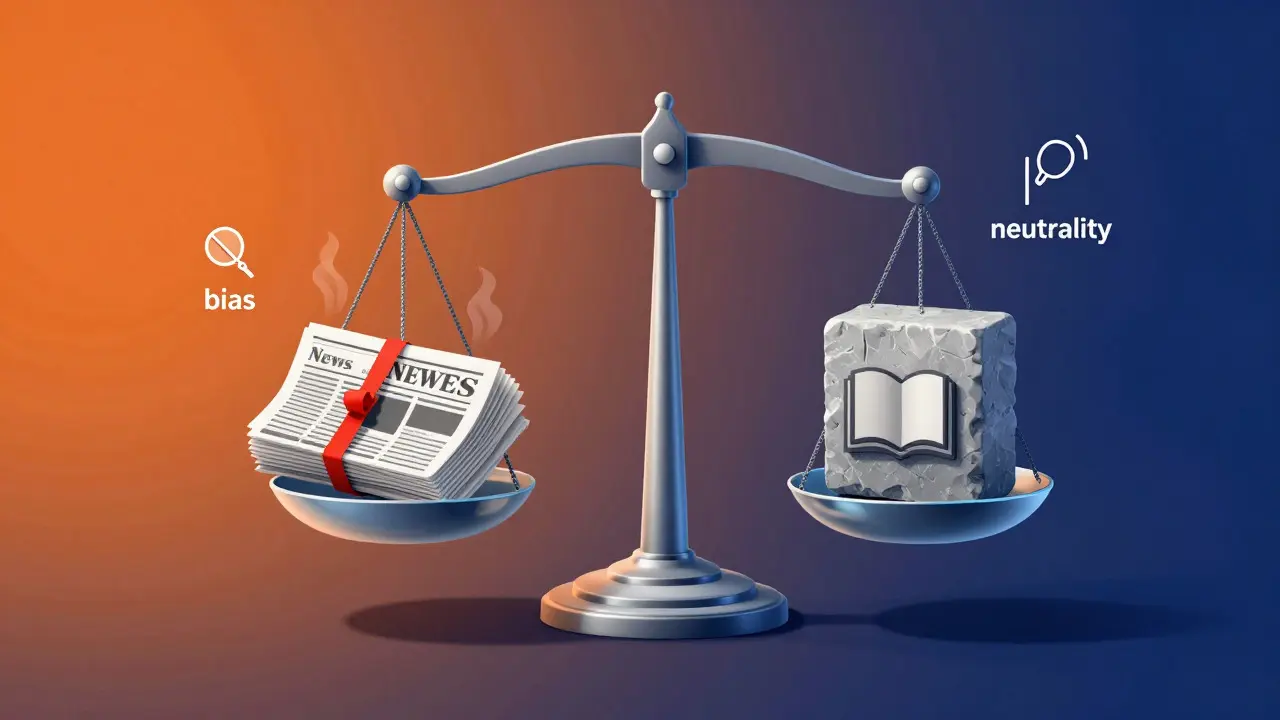
This approach has strengths and weaknesses. The strength is clarity. A well-written election piece explains the 'why' behind the numbers. The weakness is bias, even when unintentional. Editors choose which stories to run, which quotes to highlight, and which angles to ignore. For example, a major outlet might focus heavily on a candidate's economic policy because their readership cares most about that issue. Meanwhile, another outlet might emphasize social issues. Both are 'true,' but neither is the whole truth. This is where the concept of Media Bias is the tendency of journalists and editors to present information in a way that reflects their own political or ideological views. becomes critical. It’s not always overt; it’s often structural, baked into the format of the medium itself.
The Collaborative Record: Inside Wikipedia’s Edit History
On the other side of the fence sits Wikipedia. Unlike a newsroom, which has a single editorial voice, Wikipedia is a collective effort. Its power comes from its transparency. Every change to an article is logged in the Edit History is a chronological log of all changes made to a specific page, including who made the change, when, and what was altered.. This is a goldmine for researchers. If you look at the edit history of a presidential election article during the final weeks of the campaign, you’ll see a flurry of activity. Users adding polling data, correcting typos, debating the wording of a summary sentence, and reverting edits they felt were biased.
This process is messy. It’s not a smooth flow of information; it’s a constant negotiation. Some edits are obvious vandalism-changing a candidate’s name to a cartoon character. Others are subtle disputes over tone. Is the phrase "controversial decision" too loaded? Should we say "voters favored" or "voters preferred"? These micro-debats happen thousands of times. The result is an article that strives for Neutral Point of View (NPOV) is a core policy of Wikipedia requiring articles to be written fairly, proportionally, and without taking sides.. It’s not perfect, but the sheer volume of eyes watching the page acts as a powerful self-correcting mechanism. If one person tries to skew the facts, someone else usually reverts it within hours.
Comparing Speed, Depth, and Accuracy
So, how do these two systems stack up against each other? Let’s break it down by three key metrics: speed, depth, and accuracy. Speed is where newsrooms win hands down. Breaking news happens in real-time. If a candidate drops out, the news site updates in minutes. Wikipedia editors might take hours or even days to update the lead section, waiting for reliable sources to confirm the story. Depth is a toss-up. News articles offer deep dives into specific aspects of the election, like a detailed profile of a candidate’s past. Wikipedia offers broad, encyclopedic coverage, linking to related topics, historical contexts, and statistical data. It’s wider but shallower in any single moment.
Accuracy is the most complex metric. News outlets have fact-checkers, but they still make errors. Typos, misquoted statistics, or wrong names slip through. Wikipedia has no single authority, so errors can persist if no one notices them. However, because anyone can fix them, the average error rate on major pages tends to be low. Studies have shown that for stable, well-covered topics, Wikipedia’s accuracy is comparable to traditional encyclopedias. But for breaking, fast-moving events like election nights, the lag in updating can make it feel outdated compared to live news feeds.
| Feature | Newsroom Coverage | Wikipedia Article History |
|---|---|---|
| Primary Goal | Inform, Analyze, Narrate | Document, Verify, Neutralize |
| Update Speed | Real-time / Minutes | Delayed / Hours to Days |
| Source of Authority | Editorial Board / Journalists | Volunteer Community / Consensus |
| Bias Control | Editorial Standards / Fact-Checkers | NPOV Policy / Peer Review via Edits |
| Transparency | Low (Process hidden) | High (Full edit log visible) |
The Role of Citations and Sourcing
A crucial part of both systems is sourcing, but they handle it differently. In journalism, citations are often implicit. You trust the reporter because they have a byline and a reputation to protect. Explicit links to sources are becoming more common, but the focus is on the narrative flow. On Wikipedia, citations are mandatory. Every factual claim needs a reference to a reliable source. If you remove a citation, the statement is vulnerable to being deleted by another editor. This creates a rigorous standard of evidence. You can’t just say "Candidate B was unpopular"; you need to link to a poll or a news report that says so.
This reliance on external sources means Wikipedia is heavily dependent on the quality of Reliable Sources are publications or media outlets recognized by the community as credible and independent, such as peer-reviewed journals or major news agencies.. If a controversial claim is made, editors will debate whether the source is reputable enough. This process slows things down but ensures that the final product is backed by verifiable data. It’s a slower, more bureaucratic approach than journalism, but it leaves a trail of evidence that you can follow yourself.

How to Use Both for Better Understanding
Here’s the practical takeaway: don’t choose one over the other. Use them together. Start with the news coverage to get the immediate context, the human element, and the analysis. Read the headlines, watch the debates, and understand the emotional stakes. Then, go to Wikipedia to check the facts. Look at the infobox for the exact vote counts. Check the references to see where the data comes from. If something seems off in the news report, check the Wikipedia edit history to see if there was a recent correction or dispute.
This dual approach gives you both the story and the data. It helps you spot inconsistencies. For instance, if a news article claims a candidate won by a large margin, but the Wikipedia data shows a narrow victory, you now know to dig deeper. Maybe the news outlet used preliminary results, while Wikipedia waited for certified counts. By cross-referencing, you build a more robust understanding of what actually happened. It turns passive reading into active verification.
Frequently Asked Questions
Is Wikipedia more accurate than news outlets?
For stable, well-documented topics, Wikipedia is often as accurate as traditional encyclopedias due to its peer-review-like editing process. However, for breaking news like election nights, news outlets are faster and may have more immediate access to exclusive information. Wikipedia’s advantage lies in its long-term consistency and transparent sourcing rather than real-time speed.
Why do Wikipedia articles change so much during elections?
Elections generate massive amounts of new data and public interest. Volunteer editors rush to update polling numbers, candidate statements, and final results. Because the topic is hotly debated, there are also frequent edits to adjust tone and ensure neutrality, leading to a high volume of revisions in the edit history.
How can I tell if a Wikipedia edit is biased?
Look at the edit summary provided by the user and check the talk page for discussions. If an edit adds strong adjectives without citing a source, or if it removes counter-arguments, it may be biased. Also, check if the edit is quickly reverted by other users, which often signals a consensus against the change.
Should I trust news headlines over Wikipedia summaries?
Headlines are designed to grab attention and often omit nuance. Wikipedia summaries aim for neutrality and completeness. For a quick overview, Wikipedia is safer. For understanding the implications and reactions to the event, news headlines provide better context. Always read the full article on both platforms for a complete picture.
What is the main benefit of checking the edit history?
The edit history shows the evolution of the article. It reveals when facts were changed, why they were changed, and who made the changes. This transparency allows you to verify the stability of the information and identify periods of controversy or rapid development that might not be evident in the final version of the page.