Ever wonder how Wikipedia keeps millions of users from being doxxed while still allowing editors to catch vandals? It’s not magic; it’s a layered system of policies and specialized tools. If you’ve ever edited an article or just browsed the history tabs, you’ve interacted with this framework without knowing it. The core tension here is simple: how do you maintain transparency in a public encyclopedia while protecting the private data of its contributors? This is where Wikipedia's governance structure steps in.
Three pillars hold this system together: the Privacy Policy, which sets the rules for data handling; CheckUser, a tool for investigating sockpuppets; and Oversight, which hides sensitive revisions entirely. Understanding these isn't just trivia-it explains why some edits disappear, why your IP address matters, and how community trust is maintained when anonymous editing meets real-world accountability.
The Foundation: Wikipedia's Privacy Policy
Wikimedia Foundation, the non-profit behind Wikipedia, doesn’t collect personal data unless you give it to them. But there’s a catch. Every time you edit anonymously, your IP address becomes part of the public record. That’s right-your digital fingerprint is visible to anyone who checks the page history. For logged-in users, this changes dramatically. Once you create an account, your IP is hidden from public view, replaced by your username.
This distinction drives most privacy concerns. Anonymous editors are essentially public figures within the context of their specific edits. Their location (approximated by IP) and device type can be inferred. Logged-in users gain a layer of anonymity, but they aren’t invisible. The Privacy Policy explicitly states that Wikimedia stores technical information like browser types and operating systems for security purposes. They don’t sell this data. They don’t even look at it unless necessary. But if you’re worried about metadata, remember: creating an account is the single best step toward controlling your footprint on the site.
Why does this matter? Because conflicts happen. When two editors argue over content, one might accuse the other of being a "sockpuppet"-a fake account used to manipulate consensus. Without clear privacy boundaries, resolving these disputes would require exposing everyone’s personal info. The policy balances this by keeping raw data private until a specific threshold of suspicion is met.
CheckUser: The Digital Detective Tool
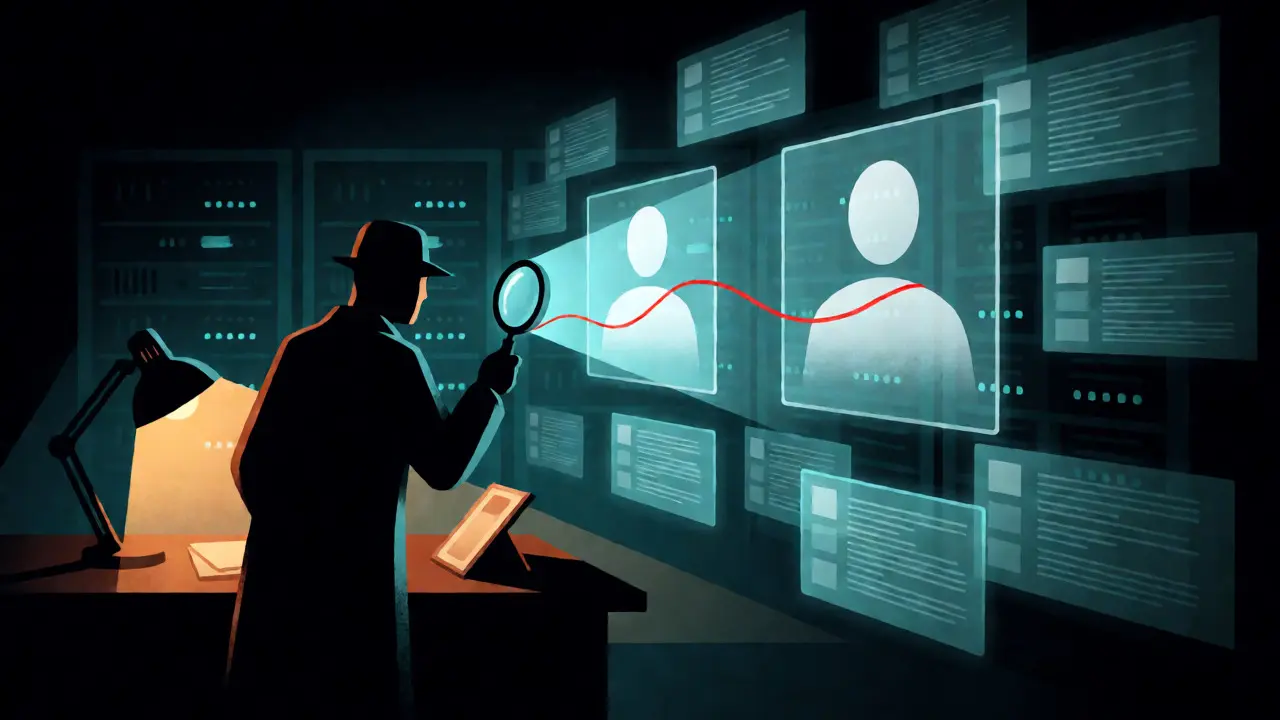
If the Privacy Policy is the law, CheckUser is the investigation squad. This isn’t something any editor can use. It’s a special permission granted to trusted volunteers who have undergone background checks. Only a handful of people worldwide hold this right at any given time. Why so few? Because CheckUser allows access to unpublicized data: specifically, IP addresses and User-Agent strings associated with accounts.
Imagine this scenario: You notice a new account praising a controversial political figure. Five minutes later, another new account criticizes the same figure. Both accounts were created today. Are they related? A regular editor can’t tell. A CheckUser can run a query to see if both accounts share the same IP address or similar connection times. If they do, it’s likely one person using multiple identities-a sockpuppet violation.
But CheckUser isn’t just about catching cheaters. It’s also used to protect users. If someone threatens to reveal your identity because you’re an anonymous editor, a CheckUser request can verify that your IP hasn’t been compromised or linked to unexpected locations. It’s a defensive tool as much as an offensive one. Crucially, CheckUser results are confidential. The investigator sees the match, but the general public does not. This preserves the presumption of innocence until proven otherwise.
Oversight: The Nuclear Option
Sometimes, hiding an edit isn’t enough. Sometimes, you need to erase it. Enter Oversight. Think of Oversight as the delete key for the entire internet, at least within Wikipedia’s database. While regular admins can delete pages, Oversight removes content from the public eye entirely. Even administrators without Oversight rights cannot see what was removed. Only Oversighters and certain stewards can restore it.
When is Oversight used? Typically for four reasons:
- Personal Information: Someone accidentally posts their home address or phone number.
- Legal Compliance: Content violates laws regarding defamation or copyright that require immediate removal.
- Harassment: Vicious slurs or threats that go beyond normal editorial disagreement.
- Child Safety: Protecting minors from exposure to inappropriate content.
The process is swift but rare. An editor flags a revision, and an Overighter reviews it. If approved, the text vanishes. To the casual reader, it looks like the edit never happened. This power is significant. Critics sometimes argue it leads to censorship, but proponents point out that Oversight is strictly limited to non-contentious issues. It’s rarely used to settle content disputes. Instead, it acts as a safety valve for emergencies.
How These Tools Interact
These three elements don’t work in isolation. They form a pipeline. Let’s walk through a typical incident. First, a user reports suspicious activity. An administrator reviews the behavior and suspects sockpuppetry. They initiate a CheckUser request. The CheckUser confirms the link between accounts. If the evidence shows malicious intent, the accounts are blocked. If the blocked user retaliates by posting personal details of the accuser, an Oversight request is filed. The Overighter hides the personal info. Throughout this, the Privacy Policy ensures that the initial IP data wasn’t leaked prematurely.
This workflow relies on trust. Editors trust that CheckUsers won’t abuse their access. They trust that Oversighters won’t suppress legitimate criticism. And they trust that the Wikimedia Foundation enforces the Privacy Policy fairly. When this trust breaks down, controversies erupt. Recent years have seen debates about whether Oversight is being used too broadly. Some communities feel it stifles free speech; others worry it’s not used enough to protect vulnerable editors.
| Feature | Privacy Policy | CheckUser | Oversight |
|---|---|---|---|
| Purpose | Define data collection and usage rules | Investigate sockpuppets and IP links | Hide sensitive or harmful revisions |
| Access Level | Publicly available document | Limited to elected/trusted users | Limited to elected/trusted users |
| Data Visibility | N/A (Framework) | Private (visible only to CU) | Hidden from all except Oversighters |
| Reversibility | N/A | Results are temporary logs | Can be restored by Oversighters |
| User Impact | Affects all users equally | Affects suspected sockpuppets | Affects readers and editors of specific pages |
Common Misconceptions
One big myth: "Wikipedia owns my data." Wrong. Under the Creative Commons Attribution-ShareAlike license, you retain copyright to your contributions. You grant Wikipedia a license to use them, but you don’t transfer ownership. Another myth: "Admins can see everything." Regular admins cannot see IP addresses of registered users. They cannot see Oversighted revisions. Only those with specific extended rights can. This tiered access prevents power concentration.
Another frequent question: "Can I delete my own edits?" Not easily. Once content is published, it’s part of the project’s history. You can remove your name from future edits by logging out, but past contributions remain attributed to your username. If you want true anonymity after contributing, you must change your username, but the old name remains in the history unless Oversight is invoked for privacy reasons.
Why This Matters for You
If you’re a student, journalist, or researcher, understanding these mechanisms helps you assess source reliability. When you see a heavily moderated article, know that Oversight may have scrubbed early drafts. When you cite a Wikipedia page, realize that the visible history is curated. For editors, these tools define your responsibilities. You’re not just writing facts; you’re participating in a governed community. Respecting the Privacy Policy means not doxxing opponents. Understanding CheckUser limits means avoiding assumptions about who is behind an edit.
Governance on Wikipedia is messy, human, and constantly evolving. It’s not perfect. But it provides a framework for balancing openness with protection. As the platform grows, so do the challenges. New technologies, changing laws, and shifting cultural norms will force updates to these policies. For now, though, the triad of Privacy, CheckUser, and Oversight remains the backbone of Wikipedia’s operational integrity.
What happens if I post my email address on Wikipedia?
If you post your email address publicly, it becomes part of the page history. Anyone can see it. To remove it completely, you usually need to request Oversight, especially if it has been scraped by search engines. Simply deleting the comment isn't enough because the history retains the old version.
Can anyone become a CheckUser?
No. CheckUser rights are granted by the Arbitration Committee after a rigorous vetting process. Candidates must demonstrate trustworthiness, experience, and a clean record. There are typically fewer than ten active CheckUsers on the English Wikipedia at any time.
Does Wikipedia track my location?
Wikipedia does not track your GPS location. However, your IP address reveals your approximate geographic region. For anonymous editors, this is visible to anyone checking the page history. For logged-in users, it is hidden from the public but accessible to CheckUsers during investigations.
What is the difference between deletion and Oversight?
Deletion removes a page from the main namespace but keeps the history visible to admins. Oversight hides specific revisions from all users, including admins, unless they have Oversight rights. Oversight is used for sensitive data like personal info or legal violations, while deletion is for pages that don't meet notability standards.
Can I appeal an Oversight decision?
Yes. If you believe content was incorrectly oversights, you can raise the issue on the appropriate noticeboard or contact an Oversight directly. In complex cases, the Arbitration Committee may review the decision. However, Oversight decisions are generally final due to their urgent nature.