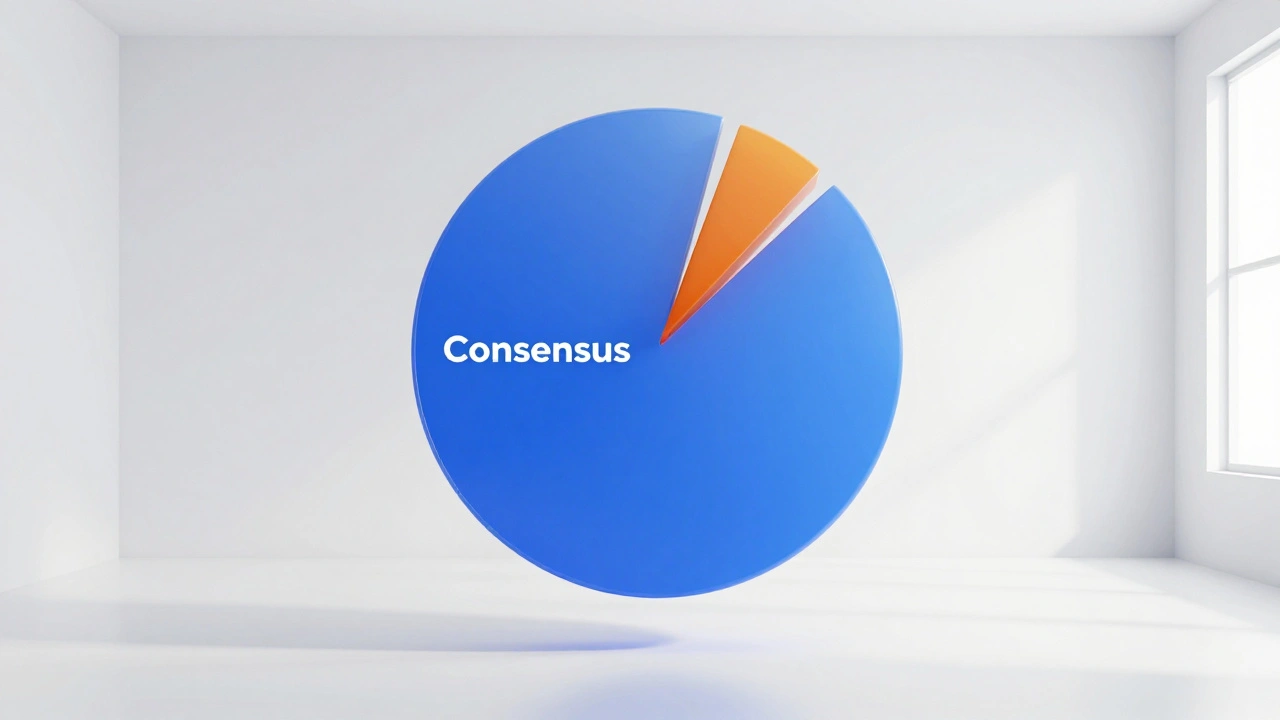
When we talk about neutrality, most people think it means giving every side an equal number of words. But in the world of documented facts, 'equal' isn't always 'fair.' If 99% of the world agrees on something and 1% disagrees, giving them 50/50 space creates a false balance. It tricks the reader into thinking the debate is a coin flip when it's actually a landslide. The goal isn't to be a referee in a boxing match; it's to be a mirror that reflects the actual state of human knowledge.
The Core of the Due Weight Principle
At its heart, Due Weight is a fundamental guideline used to ensure that the proportion of content reflects the actual prevalence of a particular view in the real world. It is a critical component of the broader Neutral Point of View (or NPOV) policy. While NPOV tells us to be unbiased, due weight tells us how to allocate the actual space on the page.
Think of it like a pie chart. If a topic has a consensus, the consensus gets the biggest slice. Minority views still get a slice-because they exist and are often important for context-but their slice shouldn't be the same size as the majority's. If you're writing about the Earth's shape, you don't spend three paragraphs on flat-earth theories and three paragraphs on the oblate spheroid model. You explain the scientific fact and briefly mention the fringe belief as a historical or social curiosity.
Why Equal Weight is Actually a Bias
It sounds counterintuitive, right? We're taught that being fair means giving everyone a turn to speak. But in an encyclopedia, "false balance" is a form of bias. When an editor gives a tiny, discredited theory the same prominence as a widely accepted fact, they are effectively promoting that minority view. They are telling the reader, "This is just as valid as the main theory," which is factually incorrect.
Let's look at a real-world scenario. Imagine an article on Climate Change. If the article spends 1,000 words on the IPCC's data and 1,000 words on a single blog post from a skeptic, the reader leaves thinking the scientific community is split 50/50. In reality, the consensus is overwhelming. By striving for "equality," the editor has failed to provide an accurate summary of the topic. True neutrality requires the courage to be unequal in space to be equal in truth.
| Feature | Equal Weight (False Balance) | Due Weight (Proportionality) |
|---|---|---|
| Goal | Give every side the same space | Reflect real-world prevalence |
| Reader Perception | Sees a 50/50 split in opinion | Sees the actual hierarchy of views |
| Handling Consensus | Treated as one of many views | Given primary prominence |
| Handling Fringe Views | Given substantial space | Mentioned briefly for context |
Identifying and Representing Minority Views
Just because a view is in the minority doesn't mean it should be deleted. In many cases, the minority view is where the most interesting tension lies. The trick is knowing how to frame it. A Minority View should be presented as such. Instead of saying "Some people believe X," which is vague, use a more precise attribution like "A small group of economists argue X, though this is not the prevailing view in the field."
To do this correctly, editors usually rely on Reliable Sources. If you can find a peer-reviewed journal or a reputable news organization that explains why a minority view exists and why it is rejected by the majority, you have a roadmap for the section. The focus should be on the *nature* of the disagreement, not just the claims themselves. You aren't arguing the point; you are describing the state of the conversation.

The Danger of 'The Middle Ground' Fallacy
There is a common temptation to find a "middle ground" between two opposing views to avoid conflict. This is often a mistake. If one side says the sky is blue and the other says it's neon green, the middle ground isn't "somewhere in between blue and green." The middle ground is simply wrong. In editorial work, trying to split the difference between a factual claim and a fabrication doesn't create neutrality-it creates misinformation.
This is especially risky in political or religious topics. If you're documenting a conflict, you can't just average out the two narratives. You have to report what each side claims, but you also have to note which claims are backed by evidence and which are disputed by international bodies or historians. The goal is to describe the conflict accurately, not to invent a compromise that doesn't exist in reality.
Practical Steps for Balancing Content
If you're editing a page and feel the balance is off, don't just start deleting paragraphs. Follow a logical process to restore due weight:
- Audit the current space: Count the words or paragraphs dedicated to each view. Does the layout match the actual prevalence of these views in reliable literature?
- Check the attributions: Are the views labeled? Use phrases like "the prevailing view," "a minority opinion," or "a widely disputed claim."
- Prune the fluff: If a minority view is taking up too much room, look for repetitive arguments. You only need to explain the core logic of a minority view once; you don't need five different examples to prove it exists.
- Prioritize the lead: The introduction (the lead section) should almost always reflect the majority view. The nuances and minority perspectives belong in the body of the article, not the first paragraph.

Handling Contentious Disputes
What happens when editors can't agree on what the "majority view" actually is? This is where Talk Pages become essential. Instead of engaging in an edit war-where two people keep reverting each other's changes-editors must bring evidence to the table. "I think this view is a minority" is an opinion. "This 2023 meta-analysis of 50 studies shows that only 5% of researchers support this view" is a fact.
When the evidence is conflicting, the best path is to describe the controversy itself. Instead of trying to decide who is right, the article should state: "There is significant disagreement regarding X, with some sources claiming Y and others arguing Z." However, even in this state, you must still apply due weight. If the disagreement is between a Nobel laureate and a random Twitter account, those two views cannot be presented with equal weight.
Does due weight mean I should delete minority opinions?
No, it doesn't. Deleting a legitimate minority view is a violation of neutrality. The goal is proportionality, not erasure. If a view is notable-meaning it's discussed in reliable sources-it deserves to be mentioned, but the amount of space it takes up should reflect its actual importance or prevalence compared to the main view.
How do I determine what counts as a "majority view"?
Look for consensus in high-quality, independent sources. This includes academic textbooks, peer-reviewed journals, and reports from established international organizations. If the vast majority of these sources agree on a point, that is your majority view. Avoid using social media or single-author blogs to determine prevalence.
What is "false balance" in writing?
False balance occurs when a writer presents two opposing views as being equally valid or prevalent, even though one is backed by overwhelming evidence and the other is not. This misleads the reader into thinking a scientific or factual certainty is actually a matter of opinion.
Where should minority views be placed in an article?
They generally belong in the body of the article, often in a dedicated "Criticism," "Alternative Views," or "Controversies" section. The introduction should focus on the most widely accepted information to give the reader a clear, accurate starting point.
What if a minority view is historically important but scientifically wrong?
In that case, the view is given weight based on its historical significance, not its current factual accuracy. For example, the geocentric model of the universe is wrong, but it's an essential part of the history of astronomy and is given significant space in articles about the history of science.
Next Steps for Improving Article Neutrality
If you're looking to apply these principles to your own work or editing, start by asking yourself: "If a stranger read only this page, would they understand which view is the consensus and which is the outlier?" If the answer is no, you have a weight problem.
For those dealing with highly volatile topics, focus on the Verifiability of your claims. The more you can tie a view to a specific, reputable source, the easier it is to justify the amount of space you give it. Don't fear the "unequal" distribution of words-fear the unequal distribution of truth.