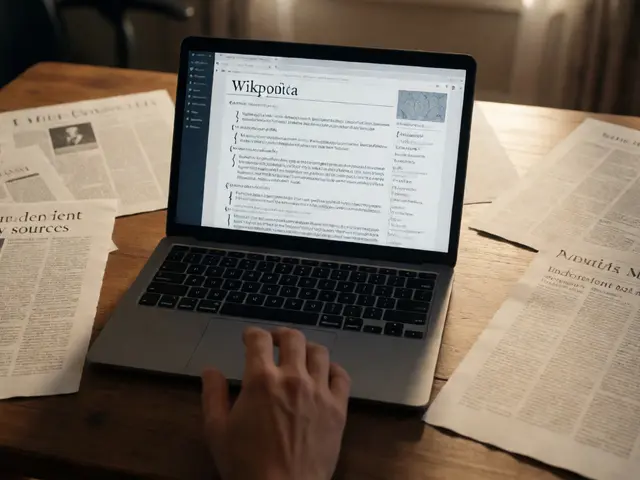
Wikipedia doesn’t just rely on volunteers to write and edit articles anymore. Since 2022, AI tools have quietly become part of its daily operations-helping fix grammar, detect vandalism, suggest edits, and even flag biased language. But who’s watching these tools? And what happens when an AI makes a mistake that changes the meaning of a historical event or erases a marginalized voice?
AI Is Already Editing Wikipedia-Without Most People Knowing
Over 200,000 automated edits happen on Wikipedia every day. Around 15% of those are powered by AI tools like WikiGrok is an AI system developed by the Wikimedia Foundation to suggest edits based on reliable sources, with a focus on filling content gaps in underrepresented topics. , EditBot is a machine learning tool trained to detect and revert vandalism in real time, with a 94% accuracy rate as of 2024. , and WikiTrust is a system that rates the reliability of edits based on the history and reputation of the editor, now enhanced with AI to detect subtle manipulation. . These tools don’t replace humans-they assist them. But they operate in the background, often without user consent or even awareness.
Take the case of the 2023 Ukraine war timeline article. In March 2024, an AI tool auto-added a disputed claim about troop movements based on a blog post mislabeled as a military source. Within minutes, three human editors reverted it. But the edit had already been cached by search engines. That’s when Wikimedia’s AI Oversight Committee stepped in-not to punish the tool, but to audit its source validation rules.
Who Decides What AI Can Do on Wikipedia?
There’s no single boss of Wikipedia’s AI. Instead, oversight is split across three layers: community norms, foundation policy, and technical controls.
- Community norms are unwritten rules built over 20 years. Editors vote on whether an AI tool should be allowed to auto-edit certain types of articles-like biographies of living people or political topics. In 2023, the community blocked AI from editing any article tagged with "biography of living person" after multiple false claims were auto-added.
- Foundation policy comes from the Wikimedia Foundation, the nonprofit that runs Wikipedia. Their AI Use Policy, updated in June 2024, requires all AI tools to be open-source, publicly documented, and subject to community review before deployment. No tool can run on Wikipedia without a public test phase lasting at least 30 days.
- Technical controls are the actual firewalls and limits built into the software. For example, AI tools can’t edit articles with fewer than five human edits in the past 90 days. They’re also banned from changing dates, names, or numbers in historical articles without a human confirmation step.
This three-layer model isn’t perfect. In late 2024, an AI tool called WikiSuggest was approved after a 30-day trial, but its training data included a biased subset of English-language sources. It started auto-replacing non-Western names with anglicized versions in hundreds of articles. The fix took six weeks because no one had flagged it during testing. The lesson? Policy can’t catch everything without active human monitoring.
How Do Volunteers Stay in Control?
Wikipedia’s power has always come from its editors. And that hasn’t changed with AI. But now, editors need new skills.
Groups like WikiProject AI Oversight-a volunteer team of 87 active members-track every AI-generated edit. They use a custom dashboard that highlights edits flagged by AI, compares them to human edits, and logs patterns. One member, a retired librarian from Toronto, noticed that AI tools were over-correcting non-native English phrasing in articles about African history. She started a monthly report that led to a change in the tool’s language model.
Every editor can report suspicious AI behavior through a simple form on Wikipedia. Reports go into a public queue. If three editors flag the same AI tool for the same issue, it’s automatically paused for review. In 2024, 14 AI tools were temporarily disabled after reports. Eight were fixed and reapproved. Six were permanently banned.
This isn’t bureaucracy-it’s accountability. And it works because volunteers aren’t just users. They’re watchdogs.

The Biggest Risks Nobody Talks About
Most people worry about AI spreading misinformation. But on Wikipedia, the real danger is invisible bias.
AI tools are trained on data-mostly from English-language sources, mostly from North America and Europe. That means they’re better at recognizing reliable sources about U.S. politics than about Indigenous land rights in Australia or labor movements in Bangladesh.
One study from the University of Oxford in 2025 analyzed 12,000 AI-generated edits to articles about global health. It found that AI was 68% more likely to cite U.S. or European journals than those from low-income countries-even when the local sources were peer-reviewed and publicly available.
Another risk: AI tools start to shape what’s considered “neutral.” For example, an AI might flag the phrase “colonial occupation” as biased and replace it with “historical administration” because the latter appears more often in Western textbooks. That’s not neutrality. That’s erasure.
Wikipedia’s solution? The Global Source Initiative, launched in 2024, now requires AI training data to include at least 30% non-Western sources. It’s not perfect-but it’s a start.
What Happens When AI Gets It Right?
It’s not all problems. AI has helped fix real gaps.
Before 2023, articles on women scientists from the Global South were 70% shorter than those on male scientists from the same regions. An AI tool called HerStoryBot was trained to find overlooked references in university archives and local publications. In 18 months, it added over 4,000 new biographies. Editors reviewed every one-but without the bot, most would’ve stayed buried.
Another tool, FactGuard, automatically checks citations against a database of retracted papers. In 2024, it caught 1,200 citations to fake or retracted studies in medical articles. Human editors had missed most of them because they looked legit.
These aren’t magic fixes. They’re force multipliers. AI doesn’t replace judgment-it gives editors more time to use it.

What’s Next? The Fight for Transparency
Wikipedia’s AI governance model is unique. Unlike social media or search engines, it’s not profit-driven. That means its rules can be more ethical-but also slower.
Right now, the biggest debate is about transparency. Should users be told when an edit was made by AI? Should every AI tool’s training data be publicly listed? Should there be a public log of every AI decision, like a “black box” audit trail?
In November 2025, the Wikimedia Foundation proposed a new rule: all AI edits must carry a visible tag-like “AI-assisted edit”-in the article history. Community feedback is open until January 2026. Early results show 62% of editors support it. Critics say it could discourage AI use and make editing feel robotic.
But the real question isn’t whether AI should be used. It’s whether we can trust it without seeing how it works.
Can This Model Work Elsewhere?
Wikipedia’s approach to AI oversight is messy, slow, and deeply human. But it’s also the only one that puts community control above efficiency.
Other platforms-like Google’s AI-powered search summaries or Facebook’s content moderation bots-operate in secret. Their rules are owned by corporations. Wikipedia’s rules are owned by its users.
If you want to know how to govern AI responsibly, look at Wikipedia. Not because it’s perfect. But because it’s trying-and letting everyone watch.
Can anyone use AI to edit Wikipedia?
Yes, but only if the AI tool follows Wikimedia’s AI Use Policy. All tools must be open-source, publicly documented, and tested for 30 days before deployment. Individual users can’t just plug in any AI bot-they need approval from the community and the Wikimedia Foundation.
How does Wikipedia prevent AI from spreading bias?
Wikipedia requires AI training data to include at least 30% non-Western sources. Editors also monitor for patterns like overuse of English-language journals or rewriting non-Western terms to sound more familiar. If an AI tool starts making biased edits, volunteers can flag it-and if three editors report the same issue, the tool is paused for review.
Are AI edits labeled on Wikipedia pages?
Not yet, but a proposal to add visible "AI-assisted edit" tags to the article history is under community review until January 2026. Right now, AI edits are visible in the edit history, but only to users who check it manually.
What happens if an AI makes a harmful edit?
Human editors revert harmful edits quickly. If the same AI tool causes repeated issues, volunteers can report it. Three reports trigger an automatic pause. The tool’s developers must fix the problem before it can be reactivated. If the issue is severe or systemic, the tool is permanently banned.
Is Wikipedia’s AI oversight model used by other platforms?
No other major platform uses a model like Wikipedia’s. Most rely on internal teams or proprietary algorithms with little public oversight. Wikipedia’s system is unique because it’s community-driven, transparent, and open to public input at every stage.