Wikipedia Commons holds over 100 million free media files - photos, videos, audio clips, and diagrams. But here’s the problem: most of them have terrible or missing metadata. No one knows who took the photo, when, where, or what’s in it. That’s where bots come in.
Why metadata matters on Commons
Without proper metadata, a photo of the Eiffel Tower taken in 1987 by a French photographer might as well be anonymous. Search engines can’t index it. Educators can’t find it. Researchers can’t verify it. Wikimedia Commons isn’t just a photo dump - it’s a public archive used by schools, museums, and newsrooms worldwide. But if you can’t search for "1970s street photography in Tokyo" or "NASA Mars rover 2012", then the files are practically useless.
Manual tagging doesn’t scale. There are more than 100,000 new files uploaded to Commons every month. Even if every volunteer spent all day tagging, they’d fall behind. That’s why automated systems - bots - are the only way to keep up.
What bots actually do
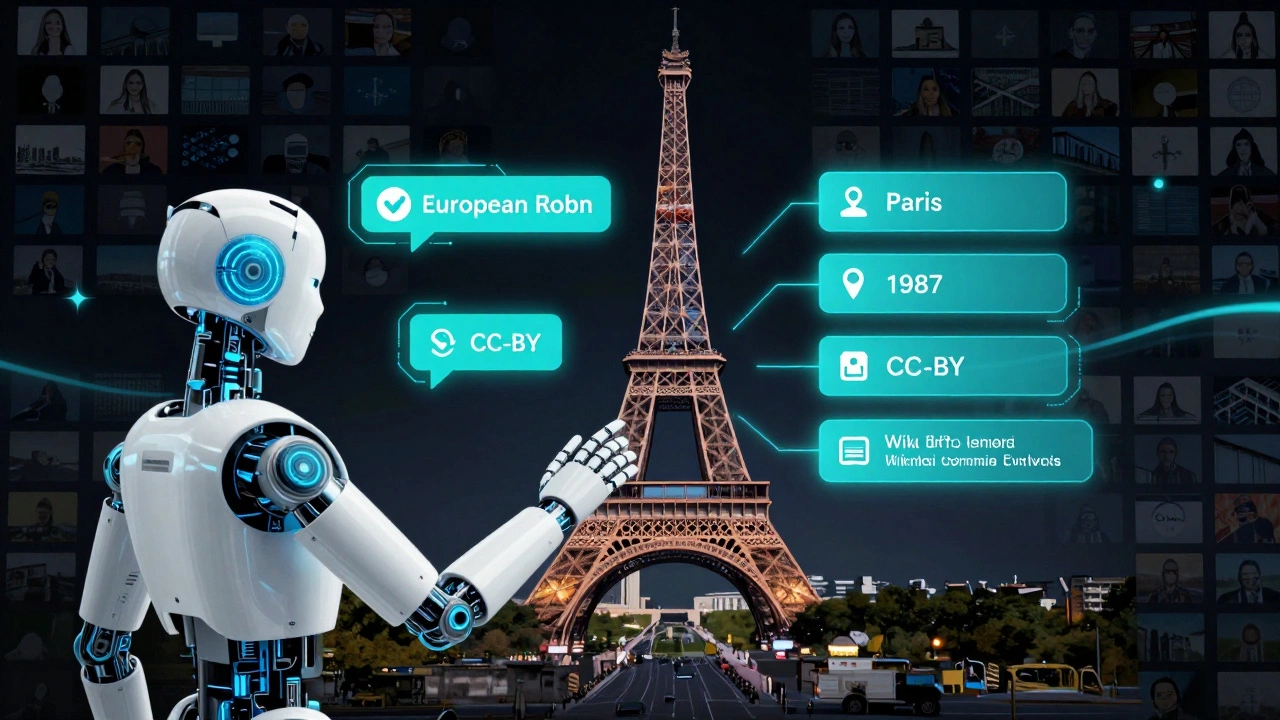
These aren’t sci-fi robots. They’re scripts running on Wikimedia’s servers, quietly processing files in the background. Their job? Extract and add structured data to media files using machine learning and rule-based logic.
For example, a bot might look at a photo of a bird and:
- Use image recognition to identify the species (e.g., "European Robin")
- Check the EXIF data to pull the date and camera model
- Match the location from GPS coordinates to a known place in Wikidata
- Add copyright info based on the uploader’s license choice
- Link the image to related articles on Wikipedia (like "Birdwatching in Germany")
One bot, CommonsHelper, has added over 8 million structured data statements since 2020. Another, File:MetadataBot, automatically fills in missing creator names by cross-referencing upload history with user profiles. These aren’t guesses - they’re data-driven decisions based on verified sources like Wikidata, GeoNames, and public domain databases.
How structured data works on Commons
Structured data on Commons uses the same system as Wikidata: a simple Subject-Predicate-Object format. For a photo, it looks like this:
- Subject: File:Berlin_Brandenburg_Airport_2023.jpg
- Predicate: depicts
- Object: Q11675 (Berlin Brandenburg Airport)
Another example:
- Subject: File:Sunset_over_Sierra_Nevada.jpg
- Predicate: location
- Object: Q2731 (Sierra Nevada mountain range)
This isn’t just for humans. Search engines like Google use this data to show rich results - like displaying a photo directly in search results with proper attribution. Museums use it to pull images for digital exhibits. Students use it to cite sources correctly.

Who builds and maintains these bots?
Most bot developers are volunteers - not paid staff. Many are students, librarians, or retired tech workers who care about open knowledge. They write code in Python or JavaScript, test it on sandbox pages, and submit it for review by the Wikimedia Commons community.
There’s a strict approval process. Bots can’t just start tagging files. They must:
- Have a clear, documented purpose
- Run in test mode for at least 30 days
- Prove they don’t create errors or duplicates
- Get approval from at least five experienced Commons editors
Once approved, they’re given a bot flag - meaning they can edit without triggering edit notifications. This keeps the system quiet and efficient.
Common problems bots fix
Here’s what bots handle that humans rarely do:
- Missing dates: 62% of uploaded images have no date in their metadata (Wikimedia Foundation, 2024)
- Wrong locations: GPS data is often missing or mislabeled - bots use reverse geocoding to fix this
- Unclear copyright: Bots flag files that don’t match known licenses (CC0, CC-BY, public domain)
- Redundant uploads: Bots detect near-duplicates and suggest merging or deleting
- Language gaps: Bots auto-translate captions using machine translation APIs, then flag them for human review
One bot, GeoTagBot, improved location accuracy by 78% in rural areas of Africa and Southeast Asia - places where human volunteers are scarce but uploads are growing fast.
What bots can’t do
They’re powerful, but they’re not perfect. Bots struggle with:
- Artistic interpretation - they can’t tell if a photo is a protest, a celebration, or a quiet moment
- Historical context - they don’t know why a 1940s photo of a factory matters unless someone tells them
- Cultural nuance - a bot might tag a traditional garment as "costume" when it’s actually everyday wear
- Complex relationships - like identifying multiple people in a crowd photo and linking them to their Wikidata pages
That’s why human review is still essential. Bots make suggestions. Humans make decisions. The best systems combine automation with community oversight.
The future of bot-powered metadata
By 2025, over 40% of all media files on Commons have structured data - up from just 8% in 2020. That’s thanks to better AI models and more bot developers.
New tools are emerging:
- AI that detects endangered species in wildlife photos and links them to conservation databases
- Bot clusters that work together - one bot identifies objects, another adds locations, a third checks copyright
- Mobile apps that let users tag photos with voice notes before uploading
There’s also a push to make metadata more accessible. Projects like CommonsLens let you search Commons by spoken queries - "show me photos of red pandas in Nepal" - and get results powered entirely by structured data.
How you can help
You don’t need to code to contribute. Here’s how:
- Upload photos with clear, accurate descriptions and dates
- Use the correct license - CC0 or CC-BY are best
- Check if your file already has structured data and fix errors
- Join the Structured Data on Commons discussion page to suggest bot improvements
- Report bad bot behavior - if a bot mislabels something, flag it
Even small fixes help. A single corrected date or location can make a photo usable for a student’s research paper or a museum exhibit.
Why this matters beyond Wikipedia
Wikipedia Commons is the largest open media library in the world. It’s the backbone for educational websites, open-source projects, and even AI training datasets. If the metadata is broken, the whole system suffers.
Bots keep it alive. They turn chaos into order. They make sure that a photo taken by a child in rural Kenya can be found and used by a teacher in Canada - decades later. That’s not just tech. That’s equity in knowledge.
Do bots delete files on Wikipedia Commons?
No, bots don’t delete files. They only add or update metadata. Deletion is handled by human volunteers through a formal review process. Bots can flag files that violate copyright or are duplicates, but they can’t remove them.
Can I run my own bot on Commons?
Yes, but you need approval. You must document your bot’s purpose, test it for 30 days on a sandbox, and get feedback from at least five experienced editors. Once approved, you’ll be granted a bot flag. The process is open and transparent - all requests are posted on the Commons:Bot_requests page.
Are bots faster than humans at tagging?
Far faster. One bot can process 10,000 files in a single day. A human might tag 50 correctly in the same time. But bots aren’t perfect - they make mistakes, especially with context. That’s why humans review their output. The best results come from combining speed with judgment.
What happens if a bot adds wrong information?
Anyone can fix it. Each structured data entry has an edit history. If a bot mislabels a photo as "Eiffel Tower" when it’s actually the London Eye, you can click "Edit" and correct it. The bot’s next run will usually pick up the fix and stop repeating the error. Community oversight keeps bots accurate.
Do bots work on all types of media?
Mostly photos and videos. Audio files are harder because they lack visual data, but some bots can analyze spectrograms to guess instruments or genres. 3D models and PDFs are still mostly manual. The focus is on the most commonly used formats - images and video - because they make up over 95% of uploads.