Wikipedia doesn’t just accept any source. If you’ve ever tried to add a claim about a medical treatment, a psychological study, or a climate change trend to a Wikipedia article, you’ve probably been asked: Where’s your source? Not just any source. The best sources are systematic reviews and meta-analyses. These aren’t just fancy academic terms-they’re the gold standard for what counts as reliable evidence on Wikipedia.
Why systematic reviews matter on Wikipedia
Wikipedia’s policy on reliable sources is strict because it’s used by millions of people who don’t know how to fact-check. A blog post, a news article, or even a textbook might be cited-but they’re not enough when the topic is complex or controversial. That’s where systematic reviews come in.
A systematic review is a study that doesn’t just pick one or two papers. It finds every relevant study on a topic, checks their quality, and combines the results. Think of it like a detective gathering all the clues before making a conclusion. For example, if someone wants to say that “vaccines cause autism,” a systematic review of hundreds of studies will show there’s no credible link. That’s the kind of evidence Wikipedia needs to shut down misinformation.
Meta-analyses take this one step further. They use statistical methods to combine data from multiple studies into one big number. If five studies say a drug reduces blood pressure by 5%, 7%, 3%, 6%, and 8%, a meta-analysis calculates the average effect-and how sure we are about it. That’s powerful. Wikipedia editors love this because it gives a clear, measurable answer instead of vague opinions.
How to find systematic reviews and meta-analyses
You don’t need a university login to find these. Here’s how real Wikipedia editors do it:
- Go to PubMed (free, run by the U.S. National Library of Medicine).
- Type your topic + “systematic review” or “meta-analysis.” For example: “ketogenic diet meta-analysis” or “cognitive behavioral therapy systematic review depression”.
- Filter by “Publication Date” to get the last 5 years. Newer reviews are better-they include the latest data.
- Look for reviews published in journals like The Cochrane Library, The Lancet, JAMA, or PLOS Medicine. These are high-quality, peer-reviewed sources.
- Click on the article. If it has a “PRISMA flow diagram,” that’s a good sign. It means the authors followed strict rules to find and select studies.
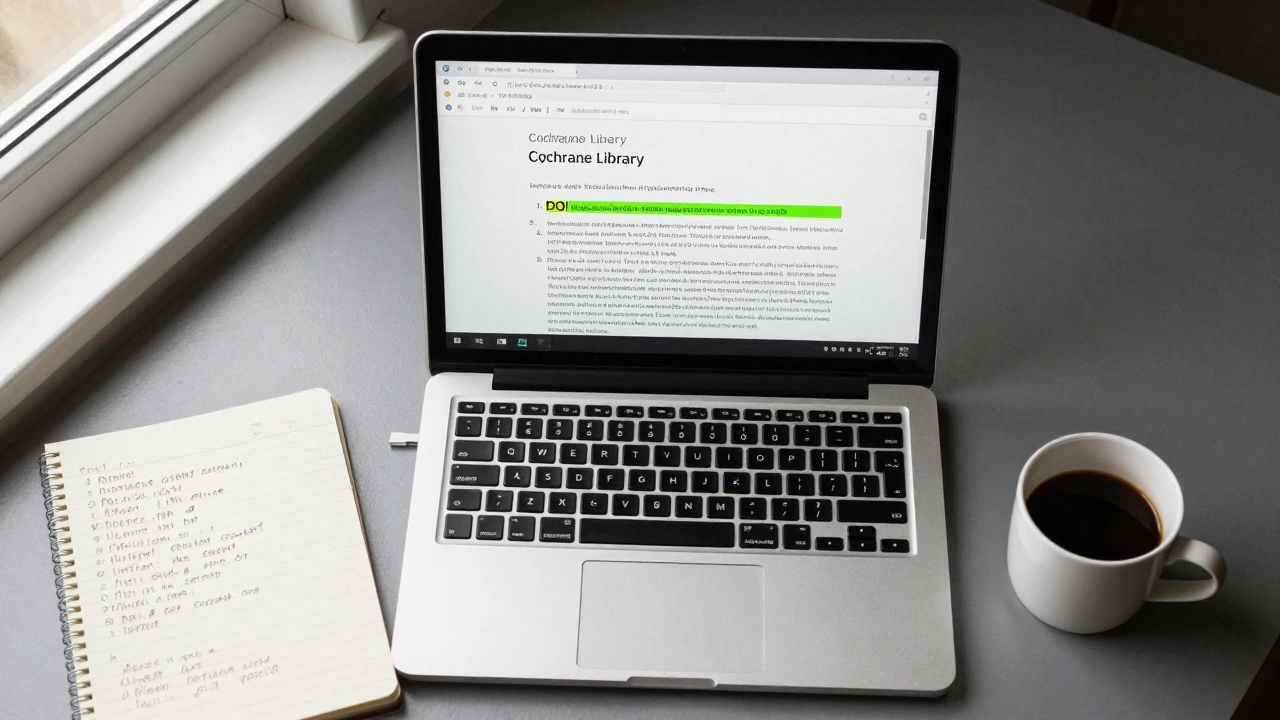
Many of these reviews are open access. If you hit a paywall, try searching the title on Google Scholar. Sometimes the authors upload free versions. Or use Unpaywall, a browser extension that finds legal free copies.
How to cite them on Wikipedia
Just finding the review isn’t enough. You have to cite it correctly.
Wikipedia uses a simple citation style. For a Cochrane review, you’d write:
{{Cite journal | last1 = Smith | first1 = J. | last2 = Lee | first2 = A. | title = Systematic review of omega-3 supplements for anxiety | journal = Cochrane Database Syst Rev | year = 2024 | volume = 3 | issue = 3 | pages = CD012345 | doi = 10.1002/14651858.CD012345.pub3 }}For other journals, use the same format. The key is to include:
- Author names
- Title of the review
- Journal name
- Year
- DOI or PMID (PubMed ID)
Don’t just link to the journal page. Link directly to the article using the DOI. Wikipedia prefers stable, permanent links. If the DOI doesn’t work, use the PubMed ID instead.
Also, don’t just drop the citation at the end of a sentence. Explain why it matters. For example:
“A 2023 Cochrane systematic review of 47 randomized trials found that mindfulness-based therapy significantly reduced symptoms of generalized anxiety disorder, with moderate effect sizes (SMD = −0.61).”
That tells readers why the source is trustworthy-not just that it exists.
What Wikipedia editors look for in these sources
Not every systematic review is created equal. Wikipedia editors check for these red flags:
- Conflict of interest: Was the review funded by a drug company? If so, it might downplay side effects.
- Outdated methods: Reviews older than 5 years might miss newer studies.
- Small sample size: If only 3 studies were included, the results aren’t reliable.
- No quality assessment: Did the authors check if the original studies were well-designed? If not, the review is weak.
- Non-peer-reviewed: Preprints (like on bioRxiv) aren’t accepted unless they’re later published.
For example, a 2022 meta-analysis on intermittent fasting and weight loss was rejected on Wikipedia because it only included 4 studies, all from the same research group. That’s not broad enough. Editors want diversity in sources.
When not to use them
Systematic reviews aren’t magic. They don’t work for everything.
Don’t use them for:
- Historical events: There’s no meta-analysis on whether the Titanic sank because of icebergs. Use primary sources like ship logs or survivor accounts.
- Current political debates: If the topic is too new (like a law passed last month), there won’t be any reviews yet.
- Opinions or personal experiences: A review can’t tell you how someone felt about their therapy. That’s anecdotal.
- Non-scientific topics: You won’t find a meta-analysis on the best pizza topping. Use reputable food publications instead.
Wikipedia’s goal is to reflect what experts agree on-not what’s trendy, controversial, or unproven.
Real examples of systematic reviews on Wikipedia
Here are three actual Wikipedia articles where systematic reviews made the difference:
- Flu vaccine effectiveness: The article cites a 2023 Cochrane review that analyzed 88 studies. It shows the vaccine reduces flu cases by 40-60% in healthy adults.
- Antidepressants: The article uses a 2022 meta-analysis from JAMA Psychiatry that compared 522 trials. It found that most antidepressants work better than placebos, but the effect size varies by drug.
- Climate change and extreme weather: The article references a 2021 IPCC report, which is essentially a systematic review of thousands of climate studies. That’s why Wikipedia says human activity is “extremely likely” the main driver of global warming.
These aren’t just citations. They’re the backbone of the article’s credibility.
What happens when you use weak sources
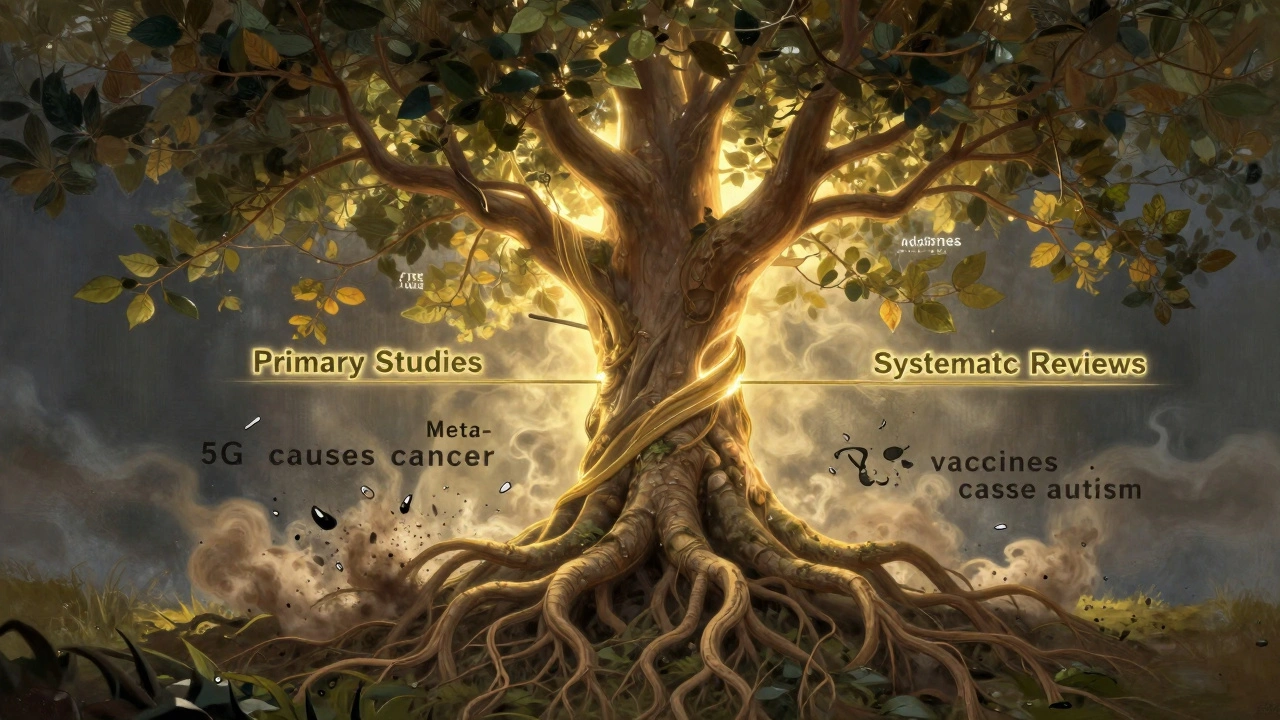
Wikipedia editors don’t just delete bad sources-they flag them. If you cite a blog post saying “5G causes cancer,” it’ll be removed within hours. If you cite a 2018 meta-analysis from The Lancet showing no link, it’ll be kept and even expanded.
There’s a reason for this. In 2020, a Wikipedia article on hydroxychloroquine as a COVID-19 treatment was flooded with bad sources from social media. The article was semi-protected for months. Only after systematic reviews from the WHO and NIH were added did the content stabilize.
Using strong sources isn’t just about being right. It’s about preventing harm.
How to get started editing with these sources
If you want to improve Wikipedia:
- Find a medical, psychological, or environmental article that feels incomplete or biased.
- Search PubMed for a recent systematic review on that topic.
- Read the abstract and conclusion. Does it support or contradict what’s already there?
- If it adds new, reliable info, edit the article. Use the citation format above.
- Leave a note on the article’s talk page explaining why you added it.
Many Wikipedia editors are volunteers with no formal training. You don’t need a PhD to help. You just need to know how to find the best evidence.
Why this matters beyond Wikipedia
Wikipedia is the fifth most visited website in the world. People use it to make health decisions, write school papers, and understand public policy. If the information is wrong, real people get hurt.
Systematic reviews and meta-analyses are the tools that keep Wikipedia accurate. They turn noise into clarity. Opinion into evidence. Guesswork into knowledge.
When you use them, you’re not just editing a webpage. You’re helping millions of people make better decisions.
Can I use a systematic review from a non-academic website?
No. Wikipedia requires sources to be published in peer-reviewed journals or by reputable organizations like the Cochrane Collaboration, WHO, or NIH. Reviews from blogs, news sites, or Wikipedia itself aren’t acceptable as primary evidence.
What if the systematic review contradicts what’s already on Wikipedia?
Update the article. Wikipedia’s policy is to reflect the most current, reliable evidence. If a new high-quality review changes the consensus, the article must change too. Always cite the review clearly and explain the change on the article’s talk page.
Are meta-analyses always more reliable than single studies?
Usually, yes. Meta-analyses combine data from multiple studies, reducing the chance that one flawed study skews the results. But if the original studies are low-quality, the meta-analysis will be too. Always check the quality of the included studies in the review.
Can I use systematic reviews for non-medical topics?
Yes. Systematic reviews exist in education, criminology, environmental science, and economics. For example, a 2023 review in the Review of Educational Research analyzed 120 studies on homework effectiveness. That’s a valid source for Wikipedia articles on education policy.
Do I need to read the whole systematic review to cite it?
You should read the abstract, methods, and conclusion. You don’t need to digest every statistical detail, but you must understand what the review actually found. Never cite a source you haven’t read. Wikipedia editors can and will check.