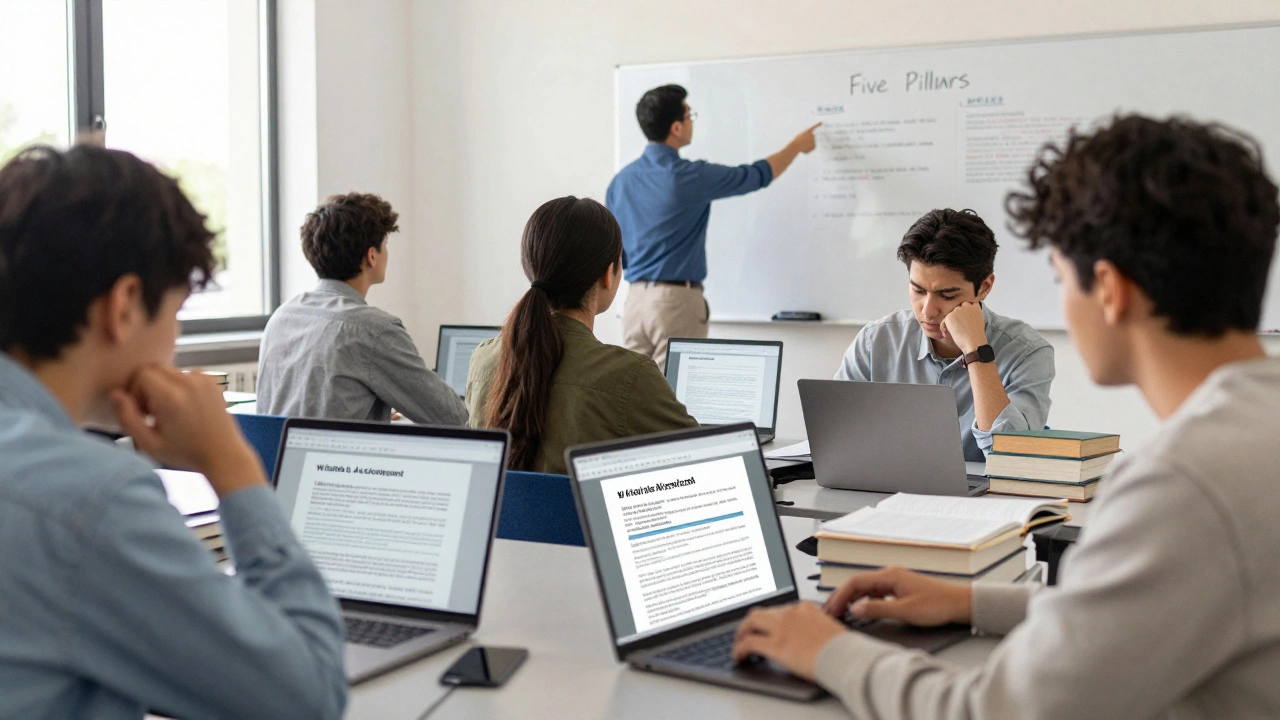
When students start editing Wikipedia, they’re not just adding text-they’re joining a global conversation that millions rely on every day. But most students walk into this without any real training. They think it’s like writing a school paper. It’s not. Wikipedia has rules, culture, and expectations that can trip up even the smartest undergrads. Without proper training, good-faith edits get reverted. Valuable knowledge gets lost. And students walk away frustrated, thinking Wikipedia is hostile. It doesn’t have to be that way.
Start with the Five Pillars
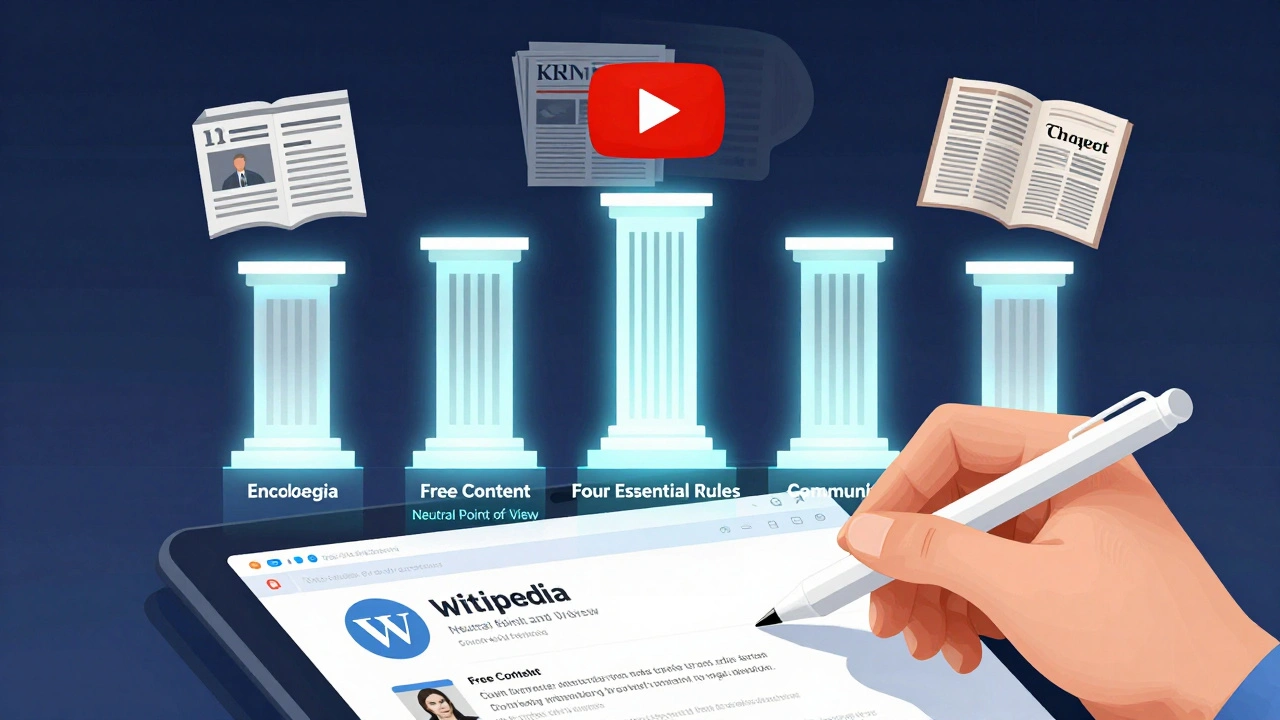
Before teaching students how to format citations or use templates, they need to understand the foundation. Wikipedia runs on five core principles, called the Five Pillars. These aren’t suggestions-they’re the operating system of the site.
- Wikipedia is an encyclopedia: It’s not a blog, a forum, or a personal website. Entries must be factual, notable, and written for a general audience.
- Wikipedia has a neutral point of view: No pushing agendas. Even if a student believes something strongly, they must present all sides fairly.
- Wikipedia is free content: Everything is licensed under CC-BY-SA. That means anyone can reuse it, even commercially. Students need to know they’re giving up copyright on their edits.
- Wikipedia has four essential rules: No original research, no copyright violations, no personal attacks, and no vandalism.
- Wikipedia is a community: It’s run by volunteers. Disagreements happen. Learning how to talk to other editors-not argue with them-is part of the skill.
These aren’t just rules to memorize. They’re lenses. Every edit should pass through them. A good training module tests students with real scenarios: “You found a blog post that says climate change is fake. Can you cite it?” The answer is no. Why? Because blogs aren’t reliable sources. That’s not opinion-it’s policy.
Teach Reliable Sources, Not Just Citations
Most students think citing a source means just throwing a URL into a footnote. That’s not enough. Wikipedia requires reliable sources, and not all sources are equal.
Academics often assume peer-reviewed journals are the gold standard. That’s true-but Wikipedia also accepts books from university presses, major newspapers like The New York Times or The Guardian, and government reports. What’s rejected? Personal blogs, YouTube videos, corporate press releases, and self-published material.
Here’s a simple rule students should memorize: If you wouldn’t quote it in a college paper, don’t use it on Wikipedia. A 2023 study from the University of Michigan found that 68% of student edits to science articles were reverted because they used unreliable sources like Reddit or Medium posts.
Training should include hands-on source evaluation. Give students five links-one from a peer-reviewed journal, one from a university website, one from a blog, one from a Wikipedia talk page, and one from a news outlet. Ask them to rank them. Then show them the official Wikipedia guideline: “Reliable sources are those with editorial oversight.” That’s the filter.
Teach the Difference Between Notability and Truth
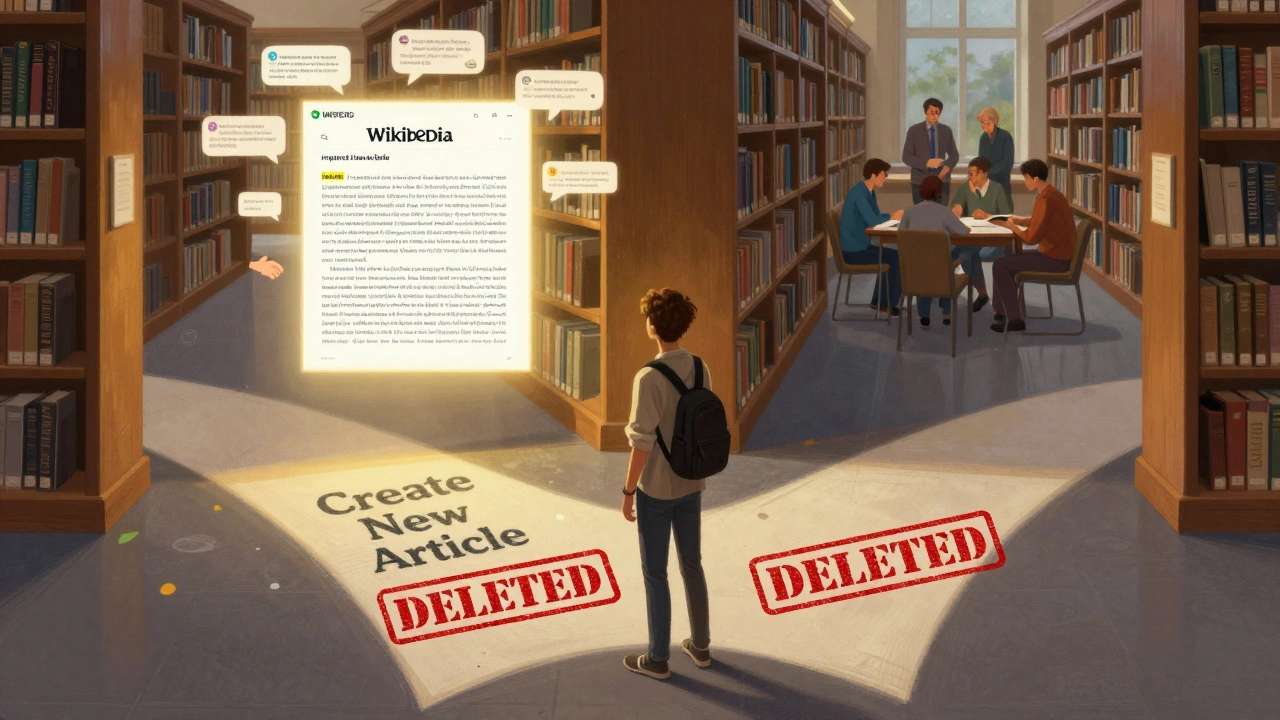
Many students edit because they care about a topic-say, a local environmental activist, a small indie game studio, or their school’s robotics team. They write detailed, well-sourced entries. Then they get deleted. Why? Notability.
Wikipedia doesn’t archive everything that’s true. It archives what’s notable. That means the subject must have received significant coverage in independent, reliable sources. A student’s cousin who won a regional science fair? Not notable. The science fair itself? If it’s been covered by three local newspapers over five years? Maybe.
Training should include real deletion cases. Show students the Wikipedia page for “Dr. Elena Ramirez, founder of the Green Roots Initiative.” Then show them the deletion discussion. Why was it deleted? Because only one news article existed, and it was a press release from her nonprofit. The lesson: Notability isn’t about importance-it’s about public documentation.
Walk Through the Edit Process Step by Step
Students don’t need to learn all of Wikipedia’s tools at once. Start with the basics:
- Create a Wikipedia account (never edit as an IP address).
- Use the sandbox to practice formatting.
- Search for the article they want to improve-don’t create new ones until they’ve edited 5-10 existing pages.
- Click “Edit,” make a small change (fix a typo, add a citation), then click “Show preview.”
- Write a clear edit summary: “Added citation for 2022 study on urban heat islands.”
- Click “Publish changes.”
Then, teach them how to handle feedback. If their edit gets reverted, they’ll see a message like “No reliable source.” They need to know: Don’t argue. Don’t revert back. Go to the talk page. Say: “I appreciate your feedback. Could you help me find a better source?” Most experienced editors will respond.
Use screen recordings to show this process. A 90-second video of a real edit-flawed, then fixed-sticks better than a 10-page PDF.
Include Real-World Examples from Academic Fields
Students in biology, history, and engineering all edit Wikipedia differently. A biology student might add a new species’ habitat data. A history student might correct a date in a Cold War timeline. An engineering student might update the specs of a new microchip.
Training modules should include field-specific examples:
- Biology: Adding a new peer-reviewed study on coral bleaching. Avoiding “common name” confusion (e.g., “killer whale” vs. “orca”).
- History: Correcting biased language (“Native Americans” vs. “Indigenous peoples”) with scholarly consensus.
- Computer Science: Updating the version history of open-source software like Linux or Python. Avoiding promotional language like “revolutionary.”
Each example should come with before-and-after edits. Show the messy version, then the clean, policy-compliant version. Students learn by seeing the gap.
Teach How to Handle Conflict-Without Getting Burned Out
Wikipedia can feel like a battlefield. Students might get called “vandal,” have their edits deleted, or be told to “read the guidelines.” That’s discouraging. But conflict isn’t personal-it’s procedural.
Training should include:
- How to read a talk page without taking it personally.
- How to use “Request for Comment” (RfC) when stuck.
- When to walk away: If an edit gets reverted three times in a week, pause. Ask a professor or librarian for help.
One university in Oregon tracks student editors over a semester. Those who completed a 45-minute conflict module had a 72% higher retention rate than those who didn’t. They didn’t become perfect editors-they became persistent ones.
Make It a Credit-Bearing Course
The most successful programs don’t treat Wikipedia editing as an optional activity. They make it part of the syllabus.
At the University of Wisconsin-Madison, students in the “Digital Public Scholarship” course earn 3 credits by completing 10 Wikipedia edits. They write a reflection paper on what they learned. The course has run since 2021. Over 200 students have edited 1,400+ articles. Half of those edits still stand today.
When students know their work counts toward a grade, they take it seriously. And when professors co-sign the edits, Wikipedia editors take them seriously too.
What to Avoid
Don’t:
- Let students create new articles as their first assignment.
- Use vague instructions like “Just edit something.”
- Ignore the difference between citation and sourcing.
- Assume students know how to use the mobile app or talk pages.
- Skimp on feedback. One quick comment from a TA makes all the difference.
Do:
- Partner with Wikipedia Ambassadors or local Wikimedia chapters.
- Use the Wikipedia Education Program dashboard-it tracks edits and gives feedback.
- Invite a Wikipedia editor to guest lecture.
- Share success stories: “A student added data on Wisconsin’s wetlands. Now it’s cited in three state reports.”
Final Thought: It’s Not About Perfect Edits
The goal isn’t to make every student a top-tier Wikipedia editor. The goal is to teach them how knowledge is built, challenged, and maintained in the real world. Wikipedia is messy. It’s slow. It’s full of people arguing over commas. And that’s exactly why it’s valuable.
When students learn to edit Wikipedia, they’re not learning how to write an encyclopedia entry. They’re learning how to think critically, verify claims, collaborate across differences, and contribute to public knowledge. That’s not just academic training. It’s civic training.
Can students create new Wikipedia articles as part of their training?
New article creation should be avoided until students have completed at least 5-10 edits to existing pages. Creating new articles requires deep understanding of notability and sourcing. Most student-created articles get deleted because they don’t meet Wikipedia’s criteria. Start with improving existing content.
Do students need to cite every single fact they add?
Yes. Wikipedia requires every factual claim to be backed by a reliable source. Even seemingly obvious facts-like “The Earth orbits the Sun”-must be cited if they’re part of a larger claim. Students should be trained to find and cite sources for every sentence they add or change.
What’s the biggest mistake students make when editing Wikipedia?
The biggest mistake is using unreliable sources. Students often cite blogs, social media, or personal websites because they’re easy to find. But Wikipedia rejects these. Training should focus on teaching students how to identify reliable sources, not just how to insert citations.
How can professors support student editors?
Professors can support students by co-signing edits, reviewing sources before submission, and requiring reflection papers. They can also invite Wikipedia editors to speak in class or use the Wikipedia Education Program’s dashboard to track student progress. When professors treat Wikipedia editing as academic work, students take it seriously.
Is Wikipedia editing suitable for all academic disciplines?
Yes. Students in biology, history, engineering, sociology, and even literature can contribute meaningfully. Each discipline has its own challenges-like handling technical jargon or correcting biased language-but all benefit from learning how to communicate knowledge clearly and neutrally. The key is tailoring training to the field.
Students who edit Wikipedia don’t just improve articles-they improve their own thinking. And that’s the real win.