Wikipedia doesn’t pretend to be perfect. It knows it’s edited by real people-with real opinions, backgrounds, and biases. That’s why its biggest strength isn’t avoiding bias-it’s how it handles claims of political bias from every side. Whether you’re left, right, or somewhere in between, if you think an article is skewed, Wikipedia has a system built to listen, review, and correct it. Not because it’s perfect, but because it’s designed to be constantly fixed.
Wikipedia’s Core Rule: Neutral Point of View
Every editor on Wikipedia is required to follow one rule above all others: Neutral Point of View (NPOV). It’s not about being boring. It’s about fairness. An article on climate change, abortion, or U.S. elections must present all significant viewpoints in proportion to their actual support in reliable sources. That means if 70% of peer-reviewed studies support human-caused climate change, the article reflects that. If 30% of published scholars disagree, they’re included too-but not as a false equivalence. The weight comes from evidence, not equal airtime.
There’s no “Wikipedia truth.” There’s only “what reliable sources say.” That’s the backbone. Editors don’t add their own beliefs. They cite academic journals, books from university presses, major newspapers, and government reports. If a source is fringe-say, a blog with no peer review or a partisan outlet with a history of distortion-it gets flagged. Not because it’s offensive, but because it doesn’t meet the standard for reliability.
How Claims of Bias Are Reported
When someone thinks an article is biased, they don’t just yell into the void. They use the tools built into Wikipedia. Every article has a “Talk” tab. That’s where editors debate changes. If you think the section on immigration policy favors one side, you don’t edit it blindly. You start a discussion. You quote the sources you believe were ignored. You link to credible alternatives. You don’t just say “this is biased.” You prove it.
Wikipedia also has formal processes. The Dispute Resolution Noticeboard lets editors escalate unresolved conflicts. The Arbitration Committee steps in for serious, long-running disputes-like when editors from opposing ideologies repeatedly revert each other’s edits. These aren’t secret panels. Their decisions are public. Their reasoning is documented. And they don’t pick sides. They check whether edits followed the rules, not whether the content matched their personal views.
Real Examples: Left and Right Complaints
Let’s look at two real cases. In 2023, a group of conservative editors flagged the Wikipedia page on the 2020 U.S. election. They argued it downplayed claims of voter fraud, even though major courts and state officials had dismissed them. The response? Editors didn’t delete the claims. They added context: “Multiple state courts and federal judges dismissed these claims due to lack of evidence.” They cited rulings from Republican-appointed judges. They linked to official election certification documents. The article didn’t become “pro-liberal.” It became more accurate.
On the other side, progressive editors raised concerns about the article on gender identity. They said it used outdated terminology and excluded peer-reviewed medical consensus. The fix? Editors updated language to match guidelines from the American Psychological Association and the World Health Organization. They added citations from studies published in The Lancet and JAMA. They didn’t remove dissenting views-they marked them as minority positions with limited scholarly support.
In both cases, Wikipedia didn’t erase controversy. It embedded it in context. Bias wasn’t ignored. It was measured against evidence.
The Role of Bots and Automation
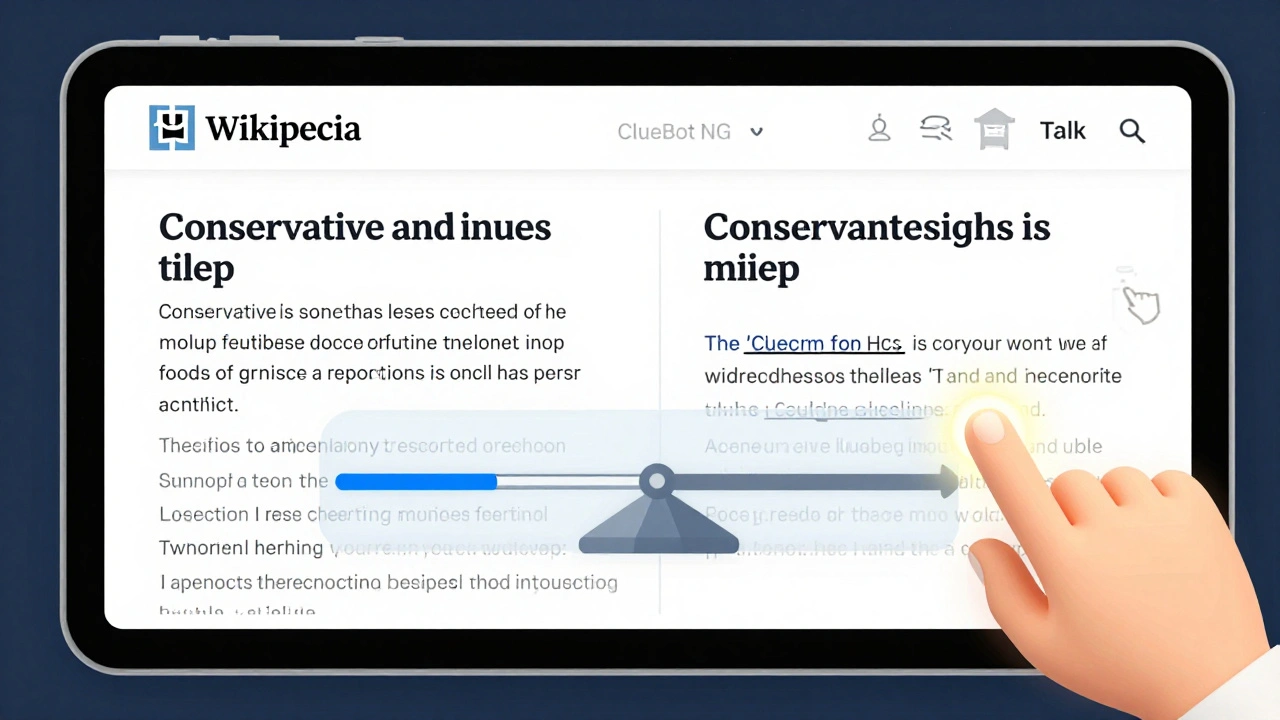
Humans make mistakes. That’s why Wikipedia uses bots-automated tools that catch patterns humans miss. One bot, called ClueBot NG, scans edits for vandalism, like deleting entire sections or inserting slurs. Another, Twinkle, helps editors flag potential bias by checking if edits add unsupported claims or remove citations without reason.
These bots don’t decide truth. They flag anomalies. If 10 edits in a row add the same unverified claim about a politician, the bot alerts human editors. It doesn’t delete anything. It just says, “Hey, this looks odd. Check it.” That’s how Wikipedia scales. Humans set the rules. Machines spot the noise.
Who Gets to Edit? And Why It Matters
Wikipedia isn’t run by a corporate board. It’s edited by volunteers. About 1% of users make 80% of edits. That sounds scary-until you know who they are. Studies from the University of Minnesota and the Oxford Internet Institute show that Wikipedia’s most active editors are diverse in politics, but they’re united by one thing: a commitment to sourcing. A conservative editor might fix a liberal bias. A liberal editor might fix a conservative one. The goal isn’t to win. It’s to get the article right.
Wikipedia doesn’t require editors to disclose their politics. And that’s intentional. If you had to say, “I’m a Democrat,” before editing a page on healthcare, you’d scare away half the contributors. Instead, it’s about the edit. Does it improve the article? Does it follow the rules? That’s all that matters.
What Happens When Bias Isn’t Fixed?
It’s not perfect. Sometimes, bias slips through. Articles on controversial topics can stay unbalanced for months-or even years. That’s when the community steps in. The Wikipedia:Requests for Comment process lets anyone ask for a broader review. Dozens of editors from around the world weigh in. They look at sources. They check tone. They vote on whether changes are needed.
There’s no censorship. There’s no deletion of viewpoints. There’s only one question: “Is this supported by reliable sources?” If the answer is no, the content gets revised. If it is, it stays-even if it’s uncomfortable.
Why This System Works
Wikipedia’s model flips the script. Instead of trying to eliminate bias (which is impossible), it builds a system that exposes it, challenges it, and corrects it-over and over. It’s messy. It’s slow. It’s loud. But it works.
Compare it to a corporate news site. If a CEO says “we don’t report on X,” that’s censorship. On Wikipedia, if a group says “this article ignores our side,” the system doesn’t shut them down. It invites them to fix it. And if they do it right-with sources, not anger-they win.
That’s why Wikipedia remains one of the most trusted sources of information globally, even as traditional media struggles with credibility. It doesn’t claim to be unbiased. It claims to be verifiable. And that’s a difference that matters.
What You Can Do
If you think an article on Wikipedia is biased, don’t just complain. Edit it. Or start a discussion. Find the sources that back your view. Add them. Cite them. Be patient. The system works if you use it. And it’s open to anyone-with an internet connection and a willingness to follow the rules.
Can Wikipedia be trusted if anyone can edit it?
Yes-because it’s not just anyone. While anyone can make an edit, most changes are reviewed by experienced editors who check sources, revert vandalism, and enforce policies like Neutral Point of View. High-traffic pages like those on politics, science, and history are monitored closely. Studies show Wikipedia’s accuracy rivals that of traditional encyclopedias like Britannica. The key is that edits are traceable and reversible, not that they’re locked behind paywalls.
Do political groups try to manipulate Wikipedia articles?
Yes, and they often fail. Organized groups, from political campaigns to advocacy organizations, have tried to push narratives on Wikipedia. But Wikipedia’s community is vigilant. Edits made by paid editors or sockpuppet accounts are quickly detected and reverted. The system relies on transparency: every edit is logged, every user’s history is public. If someone tries to game the system, they get banned-not because of their politics, but because they broke the rules.
Why doesn’t Wikipedia just delete biased content?
Because bias isn’t always falsehood. Sometimes, a viewpoint is biased but still supported by credible sources. Wikipedia doesn’t remove opinions-it removes unsupported claims. If a source says “X percent of experts believe Y,” that gets included. If someone says “I think Y is wrong,” without a source, that gets removed. The line isn’t political-it’s evidentiary.
How does Wikipedia handle misinformation from fringe sources?
Fringe sources-like conspiracy blogs, unverified YouTube channels, or partisan newsletters-are not considered reliable. Wikipedia’s guidelines require sources to have editorial oversight, fact-checking, and a reputation for accuracy. If a claim comes only from fringe sources, it’s excluded. But if multiple credible sources report on a fringe idea (e.g., “some activists claim X”), then it can be mentioned with context-like “this claim has been widely debunked by scientists.”
Is Wikipedia’s editing process too slow to respond to current events?
For breaking news, Wikipedia moves quickly. Major events like elections, natural disasters, or political scandals are updated within hours. Editors prioritize reliable sources-official statements, major news outlets, academic analyses. While detailed articles take time to build, the core facts are added fast. The goal isn’t speed for its own sake-it’s accuracy over speed. A rushed edit with bad sourcing does more harm than a delay.