Every day, thousands of events happen around the world - a landslide in Nepal, a protest in Santiago, a new law passed in Tokyo, a spacecraft launch from Cape Canaveral. But where do you go to find a reliable, neutral, and instantly updated summary of what’s actually going on? For millions, the answer is simple: Wikipedia's Current Events Portal is a real-time, community-maintained page that documents breaking news and ongoing global events with citations, context, and historical framing. Also known as Wikipedia:Current events, it has been running since 2004 and is updated by volunteers every few minutes during major events.
What Is the Current Events Portal?
The Current Events Portal isn’t a news site. It doesn’t have reporters, editors, or breaking alerts. It’s a Wikipedia page - one of the most heavily edited pages on the entire site. Every event listed here must meet Wikipedia’s strict standards: verifiable, neutral, and notable. That means no rumors, no opinion, no unconfirmed tweets. Just facts backed by reliable sources like major newspapers, government releases, or official statements.
Think of it as a living archive. When the 2023 Turkey-Syria earthquake hit, the portal was updated within 17 minutes with confirmed death tolls, rescue efforts, and international aid responses. By the next day, it included maps, timelines, and links to related articles about earthquake preparedness in the region. This isn’t just reporting - it’s documentation that lasts.
How Is It Different From Regular News?
Most news outlets chase speed. The Current Events Portal chases accuracy. A major TV network might report that a fire broke out at a chemical plant. Wikipedia waits until multiple credible sources confirm the location, the number of people evacuated, whether there were injuries, and which agencies are responding. That delay isn’t a flaw - it’s the point.
Here’s how it stacks up:
| Feature | Traditional News | Wikipedia Current Events Portal |
|---|---|---|
| Speed | Seconds to minutes | Minutes to hours |
| Verification | Often partial or evolving | Requires multiple independent sources |
| Context | Limited unless follow-up | Links to background articles (history, politics, science) |
| Updates | Fixed article, new story posted | Single page continuously revised |
| Neutrality | Can be influenced by ownership or bias | Strict neutral point of view policy enforced |
The portal doesn’t replace news - it complements it. If you want to know what happened, go to CNN. If you want to know what really happened, and why it matters, check Wikipedia.
Who Runs It?
No corporation owns it. No editor-in-chief approves each line. It’s maintained by a rotating group of about 200 active volunteers - students, retired journalists, engineers, librarians - from over 40 countries. Most are anonymous. Some have been editing for over a decade.
The workflow is simple:
- A volunteer spots a credible news report - say, from Reuters, BBC, or AP.
- They check if the event meets Wikipedia’s notability guidelines (does it have lasting significance?).
- They draft a concise summary, usually under 50 words.
- They add citations using official URLs or archived versions.
- Other editors review it within minutes. If there’s disagreement, they discuss it on the talk page.
- Once approved, it goes live.
There’s no pay. No recognition. Just a shared belief that public knowledge should be accurate and accessible.

What Kinds of Events Are Covered?
Not everything makes the cut. A cat stuck in a tree? No. A national election? Yes. A minor car crash? No. A plane crash with 100+ fatalities? Yes.
The portal focuses on events that are:
- Notable - they affect large populations, institutions, or global systems.
- Verifiable - multiple independent sources confirm the facts.
- Current - happening within the last 24 to 72 hours.
- Global in scope - even if it happens in one city, its impact must extend beyond.
Recent examples from early 2026 include:
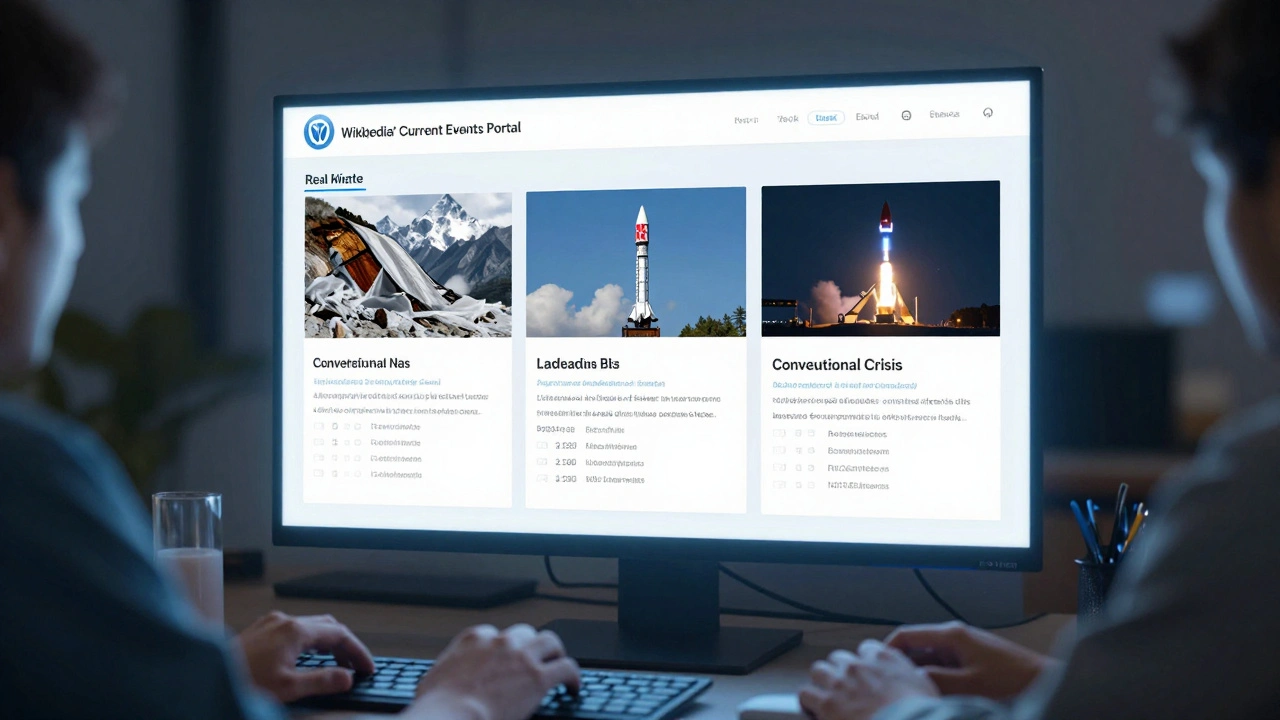
- The collapse of a major bridge in Jakarta, Indonesia, after flooding - with links to climate resilience studies.
- The first commercial lunar landing by a private company - with details on the payload and mission partners.
- A constitutional crisis in Chile, triggered by a court ruling - with background on the country’s 2022 constitutional process.
Each entry includes a link to the full Wikipedia article on the topic. So if you read about the bridge collapse, you can click through to learn about Jakarta’s infrastructure history, past floods, and engineering challenges.
Why Does It Matter?
In an age of misinformation, the Current Events Portal is one of the last places on the internet where facts are built like a library - not like a social media feed. It doesn’t amplify outrage. It doesn’t favor headlines. It doesn’t chase clicks.
Researchers use it to track global trends. Teachers use it to show students how knowledge is constructed. Journalists use it as a fact-checking tool. Students writing papers cite it as a primary source of real-time documentation.
A 2024 study by the University of California found that over 68% of university students in the U.S. used the Current Events Portal as a starting point for research on current affairs - more than any commercial news app. Why? Because it doesn’t just tell you what happened. It tells you where to learn more.
How to Use It
It’s easy. Go to wikipedia.org/wiki/Portal:Current_events. The page is divided into sections by continent and topic: Politics, Disasters, Science, Sports, Culture.
Each event is listed with:
- A one-line summary
- A citation (usually a link to a news article or official statement)
- A timestamp (when it was last updated)
- A link to the full Wikipedia article on the subject
You can also subscribe to the page’s RSS feed or set up email alerts through Wikipedia’s watchlist feature. Some users even run bots that monitor changes and send notifications.
Common Misconceptions
People often assume:
- “It’s just Wikipedia, so it’s unreliable.” - Wrong. The portal has stricter rules than most newsrooms. It doesn’t accept single-source reports.
- “It’s too slow to be useful.” - True, it’s not for live updates. But for understanding what actually happened - not what was rumored - it’s unmatched.
- “It’s only in English.” - No. The portal exists in over 30 languages, including Arabic, Hindi, Spanish, and Mandarin. Each version is independently maintained.
What’s Next?
The portal is evolving. In 2025, volunteers began testing AI-assisted tools to flag potential updates from trusted news APIs - but human editors still review every change. There’s also a push to better link events to historical context - so when you read about a new conflict, you can instantly see its roots in past treaties or colonial history.
Wikipedia’s goal isn’t to be first. It’s to be right. And for those who need truth over noise, the Current Events Portal remains one of the most powerful tools on the internet.
Is the Wikipedia Current Events Portal editable by anyone?
Yes, anyone can edit it - but edits are reviewed by experienced volunteers before being published. Most changes are made by registered users with a history of reliable contributions. Vandalism or unverified claims are reverted within minutes.
Can I trust the Wikipedia Current Events Portal as a source for academic work?
You should cite the original sources linked on the page - not the portal itself. The portal is a curated index of reliable reporting. For academic papers, use the cited articles (e.g., from The New York Times or Reuters) as your primary sources. The portal helps you find them quickly and accurately.
Why doesn’t the portal include every news story?
Wikipedia requires events to be notable - meaning they have lasting significance, broad impact, or widespread coverage. A local fire or a celebrity breakup won’t make the cut. The goal is to document what shapes history, not what trends online.
How often is the portal updated?
During major events - like wars, natural disasters, or elections - updates happen every 5 to 15 minutes. On quiet days, updates may occur every few hours. The page is monitored 24/7 by volunteers across time zones.
Are there versions of the portal in other languages?
Yes. Over 30 language editions exist, including Spanish, French, Arabic, Chinese, and Russian. Each is maintained by local volunteers and follows the same standards. Content varies slightly based on regional relevance, but all use the same verification rules.