Students often turn to Wikipedia when starting a research project. It’s fast, free, and covers almost every topic imaginable. But here’s the hard truth: using Wikipedia as a source in academic work can cross the line into plagiarism-even if you didn’t copy and paste. Many don’t realize that simply paraphrasing Wikipedia without proper attribution is still academic dishonesty. And worse, some professors treat it as a red flag before even reading the rest of the paper.
Why Wikipedia Isn’t a Scholarly Source
Wikipedia is not a peer-reviewed journal. It’s a crowd-sourced encyclopedia. Anyone can edit it. That means a fact you read today might have been added by someone with no expertise, or worse, removed by someone with a bias. A 2021 study from the University of Michigan found that 23% of Wikipedia entries on scientific topics contained at least one factual error, and 14% had outdated information. That’s not a flaw in the system-it’s built into its design.
Academic writing requires sources that are vetted by experts: peer-reviewed articles, books published by university presses, government reports, or primary data. These sources have authors you can trace, methods you can evaluate, and references you can check. Wikipedia doesn’t meet any of those standards. It’s a starting point, not an endpoint.
How Students Accidentally Plagiarize Wikipedia
Most students don’t intentionally steal from Wikipedia. They think they’re being smart. They read a paragraph, reword it, and drop it into their paper. They don’t cite it because they assume it’s common knowledge. But here’s the problem: common knowledge doesn’t mean commonly found on the internet.
Take this example: A student writes, “The Industrial Revolution began in Britain in the late 1700s due to advances in textile manufacturing and steam power.” Sounds basic, right? But that exact phrasing appears in multiple Wikipedia articles. If you didn’t write it yourself, and you didn’t cite the source-even if you changed a few words-you’re plagiarizing. Universities use software like Turnitin that flags even subtle paraphrasing from Wikipedia. And when it flags Wikipedia, it’s not just about the text-it’s about the lack of scholarly rigor.
Another trap: students copy Wikipedia’s citations. They see a reference in a Wikipedia footnote, click it, and use that source in their bibliography. But they never read the original. They’re citing a source through a secondhand filter. That’s not research. That’s a shortcut with consequences.
When Wikipedia Is Okay to Use
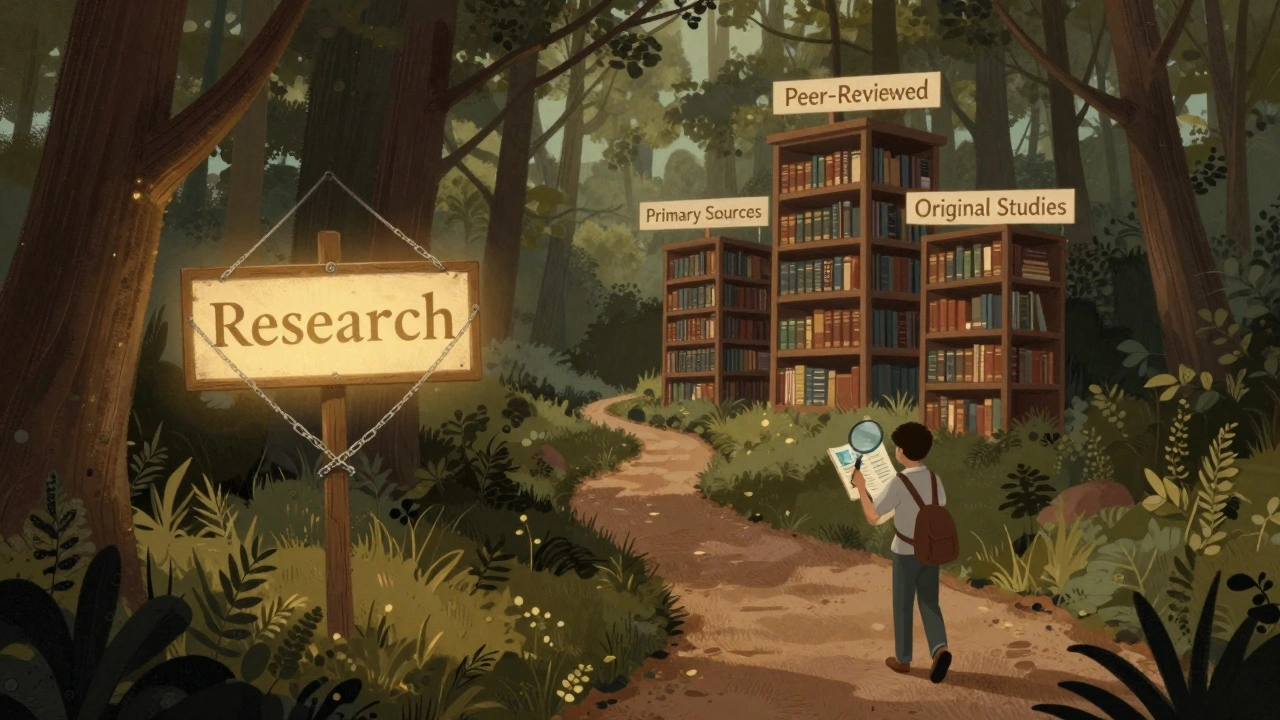
Wikipedia isn’t evil. It’s just not meant for academic citations. Think of it like a map before a hike. You wouldn’t use a Google Maps screenshot as proof of where you hiked-but you’d use it to plan your route. The same applies here.
Use Wikipedia to:
- Understand the basics of a topic you’re unfamiliar with
- Find keywords and terms used in the field
- Locate credible sources in the references section
For example, if you’re writing about climate change and migration, read the Wikipedia page. Note the key terms: “climate refugees,” “displacement thresholds,” “policy frameworks.” Then check the citations. You’ll find peer-reviewed studies from journals like Nature Climate Change or reports from the IPCC. Those are your real sources.
A 2023 survey of 1,200 university students showed that those who used Wikipedia to find sources-rather than cite it-wrote papers with 40% higher citation quality and 30% fewer plagiarism flags.
How to Avoid Plagiarism When Researching With Wikipedia
If you’re going to use Wikipedia (and you will), here’s how to stay on the right side of academic integrity:
- Don’t cite it. Treat it like a library catalog-not a book.
- Follow the references. Click every citation in the “References” section. Read at least three original sources.
- Take notes in your own words. Don’t copy-paste from Wikipedia. Summarize what you learn, then close the tab.
- Use citation tools wisely. Tools like Zotero or Mendeley help organize sources-but they won’t tell you if a source is credible. You still have to judge.
- Double-check facts. If a claim seems too simple, look it up in two other places. A fact that appears on Wikipedia and two academic journals? That’s solid.
One student at the University of Toronto made a habit of writing down every Wikipedia page she read. She didn’t cite them-but she tracked where her ideas came from. When she wrote her final paper, she cited the original studies, not Wikipedia. Her professor praised her for “showing the full arc of research.” That’s the gold standard.
What Professors Really Think
Many professors don’t ban Wikipedia-they ban lazy research. A 2024 study from the American Association of University Professors found that 78% of instructors consider Wikipedia use a sign of poor research habits, not plagiarism. But 61% said they’d accept a paper that used Wikipedia as a stepping stone, if the final citations were solid.
The real issue isn’t Wikipedia. It’s the lack of critical thinking. If you treat it as a source, you’re skipping the hardest part of research: evaluating evidence. If you treat it as a tool, you’re doing the work.
Alternatives to Wikipedia for Academic Research
You don’t need Wikipedia to get started. Here are better, free alternatives:
- Google Scholar - Searches academic papers, theses, and books. Filter by year, citation count, or peer-reviewed status.
- Directory of Open Access Journals (DOAJ) - Over 18,000 peer-reviewed journals with no paywalls.
- PubMed - For medical and life sciences research. All content is peer-reviewed.
- ERIC - For education-related topics. Managed by the U.S. Department of Education.
- Library databases - Your school library likely has access to JSTOR, ProQuest, or ScienceDirect. Use your student login.
These platforms give you the same breadth as Wikipedia-but with credibility built in. You’ll spend more time reading, but you’ll spend less time fixing your paper after it gets flagged.
Final Rule: The Wikipedia Test
Before you write anything, ask yourself: If I didn’t read this on Wikipedia, would I still know it?
If the answer is no, then you need to find a real source. If you learned it from Wikipedia, then you need to cite the original source-not Wikipedia. And if you’re not sure? Go back to the references. Track it down. Read it. Understand it.
Academic integrity isn’t about avoiding punishment. It’s about building your own understanding. Wikipedia can help you start. But only you can finish the work.
Can I cite Wikipedia in my college paper?
Most academic institutions discourage citing Wikipedia directly. While it’s not technically plagiarism to cite it, doing so signals poor research practices. Professors expect you to go beyond Wikipedia-to find peer-reviewed sources, primary documents, or scholarly books. If you must mention Wikipedia, do so only in your methodology or research process, not as a source of facts.
Is paraphrasing Wikipedia still plagiarism?
Yes. Paraphrasing Wikipedia without attribution counts as plagiarism because you’re using someone else’s structure, wording, and ideas without credit-even if you change the sentences. Wikipedia’s content is copyrighted, and its contributors expect attribution. More importantly, academic work requires original synthesis, not reworded internet summaries.
Why do professors hate Wikipedia citations?
Professors don’t hate Wikipedia-they hate lazy research. A Wikipedia citation suggests you didn’t dig deeper. Academic writing is about engaging with expert voices, not summarizing crowd-sourced summaries. If you cite a journal article you found through Wikipedia, that’s fine. If you cite Wikipedia itself, it looks like you stopped at the first result.
Can I use Wikipedia to find sources for my paper?
Absolutely. The references section on Wikipedia is one of its most valuable features. Many entries include links to peer-reviewed studies, government reports, and academic books. Use those links to find credible sources, then read them directly. Never cite Wikipedia-cite the original source you found via Wikipedia.
Do all universities ban Wikipedia?
No. Most universities don’t have a formal ban. Instead, they teach students to avoid using it as a source. Some departments, like history or literature, may allow limited use if you explain why you used it. But in science, engineering, and medicine, citing Wikipedia almost always results in point deductions or a request to revise.