Ever tried editing a Wikipedia page and got stuck trying to format a source? You copy-paste a news article or a research paper, but the citation looks messy, incomplete, or just plain wrong. That’s where citation templates come in. They’re not just fancy code - they’re the backbone of reliable information on Wikipedia. Without them, claims about history, science, or current events would be hard to verify. And that’s the whole point of Wikipedia: to be trustworthy.
Why citation templates matter
Wikipedia doesn’t allow original research. Everything must be backed by a published, reliable source. But simply listing a URL or a book title isn’t enough. Readers need to know: Who wrote it? When? Where? Is it a peer-reviewed journal or a blog post? Citation templates solve this by turning raw data into clean, standardized references.Take a news article from The New York Times. Without a template, you might write:
"The economy grew 2.1% last quarter," said The New York Times, January 10, 2026.
That’s vague. Is it an article? A press release? Did the reporter interview economists? With a template, you get:
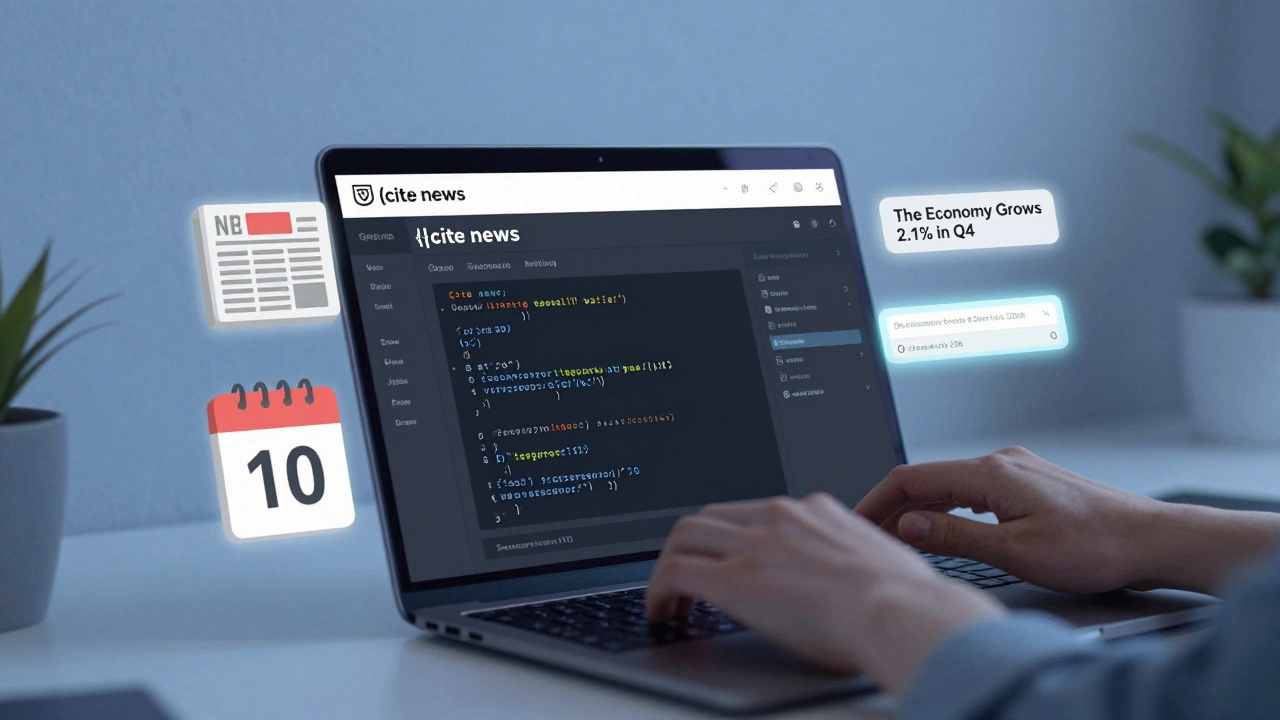
{{cite news | title=The Economy Grows 2.1% in Q4 | newspaper=The New York Times | date=January 10, 2026 | url=https://www.nytimes.com/...}}
Now the system knows it’s a news source, pulls the title, newspaper, and date automatically, and formats it properly for readers. That’s consistency. That’s clarity. That’s credibility.
The most common templates: Cite News, Cite Journal, Cite Web
There are dozens of citation templates on Wikipedia, but three cover 90% of what editors use:{{cite news}}, {{cite journal}}, and {{cite web}}.
Cite News is for articles from newspapers, magazines, or online news outlets. It asks for the author, title, publication name, date, and URL. It can even handle bylines like "By Jane Doe" or "Associated Press". If the article has a section or page number - like in print editions - you can add it too.
Cite Journal is built for academic papers. It needs the author, article title, journal name, volume, issue, pages, year, DOI, and sometimes an ISSN. This template is strict because peer-reviewed research demands precision. A missing DOI? That’s a red flag. Many editors will remove a citation without one. DOIs are unique identifiers - like ISBNs for articles - and they ensure the paper can always be found, even if the URL breaks.
Cite Web is the catch-all for websites that aren’t news or journals. Think government reports, nonprofit white papers, corporate blogs, or institutional pages. It requires the author, title, website name, date, and URL. Unlike news or journal templates, it doesn’t assume a formal structure. But that also means it’s easy to misuse. A tweet or a personal blog? That’s not reliable. Cite Web should only be used for authoritative, stable sources.
What makes a source reliable?
Templates don’t make a source reliable - you do. Wikipedia’s policy on reliable sources is clear: prioritize peer-reviewed journals, reputable news organizations, academic books, and official publications. Avoid blogs, forums, self-published content, or anything with obvious bias.Here’s what works:
- Peer-reviewed journals like The Lancet or Nature
- Major newspapers: The Guardian, Washington Post, Le Monde
- Government agencies: CDC, WHO, U.S. Census Bureau
- University press books
- Reputable NGOs like Amnesty International or the World Bank
Here’s what doesn’t:
- Wikipedia itself
- Personal websites or Medium blogs
- YouTube videos unless from verified institutions
- Press releases without independent reporting
- Forums like Reddit or Quora
Even if you use the perfect {{cite journal}} template, citing a paper from a predatory journal - one that charges authors to publish without peer review - still breaks Wikipedia’s rules. The template doesn’t fix bad sources. It just formats them cleanly.
How to use templates: A step-by-step guide
You don’t need to memorize every parameter. Here’s how to use them in practice:- Find your source. Open the article, journal, or webpage you want to cite.
- Click "Edit" on the Wikipedia page where you want to add the citation.
- In the editor, type
{{cite news}},{{cite journal}}, or{{cite web}}. - Fill in the required fields: title, author, publication, date, URL.
- Preview the page. The template will auto-format into a clean reference.
- Save your edit.
Wikipedia’s visual editor has a built-in citation tool. Click "Cite" → "Add a citation" → then paste the URL. It often auto-fills most fields. But always double-check. Auto-fill gets names wrong, misses dates, or confuses journal titles. Human eyes still matter.
Pro tip: Use the |access-date= parameter. It records when you viewed the source. Web pages change or disappear. That date helps future editors verify what you saw.
Common mistakes and how to fix them
Even experienced editors slip up. Here are the top five errors:- Missing DOI for journal articles. If the paper has one, add it. Use
|doi=10.1038/s41586-025-08912-3. If you can’t find it, search the article title on doi.org. - Using "web" for news articles. If it’s from a newspaper, use
{{cite news}}. Don’t treat The Atlantic like a blog. - Forgetting the date. A citation without a date is useless. If the page doesn’t show one, check the archive or contact the publisher.
- Using "et al." in the author field. Write out all authors if there are fewer than five. For six or more, use
|last1=Smith |first1=John |last2=Lee |first2=Anna |last3=Kim |first3=Min- don’t abbreviate. - Linking to paywalled content without alternatives. If the source is behind a paywall, add
|url-status=deadonly if it’s truly gone. Otherwise, link to a free archive like Internet Archive or a university repository.
These aren’t just nitpicks. They’re what separate a citation that holds up under scrutiny from one that gets deleted.
What about books, podcasts, and videos?
Wikipedia has templates for those too:{{cite book}}- for printed or e-books. Include publisher, ISBN, edition.{{cite podcast}}- for audio episodes. Add host, episode title, platform, date.{{cite video}}- for YouTube or Vimeo videos from credible institutions. Include uploader, title, date, URL.
Podcasts from NPR or BBC? Valid. A random person’s podcast on Spotify? Not unless it’s cited in a reliable secondary source.
Always ask: Is this source independently verifiable? Could another editor find it using just the info in the citation? If not, it doesn’t belong.
How citations protect Wikipedia
Citation templates aren’t just for readers. They’re tools for editors to fight misinformation.Imagine someone adds: "A 2026 study found that eating chocolate reverses aging." Without a citation, it stays. With a citation, someone checks the source. Turns out, it’s a satire site. The edit gets reverted. The template made that possible.
Every time you use a proper citation, you’re helping keep Wikipedia accurate. You’re not just formatting text - you’re upholding the integrity of a global reference library used by students, journalists, and researchers.
Final checklist before saving
Before you hit "Publish," run through this quick checklist:- Is the source reliable? (Not a blog or forum)
- Did you use the right template? (News, journal, web, book?)
- Are all required fields filled? (Author, title, date, URL)
- Is the DOI included for journal articles?
- Did you add an access date for web sources?
- Is the link working? (Test it in an incognito tab)
If you answer "yes" to all, your citation will survive scrutiny. If not, it’ll be flagged, edited, or removed.
Can I use Wikipedia citations as references in my own paper?
Not directly. Wikipedia is a tertiary source - it summarizes other sources. Always go back to the original article, book, or report cited in the Wikipedia reference. Use the template’s details to find the primary source. That’s what academic writing requires.
What if a source disappears after I cite it?
Use the Internet Archive (archive.org). Copy the URL of the source, paste it into the Wayback Machine, and save a snapshot. Then add the archived link using |archive-url= and |archive-date=. This keeps the citation alive even if the original page vanishes.
Do I need to cite every fact on Wikipedia?
Only facts that could be challenged. Common knowledge - like "Paris is the capital of France" - doesn’t need a citation. But anything specific, statistical, or controversial does. When in doubt, cite it.
Can I use a citation template for a source in another language?
Yes. You can cite sources in any language. Just translate the title into English in the template, and keep the original title in the |title= field. Add |language=es or |language=ja to indicate the source language. Editors appreciate this transparency.
Why does Wikipedia prefer DOIs over URLs for journals?
DOIs are permanent. URLs change when websites restructure. A DOI like 10.1016/j.jclepro.2025.142301 always points to the same paper, no matter what domain it’s hosted on. URLs can break in months. DOIs last forever.
Next steps: How to get better at citing
If you’re new to Wikipedia editing, start small. Pick one article you care about - maybe your local park, a historical event, or a scientific topic - and add three properly formatted citations. Use the citation tool. Check the source. Verify the date. Ask yourself: Would someone else find this easily?Join the Wikipedia community. There are forums like Teahouse where new editors ask questions. You’ll learn faster by watching others. And remember: every correct citation you add helps someone else trust what they read.