
Your hard work vanished. You spent hours researching, citing sources, and formatting your entry on Wikipedia is a free online encyclopedia that allows users to create and edit articles. It operates under a collaborative model where content is governed by community guidelines rather than a central editorial board., only to see it deleted overnight. The screen flashes red: "This page has been deleted." Panic sets in. But before you scream into the void or try to recreate the page (which gets you blocked), there is a path forward. The system for Article Deletion is the process by which Wikipedia editors remove pages that do not meet the site's strict content standards. This includes failures in notability, verifiability, or original research. is rigid, but it is not final. Understanding how to navigate the review and appeal process can mean the difference between a permanent ban and a restored legacy.
Understanding Why Your Page Was Removed
You cannot fix what you do not understand. Wikipedia does not delete pages because an editor had a bad day. They delete them because the content violated specific, codified policies. Most deletions happen through one of two channels: Articles for Deletion (AfD) is a formal discussion process where the community votes on whether an article should be kept or deleted based on its adherence to policies. This process typically lasts seven days and involves multiple editors weighing in. or Speedy Deletion is an expedited removal process for pages that clearly violate basic criteria, such as vandalism, blank pages, or obvious lack of notability. These are handled by administrators without a full community vote..
If your page went through AfD, you will find a record of the discussion on the talk page archive. Read every comment. Editors will cite specific rules they believe you broke. Common reasons include:
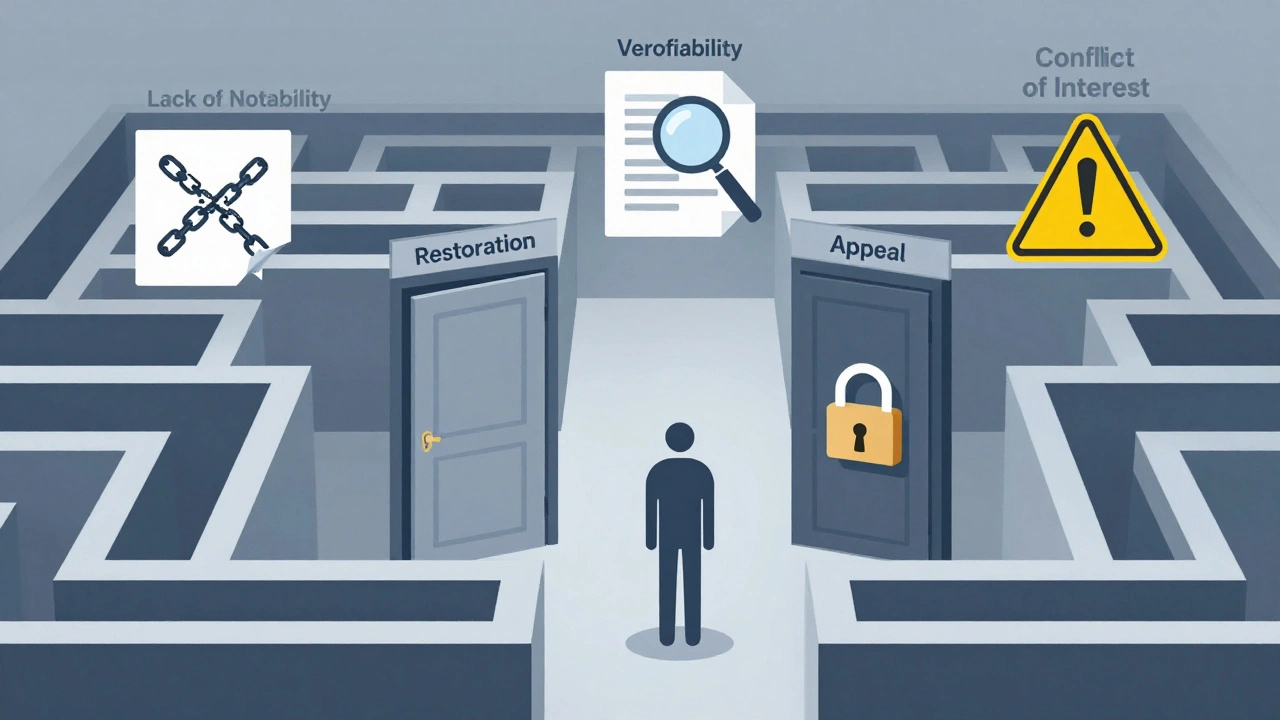
- Lack of Notability: The subject does not have significant coverage in independent, reliable sources. Being famous locally or having a large social media following does not count.
- Original Research: You synthesized information from multiple sources to create a new conclusion, rather than reporting what established sources say.
- Conflict of Interest (COI):**> You edited an article about yourself, your company, or someone you know closely without disclosing this relationship.
- Verifiability Issues: Claims were made without citations, or citations led to paywalled, self-published, or unreliable sources like blogs and press releases.
If your page was speedily deleted, check the deletion log. It will usually give a code, such as G11 ( blatant advertising) or A7 (repeated creation after deletion). Knowing the specific reason is your first step toward a successful appeal.
The Difference Between Restoration and Appeal
New contributors often confuse asking for their page back with appealing the decision. These are two different processes with different success rates. Article Restoration is a request to bring back a deleted page, usually because new evidence or improved content now meets Wikipedia's standards. This is the preferred route if you believe you can fix the problems that caused the deletion.
An appeal, on the other hand, challenges the judgment of the editors who voted to delete. You are arguing that they misinterpreted the rules. Appeals are harder to win. If you simply want your page back, start with a restoration request. If you believe the deletion itself was wrong-perhaps due to bias or a clear misunderstanding of policy-then you file an appeal.
For most people, the goal is restoration. You need to prove that the current state of the world has changed, or that you have found better sources. Did a major newspaper write a feature story on your subject? Did a peer-reviewed journal publish a study? If yes, you have grounds for restoration. If no, you likely do not.
How to File a Successful Restoration Request
Do not just email an admin or post on a random forum. There is a designated place for this: Requests for Page Restoration (RfPP) is a specialized Wikipedia page where users submit requests to restore deleted articles, providing arguments and new evidence. Administrators monitor this page and evaluate each case individually..
Here is how to structure your request to get a positive response:
- State the Title Clearly: Begin with the exact title of the deleted article.
- Summarize the Deletion Reason: Briefly explain why it was deleted. Show you understand the previous critique. "The article was deleted due to lack of independent sources" is better than "They didn't like my links."
- Provide New Evidence: This is the most critical part. List at least three high-quality, independent sources. These must be secondary sources-books, news articles, academic journals-that discuss the subject in depth. Do not link to the subject's own website, press releases, or interviews.
- Show, Don't Just Tell: Quote specific sentences from these sources that demonstrate notability. Explain how they meet the General Notability Guideline (GNG) is the core standard for inclusion on Wikipedia, requiring significant coverage in reliable, independent secondary sources. The GNG is the gold standard for determining if a topic deserves its own article..
- Draft the Content Elsewhere: Create a draft in your user space. Link to it in your RfPP request. This proves you can write a neutral, well-sourced article. Admins are more likely to restore a page if they see you have done the homework.
Be patient. Responses can take days or even weeks. Do not spam the thread. One well-argued request is worth ten angry follow-ups.
When to Escalate to a Formal Appeal
If your restoration request is denied, or if you believe the initial deletion was procedurally flawed, you may consider a formal appeal. This is rare and requires a strong legalistic argument. You would file this at Appeals is a formal mechanism within Wikipedia to challenge decisions made by administrators or the community, particularly regarding blocks or deletions. This process is serious and should only be used when all other options have failed..
Grounds for a successful appeal include:
- Procedural Error: The AfD discussion did not last the required seven days, or key editors were not notified.
- Bias or Harassment: Editors acted out of personal animosity rather than policy adherence. Provide timestamps and quotes as proof.
- Misapplication of Policy: The editors cited a rule that does not apply to your subject. For example, applying music-specific notability guidelines to a historical figure.
Note: Appealing because "you think your topic is important" is not valid. Importance is subjective; notability is objective. If you cannot point to a specific procedural error or policy misinterpretation, do not appeal. You will lose, and you may get blocked for disruption.
Common Mistakes That Kill Your Chances
I have seen countless appeals fail for preventable reasons. Avoid these pitfalls:
- Emotional Language: Phrases like "This is unfair," "My client is very important," or "You are ruining our reputation" signal bias. Write calmly and factually.
- Using Self-Published Sources: Submitting your own blog, LinkedIn profile, or company newsletter as evidence guarantees rejection. Wikipedia requires independent verification.
- Ignoring COI Policies: If you have a conflict of interest, disclose it upfront. Hiding it destroys your credibility instantly. Use the paid editing disclosure tool if applicable.
- Recreating the Page Immediately: After deletion, creating the same page again is considered "disruptive editing." It leads to faster blocks. Always go through the proper channels first.

Building a Case for Notability
The heart of any deletion dispute is notability. Wikipedia’s definition is stricter than most people realize. It is not enough to be known; you must be significantly covered by reliable sources.
Consider the difference between a local business owner who won a regional award and a CEO featured in a national trade publication. The former might have a Facebook post and a local news blurb. The latter has in-depth profiles analyzing their leadership style, business impact, and industry influence. Only the latter meets the threshold for a standalone article.
To build your case, conduct a deep source audit. Look for:
- Long-form Journalism: Magazine features, newspaper profiles, or documentary segments.
- Academic Work: Peer-reviewed papers or books that dedicate substantial sections to your subject.
- Industry Recognition: Awards from respected, independent bodies, not self-appointed organizations.
If you cannot find three such sources, you likely do not have a case. Accepting this early saves time and frustration.
Navigating the Community Mindset
Wikipedia is run by volunteers. Many are experts in their fields, but they are also protective of the project’s integrity. They have seen thousands of promotional pages. They are skeptical by design.
Your job is to lower their defenses. Do this by being transparent, polite, and rigorous. Cite your sources meticulously. Admit weaknesses in your draft. Ask for feedback rather than demanding restoration. When you treat editors as collaborators rather than obstacles, they are more likely to help you succeed.
Remember, the goal is not just to get a page back. It is to contribute valuable, verified knowledge to the world’s largest encyclopedia. If your subject truly matters, the evidence will speak for itself. If it doesn’t, perhaps a mention in a broader article is the right home. Sometimes, the best outcome is knowing when to fold.
How long does the Wikipedia deletion appeal process take?
The timeline varies significantly. Articles for Deletion (AfD) discussions last exactly seven days. Requests for Page Restoration (RfPP) can take anywhere from a few days to several weeks, depending on the complexity of the case and the availability of administrators. Formal appeals may take months if they require arbitration.
Can I hire someone to help me appeal a Wikipedia deletion?
Yes, but you must disclose any paid contributions. Wikipedia has strict policies on paid editing. If you hire a consultant or PR firm, they must register as paid editors and declare their financial interest. Failure to disclose this can result in permanent bans for both parties.
What counts as a reliable source for Wikipedia?
Reliable sources are published works with a reputation for fact-checking and accuracy. This includes major newspapers (e.g., The New York Times, The Guardian), academic journals, reputable books, and government publications. Blogs, social media, press releases, and self-published material are generally not considered reliable.
Why was my article deleted for 'lack of notability'?
Lack of notability means your subject has not received significant coverage in independent, reliable secondary sources. Having many visitors, a large fan base, or being well-known in a niche community does not satisfy Wikipedia's General Notability Guideline (GNG). The focus is on external validation, not internal popularity.
Is it possible to restore a page that was deleted years ago?
Yes, provided you can present new evidence that was not available at the time of deletion. If the subject has gained significant recognition since the original deletion, you can file a Request for Page Restoration (RfPP) with updated sources. Old deletions do not preclude future inclusion if circumstances change.