Wikipedia doesn’t have ads. It doesn’t sell your data. It doesn’t charge users to read articles. Yet, it runs on servers, pays for bandwidth, supports engineers, and keeps the site secure for over 2 billion monthly visitors. So how does it pay for all of this? The answer is simple: millions of small donations from people like you.
Why Wikipedia Needs Donations
Wikipedia is run by the Wikimedia Foundation, a nonprofit based in San Francisco. Unlike commercial sites, it doesn’t make money from advertising or subscriptions. Its only source of operational funding is public donations. That’s because its mission isn’t profit-it’s to give every person on Earth free access to the sum of all human knowledge.
Every year, the foundation spends about $150 million. That covers server costs, software development, legal protection, staff salaries, and global outreach programs. The biggest chunk? Hosting. Wikipedia gets over 50 billion page views a month. That’s more than Netflix, Amazon, and YouTube combined. Keeping that running 24/7, across dozens of countries, isn’t cheap.
And it’s not just about servers. The site needs constant updates. Bots fight vandalism. Volunteers moderate content. Developers build new tools for editors. All of that takes money. Without donations, Wikipedia would slow down, become less reliable, or worse-go offline.
How the Fundraising Campaigns Work
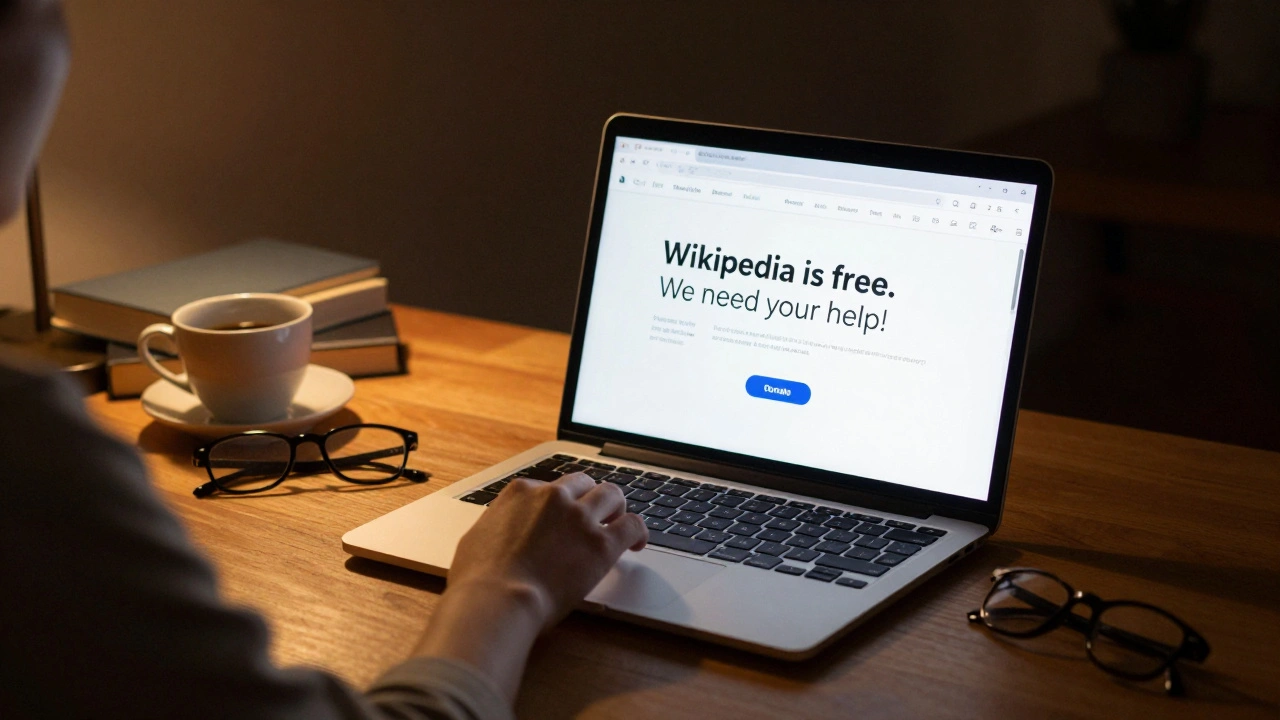
Every year, starting in late October, Wikipedia shows a short banner at the top of its pages. It’s usually just a few lines: “Wikipedia is free. We need your help.” That’s it. No flashy graphics. No countdown timers. No pop-ups.
These banners appear only to users who haven’t donated in the past year. If you’ve given before, you won’t see them. If you’re browsing from a country where donations are low, you’re more likely to see the message. The goal isn’t to annoy you-it’s to reach the right people at the right time.
People donate because they believe in the mission. In 2024, over 10 million people gave. The average donation was $15. That’s not a lot for one person. But multiplied by millions? That’s how Wikipedia stays alive.
Most donations come from the U.S., Germany, Canada, the U.K., and Australia. But the foundation also runs localized campaigns in India, Brazil, Egypt, and Nigeria. In 2023, donations from India jumped 40% after a campaign in Hindi and Tamil. That’s the power of speaking people’s language.
Transparency and Accountability
Wikipedia doesn’t just ask for money-it shows exactly how it’s used. Every year, the Wikimedia Foundation publishes a detailed financial report. You can see every dollar spent: salaries, legal fees, grants to local chapters, technology upgrades, even office supplies.
In 2024, 81% of all spending went directly to programs that support Wikipedia’s mission. That includes editing tools, mobile apps, AI moderation systems, and training for new editors in developing countries. Only 11% went to fundraising costs. The rest covered administration and governance.
There’s no mystery here. All financial documents are public. Anyone can download them. And the foundation is audited by independent firms every year. That’s rare for any organization, let alone one that doesn’t answer to shareholders.

What Happens If Donations Drop?
Imagine a year where donations fall by 30%. What would happen?
- Server capacity would shrink. Pages would load slower, especially in Africa and Southeast Asia.
- Some language versions of Wikipedia might go offline. Smaller language communities-like Swahili or Kurdish-rely on the same budget as English.
- Bot maintenance would slow. Vandalism would increase. False information would spread faster.
- Staff would be cut. Developers who fix bugs, improve search, or make the site accessible to people with disabilities would be laid off.
This isn’t speculation. In 2016, donations dipped after a failed fundraising campaign. Wikipedia’s loading speed dropped by 12% in India. Editors reported more vandalism. The foundation had to delay a major mobile app update for six months.
Donations aren’t optional. They’re the oxygen that keeps Wikipedia breathing.
Other Ways People Help Beyond Money
Not everyone can give $15. But you don’t have to. Many people help by editing articles, reviewing changes, or translating content. In fact, over 100,000 active editors contribute every month. That’s the real backbone of Wikipedia.
Local Wikimedia chapters in over 40 countries organize edit-a-thons, train teachers, and partner with libraries. In Kenya, volunteers digitized local history books and added them to Swahili Wikipedia. In Indonesia, students learned to fact-check misinformation using Wikipedia’s tools.
These efforts don’t cost millions. But they make a huge difference. They keep Wikipedia relevant, accurate, and rooted in real communities.

Why This Model Works
Wikipedia’s fundraising model is unique because it’s built on trust. People don’t donate because they’re scared of losing access. They donate because they’ve used Wikipedia to learn, teach, or fix something in their lives.
A teacher in rural Pakistan uses Wikipedia to prepare lessons. A student in Mexico finds medical info for their grandmother. A retiree in Canada writes about local birds. These aren’t just users-they’re stakeholders.
When you donate, you’re not paying for content. You’re paying for the system that lets people like you create and share knowledge. That’s why the message works: “Imagine a world where every person can freely access the sum of all human knowledge.” It’s not a pitch. It’s a promise.
What’s Next for Wikimedia Fundraising
The foundation is testing new ways to reach people. One pilot project lets users donate via crypto wallets-though most still use credit cards or PayPal. Another experiment uses AI to personalize banner messages based on browsing history, without tracking individuals.
They’re also expanding partnerships with universities and libraries. In 2025, a new program will give students in low-income countries free access to premium research databases, with links back to Wikipedia articles. The goal? Turn Wikipedia into a gateway to deeper learning.
And they’re doubling down on mobile. Over 70% of Wikipedia traffic now comes from phones. That means optimizing donation prompts for smaller screens and slower connections. In Nigeria, where mobile data is expensive, banners now load in under 0.5 seconds.
None of this changes the core idea: Wikipedia survives because people believe in it. Not because it’s perfect. But because it’s free.
What You Can Do
If you’ve ever looked up a fact on Wikipedia, you’ve already benefited from its system. Now you can help keep it going.
- Give once. Even $5 helps.
- Set up a monthly donation. It’s easier than you think.
- Turn off ad blockers on Wikipedia. That’s the only way they can test new donation tools.
- Share why you use Wikipedia with friends. Talk about it. Make it personal.
- Start editing. Fix a typo. Add a citation. Help someone else learn.
You don’t need to be an expert. You just need to care.
Does Wikipedia sell user data?
No. Wikipedia and the Wikimedia Foundation do not sell, rent, or share personal data with advertisers or third parties. Your reading history and donation details are private. The foundation only collects minimal data to keep the site running and to understand how people use it-never to target ads.
Why don’t they just put ads on Wikipedia?
Because ads would change the entire purpose of Wikipedia. Ads create pressure to attract clicks, not accuracy. They’d encourage sensationalism, slow down the site, and break the trust users have in the information. The founders believed knowledge should be free from commercial influence-and that’s still the rule today.
How much of the donation goes to staff salaries?
About 20% of the budget covers staff salaries and benefits. That includes engineers, legal teams, community support staff, and fundraisers. Most of the foundation’s 400+ employees work remotely around the world. Salaries are competitive but not excessive-they’re set to attract talent without inflating costs.
Can I donate in my local currency?
Yes. The Wikimedia Foundation accepts donations in over 40 currencies, including Indian rupees, Brazilian reais, Nigerian naira, and Egyptian pounds. You can choose your currency when you donate. They also support bank transfers and mobile payment systems in many countries.
Are donations tax-deductible?
In many countries, yes. Donations to the Wikimedia Foundation are tax-deductible in the U.S., Canada, Germany, Australia, and several others. If you’re in a country that allows it, you’ll see a tax deduction notice during the donation process. Receipts are emailed automatically.