Every semester, students get stuck on the same problem: they find a perfect explanation on Wikipedia, copy it into their essay, and then get flagged for plagiarism. It’s not because they’re trying to cheat. It’s because they don’t know how to use Wikipedia the right way. Wikipedia isn’t a source you cite in academic work-it’s a starting point. And if you treat it like a textbook, you’re setting yourself up for trouble.
Why Wikipedia Isn’t a Citable Source
Wikipedia is built by volunteers. Anyone can edit it. That means the information changes constantly. A fact you read at 8 a.m. might be corrected-or removed-by noon. Academic papers need stable, verifiable sources: peer-reviewed journals, books from university presses, government reports. Wikipedia doesn’t meet that standard. It’s not because it’s always wrong. In fact, studies from Stanford and the University of Edinburgh show that Wikipedia’s accuracy in science topics matches that of Encyclopaedia Britannica. But accuracy isn’t the issue. It’s about traceability.
When you cite Wikipedia, you’re saying, "I got this from a public wiki." Your professor can’t verify where that idea originally came from. Did it come from a 2019 study? A blog post? A rumor? Wikipedia hides the trail. Academic writing requires you to follow the trail all the way back to the original source.
The Real Danger: Unintentional Plagiarism
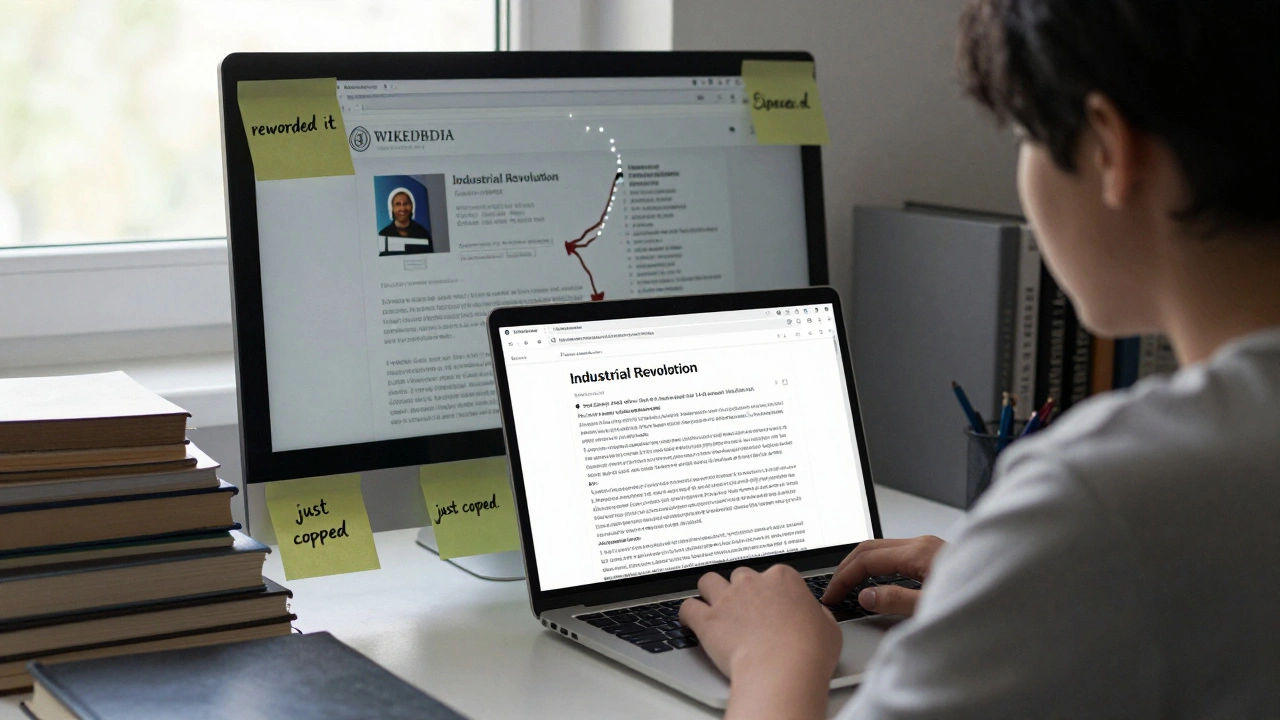
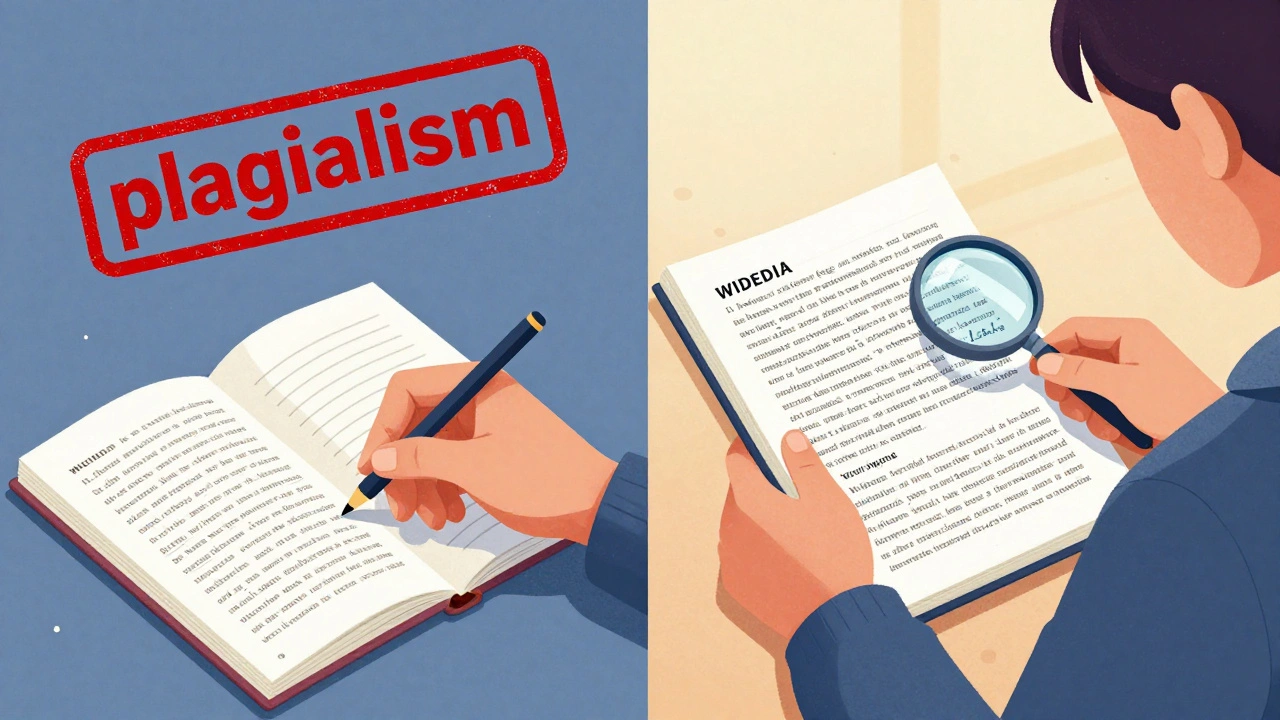
Most students who copy from Wikipedia don’t realize they’re plagiarizing. They think, "I just reworded it." But if the structure, phrasing, or sequence of ideas is too close to the original, it’s still plagiarism-even if you didn’t copy word-for-word. A 2023 study from the International Center for Academic Integrity found that 68% of plagiarism cases among undergraduates involved paraphrased content from free online sources like Wikipedia, not direct copying.
Here’s a real example: A student writes, "The Industrial Revolution began in Britain in the late 1700s due to advances in textile manufacturing and steam power." That sentence is nearly identical to the Wikipedia entry. Even if they changed "started" to "began," and "machinery" to "manufacturing," it’s still too similar. The original source didn’t change. The structure didn’t change. That’s not synthesis. That’s rewriting without attribution.
How to Use Wikipedia the Right Way
Wikipedia is powerful-if you use it as a research tool, not a source. Here’s how:
- Use it to understand the topic. If you’re writing about the Chernobyl disaster and don’t know what RBMK reactors are, Wikipedia gives you a clear, simple explanation. That’s fine.
- Check the references. Every good Wikipedia article has a "References" section at the bottom. Click on those links. Find the original book, study, or news report. That’s what you cite.
- Take notes in your own words. Don’t copy and paste. Read the Wikipedia summary, close the tab, and write what you remember. Then go find the real source to back it up.
- Use Wikipedia to find keywords. If you’re stuck, look at the bolded terms in the article. Search those terms in your school’s library database. You’ll find better sources faster.
One student in a 2024 survey at the University of Toronto said she used Wikipedia to find the term "neoliberalism" in a political science paper. She then searched her university’s JSTOR database for articles using that exact term. She found five peer-reviewed papers, cited them properly, and got an A. She never cited Wikipedia.
What Professors Actually Look For
Professors aren’t trying to catch you. They’re trying to see if you can think independently. They want to know: Did you engage with the material? Did you go beyond the surface? Did you trace ideas back to their roots?
When you use Wikipedia as a stepping stone, you show that you know how to research. When you cite it as a source, you show that you’re cutting corners. The difference isn’t in the grade-it’s in the learning.
Most grading rubrics include a category called "Source Use." If you cite Wikipedia, you automatically lose points there-even if everything else is perfect. But if you show five solid sources from academic databases, with clear connections to your argument, you earn full credit.
Common Mistakes and How to Avoid Them
- Mistake: "I used Wikipedia because it’s easier than the library." Fix: Your library database has free access to thousands of scholarly articles. Use the "Advanced Search" feature. Type in your topic + "peer-reviewed." You’ll get better results in minutes.
- Mistake: "I paraphrased it, so it’s not plagiarism." Fix: Paraphrasing isn’t enough if the structure and key phrases are unchanged. Try explaining the idea out loud to a friend, then write what you said. That’s true original thinking.
- Mistake: "I didn’t know I had to cite it." Fix: If you didn’t create the idea, you need to credit it. That’s not optional. Whether it’s Wikipedia, a YouTube video, or a tweet-if you used it, you cite it. Or better yet, find the original source.
Tools That Help You Stay Clean
There are free tools built for students:
- Citation Machine or Cite This For Me: Paste a Wikipedia URL, and it generates a proper citation in APA or MLA-but don’t use it to cite Wikipedia. Use it to cite the real source it links to.
- Google Scholar: Search a phrase from Wikipedia, and it often pulls up the original academic paper. Try it: copy a sentence from a Wikipedia article, paste it into Google Scholar in quotes, and hit search.
- Your school’s librarian: Seriously. Book a 15-minute chat. They’ll show you how to find peer-reviewed sources in under 10 minutes. Most students don’t know this is free.
What to Do If You’ve Already Used Wikipedia
If you’ve already written a draft with Wikipedia content, don’t panic. Do this:
- Go through every paragraph where you used Wikipedia.
- Find the reference in the Wikipedia "References" section.
- Click the link. Read the original source.
- Replace the Wikipedia-based text with your own summary of the real source.
- Cite the real source.
You’re not rewriting your whole paper. You’re upgrading it. You’re turning a shortcut into a real research skill.
Final Thought: Wikipedia as a Springboard
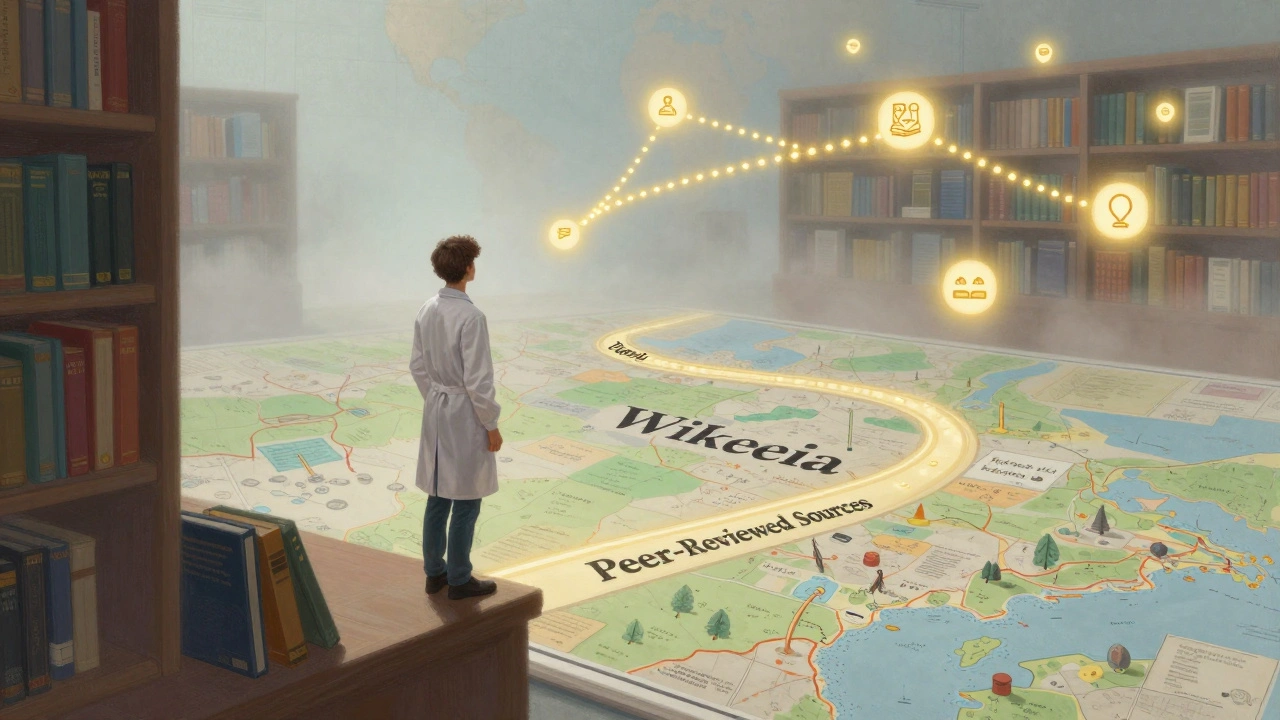
Wikipedia is like a map. It doesn’t take you to your destination-it shows you the roads. The real journey happens when you leave the map and walk the path yourself. Academic integrity isn’t about avoiding Wikipedia. It’s about knowing when to leave it behind.
Can I cite Wikipedia in my college paper?
No, most academic institutions do not allow Wikipedia as a citation. Professors expect you to use original, peer-reviewed sources. While Wikipedia can help you understand a topic, you must trace ideas back to their original publications-like journal articles, books, or official reports-and cite those instead.
Why do professors say Wikipedia is unreliable?
They don’t say it’s unreliable-they say it’s unverifiable. Wikipedia articles can be accurate, but since anyone can edit them, there’s no guarantee the information won’t change or be removed. Academic work requires sources with stable, traceable origins, like peer-reviewed journals or university-published books. Wikipedia doesn’t provide that.
Is paraphrasing from Wikipedia still plagiarism?
Yes. If your writing closely follows the structure, wording, or sequence of ideas from Wikipedia-even if you changed a few words-it’s still plagiarism. True paraphrasing means you’ve understood the concept deeply enough to explain it in your own voice, without looking at the original text. Always go back to the original source cited in Wikipedia’s references to write your own version.
How do I find the real source behind a Wikipedia article?
Scroll to the bottom of any Wikipedia article and click on the "References" section. Each numbered citation links to the original source-like a journal article, book, or news report. Click the link, read the source, take notes in your own words, then cite that source in your paper. That’s how you build real research skills.
What should I do if my professor catches me using Wikipedia?
Don’t argue. Acknowledge the mistake, explain that you didn’t realize Wikipedia couldn’t be cited, and ask how to fix it. Most professors will let you revise your paper if you show you understand the issue. Use the feedback to learn how to find proper sources next time. This isn’t a failure-it’s part of learning how to research.