Quick Guide to the Pillars
- Encyclopedia, not a dictionary: Focuses on comprehensive summaries, not short definitions.
- Neutral Point of View (NPOV): Presents all significant views fairly and without bias.
- Free Content: All information must be open for anyone to use or share.
- Respect and Civility: Keeps the community functional through polite interaction.
- No Single Truth: Focuses on verifiability rather than "absolute truth."
Pillar 1: It's an Encyclopedia, Not a Blog or Dictionary
The first thing you have to realize is that Wikipedia isn't meant to be a place for your personal opinions or a spot to define a single word. It's a summary of human knowledge. When editors look at a new page, they ask: "Does this provide a comprehensive overview of the topic?"
For example, if someone writes a page about a local coffee shop that just says "The coffee here is great," it will be deleted almost instantly. Why? Because that's a review, not an encyclopedic entry. An encyclopedic approach would describe the shop's founding date, its architecture, and its impact on the local economy, citing local news reports to back it up. This distinction is what keeps the site from turning into a giant version of Yelp or a personal diary.
Pillar 2: The Battle for a Neutral Point of View
This is where things get spicy. The Neutral Point of View, or NPOV, is arguably the hardest pillar to maintain. It doesn't mean the article has to be bland or that every single opinion is equally valid. Instead, it means the author must represent each significant perspective fairly, describing the views with an unbiased tone.
Think about a page on a controversial political figure. A biased article might use words like "claimed" or "alleged" for one side and "stated" or "proven" for the other. A neutral article says, "Supporters argue X, while critics contend Y." The goal isn't to tell the reader what to think, but to give them the full map of the conversation so they can decide for themselves. When you see "edit wars"-where two people keep changing a sentence back and forth-it's usually a fight over NPOV.
Pillar 3: Open Access and Free Content
Wikipedia is a project of the Wikimedia Foundation, a non-profit that believes knowledge should be a human right. This is why the site is free of ads and doesn't hide information behind a paywall. But "free" doesn't just mean zero dollars; it means the content is licensed under Creative Commons.
This means anyone can take a Wikipedia article, tweak it, and use it in a book or a classroom. This open-source nature creates a massive feedback loop. Because the content is free to use, it gets shared more, which attracts more critics, which leads to more corrections, which ultimately makes the information more accurate. If the content were proprietary, the growth would have stalled decades ago.
| Feature | Traditional Encyclopedia | Wikipedia |
|---|---|---|
| Authorship | Paid Experts/Academics | Volunteer Community |
| Update Speed | Years (Print Cycles) | Seconds (Real-time) |
| Access | Subscription/Purchase | Free / Open License |
| Verification | Internal Peer Review | Public Verifiability |

Pillar 4: Civility in a Digital Wild West
When you put millions of people with different worldviews in one digital room, arguments are inevitable. Pillar 4 focuses on the human element: respect and civility. While you don't have to like your fellow editors, you have to be polite to keep the project moving. This is often referred to as "Wiki-etiquette."
The community uses a system of "Talk pages" to hash out disagreements. Instead of just deleting someone else's work (which is seen as a hostile act), the rule is to discuss the change first. If a user becomes toxic or repeatedly ignores the rules, they can be blocked by administrators. This social layer is the only thing preventing the site from becoming a shouting match, ensuring that the focus remains on the Wikipedia Five Pillars rather than personal vendettas.
Pillar 5: Verifiability Over Absolute Truth
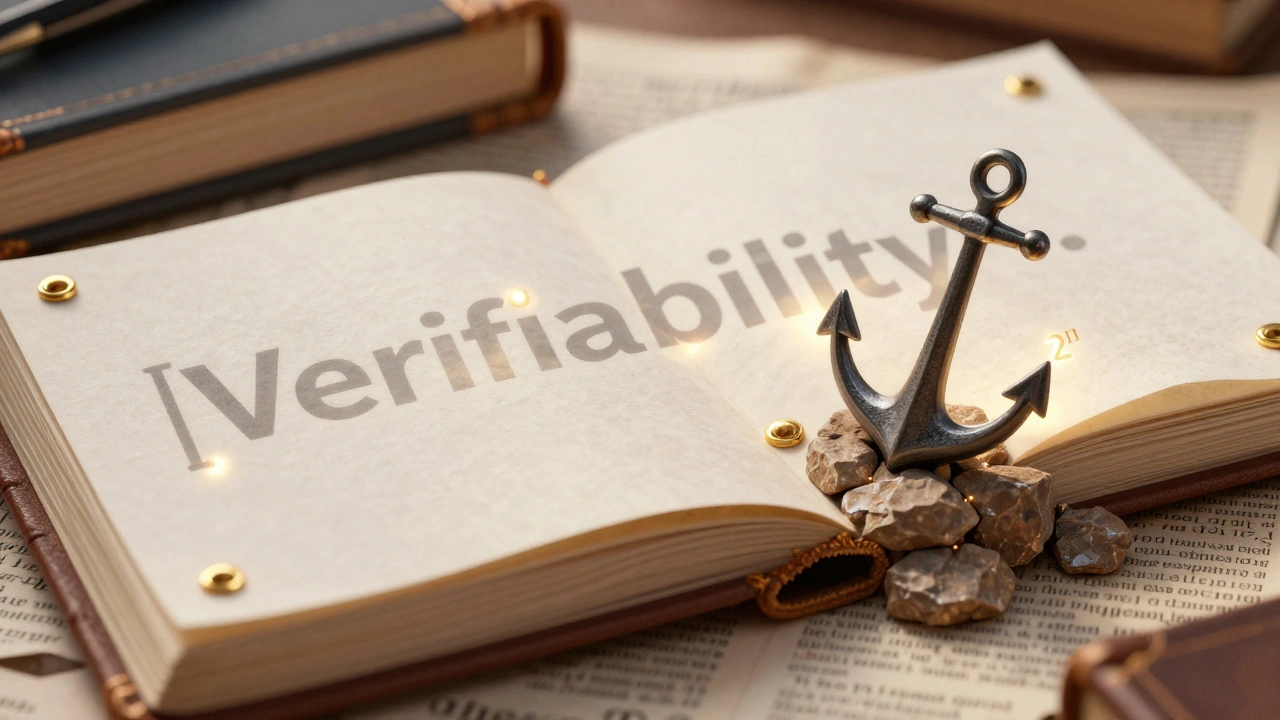
This is the most misunderstood part of the system. Wikipedia does not claim to be the source of absolute truth. Instead, it prioritizes Verifiability. What does that mean? It means an editor doesn't need to prove a fact is "true" in a philosophical sense; they just need to show that a reliable source says it is true.
If you write, "The sky is green," you'll be deleted because no reliable source supports that. But if you write, "Some 19th-century poets described the sky as green," and you cite those poems, that is a verifiable statement. This shifts the burden of proof from the editor's own knowledge to the quality of the citations. This is why you see so many little superscript numbers [1][2] on pages; those are the anchors that hold the information to reality.
Common Pitfalls for New Editors
If you're thinking about jumping in and editing, avoid these common traps that often lead to "reverts" (when someone undoes your change):
- Original Research: Don't add your own theories or discoveries. Even if you're an expert in the field, if it's not published in a reliable source, it doesn't go on Wikipedia.
- Tone Policing: Avoid using adjectives like "amazing," "terrible," or "revolutionary." Stick to the facts. Let the reader decide if something was amazing.
- Over-citation: While sources are great, don't turn an article into a bibliography. Use the most authoritative source available rather than listing five mediocre ones.
How These Pillars Scale to Millions of Pages
You might wonder how these five simple rules can possibly manage millions of articles. The magic is in the decentralization. Because the pillars are public and well-known, they act as a mental filter for every single contributor. When an editor in Tokyo and an editor in New York both agree that a sentence violates NPOV, they can resolve the issue without needing a manager to step in.
This creates a self-correcting ecosystem. The more eyes that are on a page, the faster the errors are caught. This is known as "Linus's Law," which suggests that given enough eyeballs, all bugs are shallow. In Wikipedia's case, the "bugs" are biases and inaccuracies, and the "eyeballs" are the global community of volunteers.
Can I use Wikipedia as a primary source for a college paper?
Generally, no. Because Wikipedia is a tertiary source (a summary of other sources), professors want you to go to the original research. The best way to use Wikipedia is to scroll to the bottom of the page and use the "References" section to find the primary sources the editors used.
What happens if two reliable sources contradict each other?
This is where the Neutral Point of View pillar kicks in. Instead of picking a winner, the editor should write: "Source A states X, while Source B argues Y." This accurately reflects the state of knowledge on the topic without taking a side.
Who actually decides what counts as a "reliable source"?
The community follows a general hierarchy. Peer-reviewed academic journals and university presses are at the top. Reputable news organizations with editorial standards are next. Personal blogs or social media posts are typically not considered reliable sources unless they are the subject of the article itself.
Is Wikipedia just a place for people to argue?
It can feel that way if you look at the Talk pages, but those arguments are actually the engine of quality. By debating the nuances of a topic through the lens of the Five Pillars, editors strip away personal bias until only the most verifiable and neutral information remains.
What is the difference between a lock and a protection on a page?
Protection occurs when a page is under heavy "edit war" or is being targeted by vandals. Administrators can restrict editing to only registered users or only users with a certain number of edits to ensure the content remains stable while the community works out a consensus.
Next Steps for Aspiring Contributors
If you want to start contributing, don't jump straight into a political firestorm. Start small. Find a topic you know well and look for "citation needed" tags. Adding a reliable source to a claim is the fastest way to provide value without triggering an edit war. Once you get the hang of the verifiability pillar, you can move on to improving the flow and neutrality of larger articles. Just remember to keep it civil, stay neutral, and always check your sources.