Key Takeaways
- Wikipedia is a tertiary source, meaning it summarizes secondary and primary sources.
- It is highly effective for initial discovery and finding primary citations.
- Directly citing it is generally acceptable only in specific contexts, such as studying the evolution of public perception.
- The "gray literature" status means it lacks formal peer review but offers rapid, community-driven updates.
Understanding the Tertiary Nature of Wikipedia
To use Wikipedia correctly, you first have to understand where it sits in the food chain of information. In academic terms, Wikipedia is a multilingual online encyclopedia written collaboratively by volunteers. It is categorized as a tertiary source. Unlike a primary source (a diary or a raw dataset) or a secondary source (a peer-reviewed journal article analyzing that data), a tertiary source distills and indexes information from both.
Think of it like a map. If you're trying to find a specific city, a map is a great starting point. But if you're writing a thesis on the architecture of that city, you can't just cite the map; you have to actually go to the city and look at the buildings. In this analogy, Wikipedia is the map. It tells you where the information is, who the key players are, and what the general consensus is, but it isn't the evidence itself.
When Using Wikipedia as Gray Literature is Actually Appropriate
There are specific scenarios where referencing Wikipedia isn't just a shortcut, but a legitimate methodological choice. When we treat it as Gray Literature, we are acknowledging that the value lies in the *existence* of the information rather than its academic authority. For instance, if you are writing a sociology paper on how misinformation spreads during a pandemic, the Wikipedia "Talk" pages are a goldmine. They show the real-time conflict between editors over what facts should be included.
Another valid use case is when you are documenting the "current state of public knowledge." If you're analyzing how a niche technology is perceived by the general public in 2026, citing the Wikipedia lead section provides a snapshot of that collective understanding. In these cases, you aren't citing Wikipedia for the truth of the fact, but as a representative sample of a digital community's consensus.
| Attribute | Wikipedia | Peer-Reviewed Journal |
|---|---|---|
| Review Process | Community-based/Immediate | Expert Peer Review/Slow |
| Update Speed | Seconds to Minutes | Months to Years |
| Stability | Fluid (Changes constantly) | Static (Version of record) |
| Primary Goal | General Accessibility | Knowledge Advancement |

The "Citation Mining" Technique
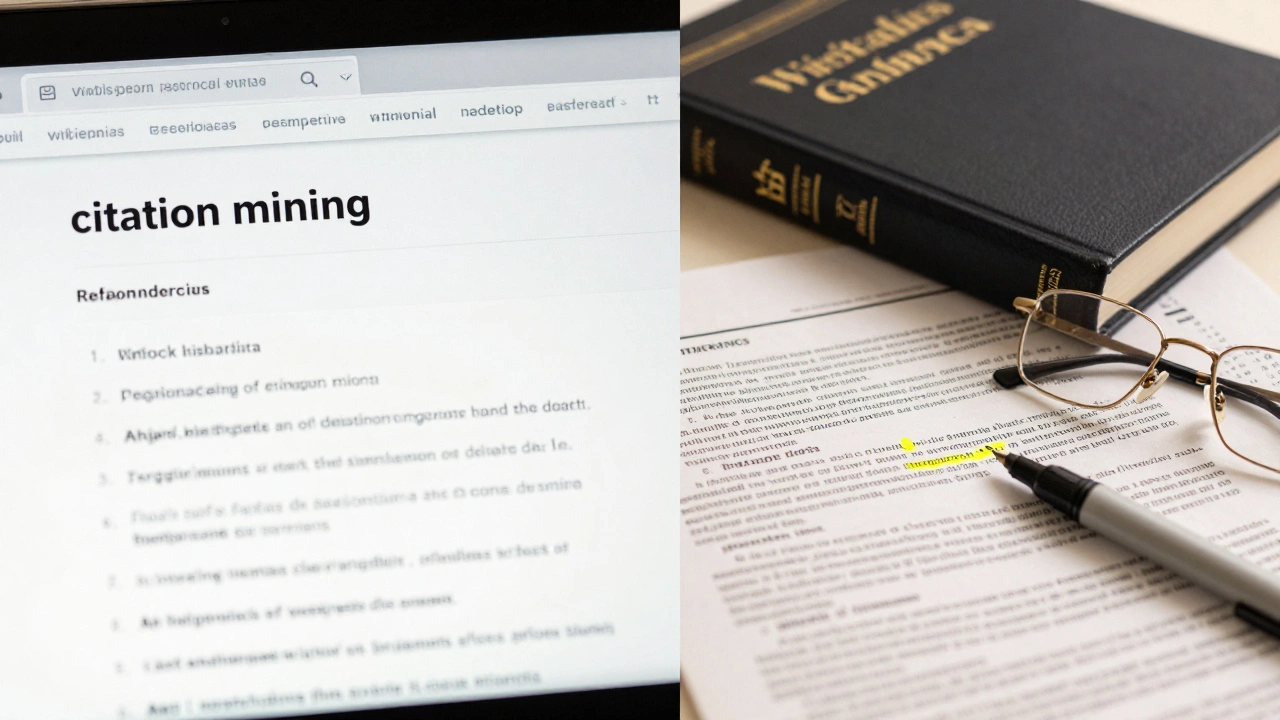
The smartest way to use Wikipedia in an academic setting is not to cite it, but to use it as a launchpad. This is called citation mining. Every well-written Wikipedia article is backed by a list of references at the bottom. These are often the very Primary Sources (like government reports) or Secondary Sources (like academic books) that your professors actually want to see.
Here is the workflow for effective citation mining:
- Read the Wikipedia entry to get a general grasp of the topic.
- Find the specific claim or data point you want to use.
- Click the superscript number (the citation) next to that claim.
- Go directly to the original source listed in the references section.
- Read the original source to verify the context wasn't stripped away.
- Cite the original source, not Wikipedia.
For example, if you find a claim on Wikipedia that a specific drug reduced mortality by 15%, don't cite the wiki page. Follow the link to the original clinical trial published in a medical journal. By doing this, you've used Wikipedia for the efficiency of discovery while maintaining the rigor of academic standards.
Navigating the Risks of Gray Literature
Using Wikipedia as a reference, even in a limited capacity, comes with risks. The most prominent is "edit warfare," where two groups of editors constantly change a sentence to suit their bias. This is particularly common in political or religious entries. If you notice a page has an extensive "Talk" section filled with arguments, the information on that page is unstable.
Another issue is the "circular reporting" loop. This happens when a journalist writes a story based on a Wikipedia entry, and then a Wikipedia editor cites that same journalist's story to verify the fact. Suddenly, the information looks authoritative because it's in a newspaper, but the root is still an unverified wiki edit. To avoid this, always track the information back to the earliest possible source, such as a legal document or a first-hand account.
Practical Guidelines for Different Academic Levels
The rules change depending on whether you are a high school student, an undergrad, or a PhD candidate. In high school, using Wikipedia is often a cardinal sin because the goal is to teach you how to find sources. In undergrad, it's generally acceptable as a starting point but rarely as a final citation.
At the graduate level, you might reference Open-access repositories or wiki-style databases when the subject is so new that formal journals haven't caught up. In the world of software development or cybersecurity, a community-driven wiki is often more accurate than a textbook written three years ago because the technology changes every six months. In these fast-moving fields, the value of speed outweighs the value of formal peer review.
Final Verdict on Reference Appropriateness
So, when is it actually appropriate to hit that "Cite" button on a Wikipedia page? Ask yourself these three questions:
- Am I citing the fact or the source? If it's a fact about the world, find the original source. If it's about how the world views the fact, Wikipedia is okay.
- Is the topic stable or volatile? For a historical date (e.g., the start of the French Revolution), a tertiary source is fine. For a developing political conflict, it's too risky.
- Does my field value speed over stability? In computer science, a wiki is a tool. In history, it's a hint.
Can I use Wikipedia for a college-level research paper?
Generally, you should not cite Wikipedia directly as a primary source of truth. However, it is an excellent tool for "pre-research." Use it to understand the terminology, identify key figures, and find the original sources in the references section, which you can then cite in your paper.
What exactly is gray literature in the context of the internet?
Gray literature refers to information produced outside of traditional publishing houses or academic journals. This includes government reports, white papers, pre-prints, and community-curated sites like Wikipedia. It's often more current than textbooks but lacks the formal vetting process of a peer-reviewed journal.
Is it ever okay to cite a Wikipedia "Talk" page?
Yes, but only if the focus of your research is the process of knowledge creation, community consensus, or digital sociology. You wouldn't cite a talk page to prove a scientific fact, but you would cite it to show how people disagree on a specific topic.
How do I verify if a Wikipedia article is reliable?
Check for a few markers: First, look for a "Featured Article" or "Good Article" badge. Second, check the number and quality of the citations-if the claims aren't backed by links, be skeptical. Third, check the "View history" tab to see if the page is currently undergoing massive, conflicting edits.
What is the difference between a secondary and a tertiary source?
A secondary source analyzes or interprets a primary source (like a biography of a president). A tertiary source, like Wikipedia or an encyclopedia, indexes and summarizes those secondary sources to provide a broad overview without adding new analysis.