Key Takeaways
- Wikipedia is a map, not the destination; use it to find the path to original data.
- Primary sources provide the legal and professional shield necessary for high-stakes reporting.
- Tertiary sources are acceptable for common knowledge but risky for niche or controversial claims.
- The "circular reporting" trap happens when a journalist cites a wiki that cited a news report that cited the same journalist.
The Hierarchy of Evidence
To understand attribution models, you first have to realize that not all information is created equal. In the world of research, we talk about primary, secondary, and tertiary sources. A Primary Source is an immediate, first-hand account of a topic, from which we derive information. Think of a birth certificate, a raw transcript of a court hearing, or a direct quote from a witness. These are the gold standard because there is no "middleman" filtering the data.
A secondary source interprets or analyzes primary data. A textbook or a peer-reviewed journal article analyzing a set of raw statistics is a secondary source. Then we have tertiary sources. Wikipedia is the quintessential tertiary source, acting as an index or a digest that summarizes primary and secondary materials. It's a community-edited encyclopedia that distills massive amounts of information into a readable format. While incredibly efficient, citing a tertiary source in a professional piece of journalism is often seen as a shortcut that compromises accuracy.
Why the "Wiki-Jump" Matters
Why can't you just cite the wiki? Because Wikipedia is volatile. A page can be edited ten times in an hour. If you cite a specific claim from a Wikipedia entry and that entry is later corrected or deleted, your source has vanished into the digital ether. More importantly, the "edit wars" on Wikipedia mean that some information might be biased or currently under dispute. If you are reporting on a political figure or a scientific breakthrough, you cannot afford to be the victim of a prank or a biased editor's whim.
The professional move is the "Wiki-Jump." You use the Wikipedia page to get your bearings, but then you scroll straight to the bottom. The References section is where the actual value lies. By clicking those citations, you move from a tertiary summary back to the primary or secondary source. If Wikipedia says a company was founded in 1992, and the reference is a 1992 SEC filing, you cite the SEC filing. You've now turned a shaky reference into an ironclad fact.

When It Is Actually Okay to Use Wikipedia
Let's be honest: not every piece of information requires a deep dive into the National Archives. There is a concept called "common knowledge." If you're mentioning that Paris is the capital of France, you don't need to cite a diplomatic treaty from 1870. In these cases, Wikipedia serves as a quick verification tool to ensure you haven't made a basic error.
Wikipedia is also useful for "contextual scaffolding." This means using it to understand the jargon of a new beat. If you've suddenly been assigned to cover Quantum Computing, Wikipedia is a great place to learn what a "qubit" is before you interview a physicist. However, the moment you move from "understanding the concept" to "making a factual claim in a story," the wiki must be swapped for a professional source.
| Source Type | Example | Reliability | Best Use Case |
|---|---|---|---|
| Primary | Original Interview / Law | Highest | Breaking news, legal claims |
| Secondary | Academic Journal / Analysis | High | Deep-dive features, trends |
| Tertiary | Wikipedia / Encyclopedia | Variable | Initial research, common facts |
The Danger of Circular Reporting
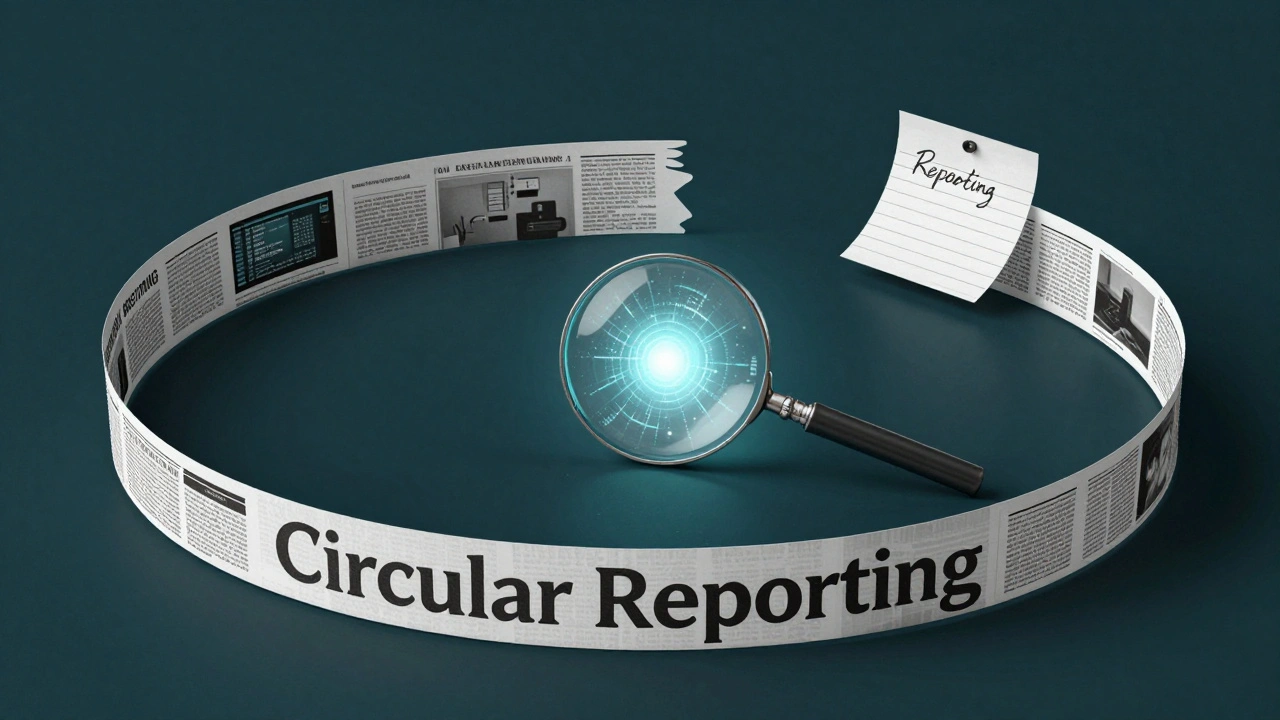
One of the biggest nightmares in modern journalism is circular reporting. This happens when a news outlet publishes a story based on a Wikipedia entry, and then a Wikipedia editor updates the entry using that news story as a source. Suddenly, the original claim is being cited as a fact because it's in a "reputable" news outlet, but the news outlet only had the info because it was on Wikipedia. The original source-the actual truth-is lost.
To avoid this, always ask: "Where did this information actually originate?" If you find yourself in a loop of news articles citing each other, you haven't found a source; you've found an echo. A disciplined journalist will keep digging until they hit the raw data, whether that's a White Paper, a government database, or a direct eyewitness account.
Practical Steps for Source Verification
If you are staring at a Wikipedia page and wondering how to transition to a professional attribution, follow this workflow:
- Identify the specific fact you need (e.g., "The 2023 revenue of X Corp was $5 billion").
- Find the superscript number next to that sentence in the Wikipedia article.
- Click that number to go to the footer.
- Open the linked source. Is it a news article, a book, or a corporate report?
- Verify that the linked source actually says what Wikipedia claims it says. (Sometimes editors misinterpret the source).
- Cite the original source in your work, completely bypassing the mention of Wikipedia.
The Ethics of Attribution
Attribution isn't just about avoiding plagiarism; it's about providing a trail that your readers can follow to verify your work. When you cite a Primary Source, you are telling your reader, "I didn't just take someone's word for it; I saw the evidence myself." This builds a level of trust that a tertiary citation can never achieve.
In an era of AI-generated content and "hallucinations," the value of a verified source has skyrocketed. AI tools often act like Wikipedia on steroids-they synthesize information without providing a reliable audit trail. This makes the manual process of source verification more important than ever. If you can't point to a specific document, person, or event, the information isn't a fact; it's a rumor.
Is it ever professionally acceptable to cite Wikipedia directly?
In high-stakes journalism or academic writing, almost never. However, in very casual blogging or internal company memos, it might be acceptable for non-critical, common-knowledge facts. Even then, it is better to use Wikipedia to find the real source and cite that instead.
What should I do if a Wikipedia reference is a dead link?
Treat the information as unverified. Use a tool like the Wayback Machine to see if a cached version of the page exists, or search for the title of the referenced document in a library database or Google Scholar. If you can't find a living source, you cannot treat the claim as a fact.
What is the difference between a secondary and tertiary source?
A secondary source analyzes and interprets primary data (like a book about the Civil War). A tertiary source indexes and summarizes both primary and secondary sources (like an encyclopedia or a dictionary). The further you move from the primary source, the more likely the information is to be filtered or simplified.
How do I handle citations when the primary source is a person?
This is an interview. In this case, the person is the primary source. You should attribute the information to them by name and title (e.g., "According to Jane Doe, Chief Economist at X Bank"). If the information was found on Wikipedia via a quote from that person, you still need to contact that person or find the original recording/transcript to verify it.
Can I use Wikipedia to find people to interview?
Yes, and this is one of its best uses. Wikipedia often lists experts, authors, and officials associated with a topic. Use the site to identify the key players, then move off the platform to contact those individuals directly for original quotes.
Next Steps for Better Reporting
If you want to sharpen your attribution game, start by auditing your last three pieces. Look for any "general" claims that aren't backed by a specific source. If you find a paragraph that feels like it was summarized from a wiki, go back and perform the "Wiki-Jump." Find the original document, read the surrounding context of the quote, and update your attribution. This small habit separates amateur content creators from professional journalists.