Ever wonder why searching for "how to make tamales" in Spanish gives you way fewer results than the same search in English? Or why articles about local history in Nigeria or traditional medicine in Indonesia are half the length-or missing entirely-compared to their English counterparts? This isn’t an accident. It’s a gap. And it’s growing.
English Wikipedia has over 6.7 million articles. That’s more than the next seven largest language versions combined. But here’s the thing: English is spoken as a first language by less than 10% of the world’s population. The rest of us? We’re relying on a platform built mostly by and for English speakers.
Why the Gap Exists
The problem isn’t that people in other countries don’t care about sharing knowledge. It’s that the system isn’t built for them. Most Wikipedia editors are from North America, Europe, or East Asia. A 2023 study by the Wikimedia Foundation found that over 60% of active editors come from just five countries: the U.S., Germany, Japan, the U.K., and Russia. That leaves billions of people with little representation in the editing community.
Language barriers are real. If you speak only Swahili or Bengali, you’re navigating a platform where the tools, tutorials, and even the discussion norms are in English. Translation tools help-but they’re clunky. Google Translate can’t handle cultural nuance. A phrase like "the village elder" in a rural Kenyan context doesn’t map cleanly to "the village chief" in English. Lose that detail, and you lose the meaning.
There’s also a feedback loop. If an article in Hindi is short, people assume it’s unimportant. So fewer people edit it. Fewer edits mean lower visibility. Lower visibility means even fewer people bother to contribute. The cycle keeps going.
What’s Missing
Let’s look at concrete examples. The article on "Kerala backwaters" in English has over 3,200 words, with detailed maps, historical context, and ecological data. The same topic in Malayalam? Around 400 words. No maps. No citations. Just a basic overview.
Or take "traditional Indonesian batik techniques." The English version lists over 30 regional styles, includes dye chemistry, and links to UNESCO heritage records. The Bahasa Indonesia version? Two paragraphs. No images. No references to specific villages or artisans.
It’s not just about culture. It’s about science, law, and health. In Swahili, there’s no detailed article on malaria prevention methods used in East African clinics. In Urdu, there’s almost nothing on Pakistan’s water rights laws. In Vietnamese, there’s no comprehensive guide to the country’s 2024 digital identity system. These aren’t niche topics-they’re daily necessities for millions.
Who’s Trying to Fix It
Some groups are stepping in. The WikiProject Global South is a volunteer network of editors from Africa, Latin America, and Southeast Asia who focus on expanding coverage in underrepresented languages. They host monthly edit-a-thons, train local contributors, and pair them with mentors who speak their language.
Then there’s the WikiLingo tool, launched in 2025. It’s not a translation engine. It’s a bridge. You start with a well-developed English article. WikiLingo highlights key sections-definitions, statistics, citations-and suggests local equivalents. If you’re editing in Arabic, it might say: "This statistic on water access in Yemen matches data from the Yemeni Ministry of Water Resources (2023). Add it here." It doesn’t translate. It connects.
Universities are helping too. The University of Cape Town runs a course where students translate Wikipedia articles from English into isiXhosa. Each student translates five articles per semester. Last year, they added 1,200 new articles. That’s 1,200 more people in rural Eastern Cape who can now read about their own history in their own language.
The Real Cost of the Gap
When knowledge is uneven, power is uneven. If a child in Lagos can’t find reliable information about vaccines in Yoruba, they might believe misinformation. If a farmer in Bangladesh can’t read about soil conservation in Bengali, they might lose their crop. If a student in Lima can’t access legal rights in Quechua, they might stay silent when exploited.
This isn’t just about completeness. It’s about dignity. People don’t want English versions of their lives. They want their own versions-accurate, detailed, and rooted in their context.
A 2024 survey by the International Federation of Library Associations found that 78% of non-English speakers trust Wikipedia more when the content is in their native language. But only 22% of them feel the content is sufficient.
What You Can Do
You don’t need to be a professional editor. You don’t even need to be fluent in another language. Here’s how you can help:
- Start with what you know. If you grew up in a place where your family speaks a language other than English, write a short article about a local tradition, food, or landmark. Even 300 words helps.
- Use WikiLingo. Go to the English version of an article you care about. Click the WikiLingo button. It’ll show you gaps in other languages. You can add sources, images, or structure-no translation needed.
- Support local editors. Many language communities have Facebook groups or Telegram channels. Join one. Ask how you can help. Sometimes, all they need is someone to fact-check or format a page.
- Share. If you find a great article in Hindi, Tamil, or Amharic, share it with your network. Visibility drives contribution.
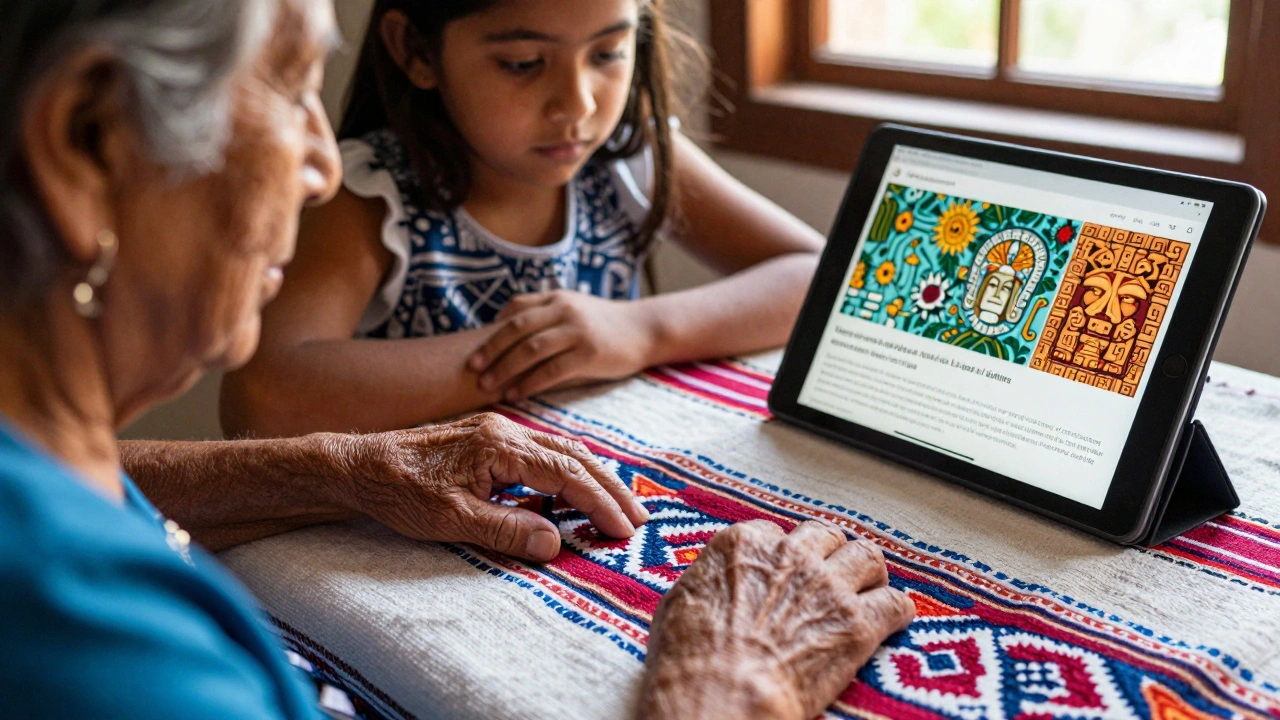
One editor in Oaxaca, Mexico, started writing about traditional textile patterns after her grandmother passed away. She didn’t know how to code. She didn’t have a degree. She just had memories. Now, her articles are the most visited in Zapotec. That’s power.
The Future Isn’t Just Bigger-It’s Fairer
Wikipedia was built on the idea that knowledge should be free. But freedom doesn’t mean the same thing to everyone. If only one language gets the full story, then the world’s knowledge isn’t free-it’s biased.
The goal isn’t to replace English. It’s to make room. Every article translated, every local voice added, every forgotten tradition documented-it all adds up. And it’s not about quantity. It’s about presence.
There are over 7,000 languages in the world. Wikipedia supports 329 of them. That’s progress. But it’s still less than 5%. The gap isn’t just a technical problem. It’s a moral one.
Someone, somewhere, is searching right now for answers in their language. And if you don’t help fill the gap, who will?
Why doesn’t Wikipedia automatically translate articles between languages?
Automatic translation tools like Google Translate can’t handle cultural context, local terminology, or nuanced references. A direct translation of "sustainable fishing" in English might not reflect the specific practices used in a village in the Philippines. Wikipedia relies on human editors who understand both the language and the culture behind the topic. That’s why tools like WikiLingo help editors connect existing knowledge rather than replace it with machine output.
Which languages have the biggest content gaps on Wikipedia?
Languages with large speaker populations but low editing activity have the biggest gaps. Examples include Swahili (over 200 million speakers), Bengali (250 million), Punjabi (120 million), and Hausa (80 million). Even though these languages are spoken by hundreds of millions, their Wikipedia versions often have fewer than 500,000 articles-compared to over 6 million in English. Smaller languages like Quechua, Aymara, and Yoruba have even fewer articles, despite deep cultural knowledge.
Can I contribute to Wikipedia even if I’m not fluent in English?
Absolutely. You can edit any Wikipedia version in your native language. Many language communities have their own guidelines, tools, and support networks. If you speak Arabic, Tamil, or Quechua, you can start editing the Arabic, Tamil, or Quechua Wikipedia directly. You don’t need to know English to contribute meaningfully to your own language version.
Is there a way to find articles that need improvement in my language?
Yes. Wikipedia has "stub" categories for every language. For example, on the Swahili Wikipedia, you can search for "Kategoria:Kichwa" (Stub articles) to find short entries needing expansion. Tools like WikiLingo also highlight articles that have rich English versions but poor translations in your language. You can add local sources, photos, or structure to improve them without translating word-for-word.
How does Wikipedia decide which languages to support?
Wikipedia supports any language with a community of active editors. There’s no official list of "approved" languages. If 10 people start editing regularly in a language-say, Tok Pisin or Krio-Wikipedia will create a version for it. The barrier isn’t technical. It’s community. The challenge is helping those communities grow, not building the platform.