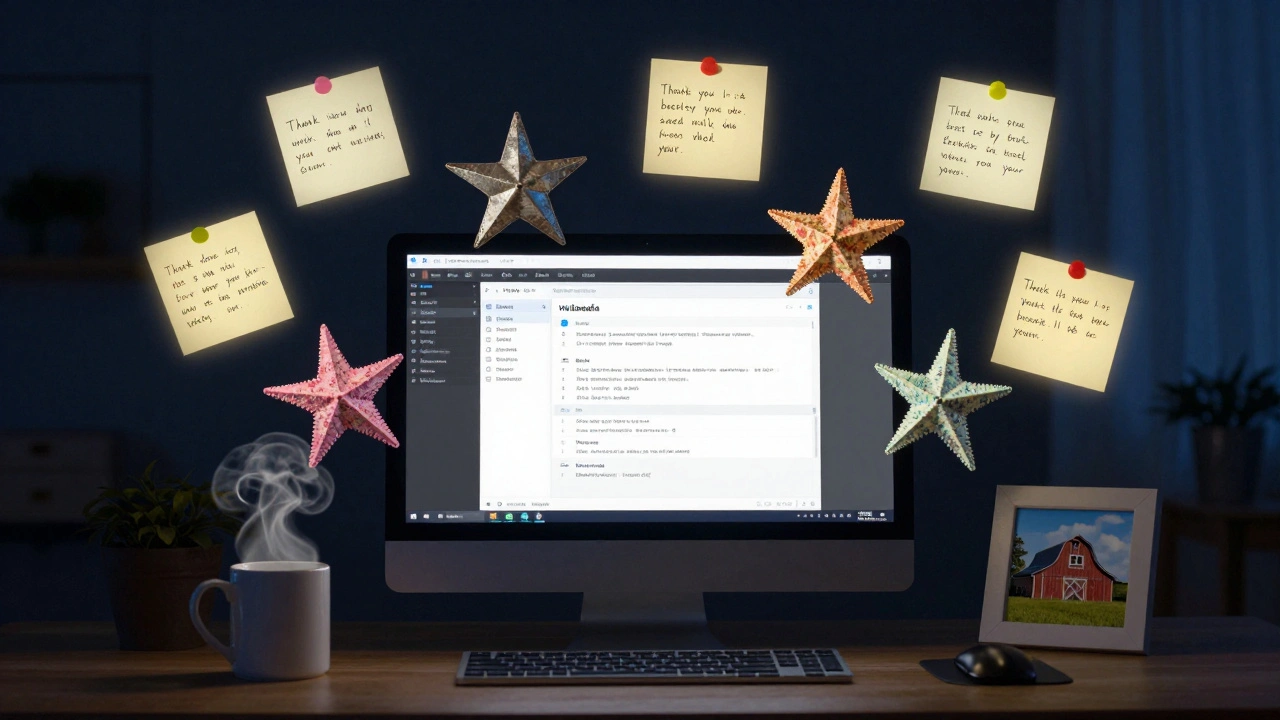
Wikipedia isn’t just a collection of articles-it’s built by people. Millions of volunteers edit, fact-check, and rewrite content every day. But unlike jobs with paychecks or promotions, most Wikipedia editors don’t get paid. So how does the community say "thank you"? The answer lies in a quiet but powerful system of recognition: barnstars, the Thanks feature, and other informal awards.
What Are Barnstars?
Barnstars are digital badges awarded by one Wikipedia editor to another. They’re not official trophies or medals. There’s no central committee handing them out. Instead, they’re shared freely, often with a personal note explaining why the recipient earned it. Think of them like handwritten thank-you cards posted on a community bulletin board-but digital, public, and lasting forever.
The first barnstar was created in 2003 by a user named Werdna as a joke. It was a simple image of a barnstar, a metal decoration often found on American barns. The idea stuck. Soon, editors began giving them out for good edits, helpful talk page responses, or even just for staying calm during heated disputes. Today, there are over 150 different barnstar designs, each with its own meaning.
Some are common: the Original Barnstar is given for outstanding contributions. Others are niche: the Teahouse Barnstar rewards patience in helping new editors, and the Copyeditor’s Barnstar honors those who fix grammar and formatting across hundreds of articles. There’s even a Anti-Harassment Barnstar for editors who stand up against abuse in the community.
These aren’t just pretty pictures. They’re social currency. Receiving a barnstar can lift an editor’s morale after months of quiet work. Some users collect them like trophies. Others frame them in their user pages as proof of their role in the community.
The Thanks Feature: A Simple "Thank You"
While barnstars are visual and personal, the Thanks feature is simpler and faster. Launched in 2014, it lets any registered editor click a "Thanks" button under another user’s edit summary or comment. A notification pops up, and the recipient gets a record in their contributions log.
It’s not flashy. No image. No ceremony. Just a quiet "thanks" logged in the system. But that simplicity made it wildly popular. By 2023, over 100 million thanks had been sent across all language versions of Wikipedia. The English Wikipedia alone saw more than 40 million thanks by the end of 2024.
Why does it matter? Because it lowers the barrier to appreciation. You don’t need to write a paragraph. You don’t need to find the right barnstar template. You just click. And that small action has real effects. Studies from the Wikimedia Foundation show that editors who receive thanks are 20% more likely to make another edit within the next week. For new editors, a single "thanks" can be the difference between quitting and sticking around.
Awards Beyond Barnstars
Not all recognition comes from individuals. Some awards are community-driven. The Wikipedia Administrator of the Year is chosen annually by a vote among active editors. It’s not about how many edits you made-it’s about how well you handled disputes, protected the site from vandalism, and supported others.
Then there’s the Wikipedian of the Year, awarded by Jimmy Wales himself since 2011. It’s rare-only one person gets it each year. Past winners include a 72-year-old retired teacher from Australia who translated 5,000 articles into Mandarin, and a high school student in Nigeria who created over 1,200 articles on African history.
Some awards are tied to specific projects. The Good Article and Featured Article badges are the closest thing Wikipedia has to formal quality ratings. Getting a Featured Article status means your work passed a rigorous review by dozens of editors. It’s not a trophy you can hang on your wall, but it’s a mark of excellence that stays with your user profile forever.
Who Gets Recognized-and Who Doesn’t
Recognition on Wikipedia isn’t evenly distributed. A 2023 analysis of over 2 million barnstars and thanks messages found that 68% went to the top 10% of active editors. The bottom 40% received less than 5% of all recognition. This isn’t because they’re less valuable-it’s because they’re less visible.
Many new editors, especially those from non-English speaking countries or underrepresented backgrounds, don’t know how to ask for help or where to find the barnstar templates. Others edit in silence, fixing typos or adding citations without ever joining talk pages. Their work gets buried in the edit history.
There’s also a gender gap. Studies show that female editors receive fewer thanks and barnstars than male editors, even when controlling for edit volume. Part of this is cultural: women are less likely to self-promote or ask for recognition. But part of it is systemic: the norms of recognition were built by early male-dominated communities and still reflect those patterns.
Efforts are underway to change this. The WikiProject Women in Red actively tracks and celebrates edits made by women and about women. Some communities now hold monthly "Thanks Thursdays," encouraging everyone to send at least one thank-you. And new tools are being tested that automatically suggest who might deserve recognition based on edit quality, not just visibility.
Why Recognition Matters
Wikipedia doesn’t pay its editors. It doesn’t give titles or bonuses. But it does give something else: belonging. Recognition systems like barnstars and thanks create a feedback loop. When you feel seen, you keep contributing. When you see others being thanked, you want to join in.
That’s why these systems are critical to Wikipedia’s survival. Without them, the site would rely entirely on guilt, duty, or altruism. But human beings need more than that. We need to feel our effort matters. We need to know someone noticed.
One editor, who goes by the username StellarGardener, spent five years quietly adding citations to articles about Indigenous languages. No one knew. Then, in 2024, another editor found her work and gave her a Cultural Preservation Barnstar. She wrote back: "I didn’t think anyone cared. But now I know I’m not alone."
That’s the power of recognition. It doesn’t cost money. It doesn’t need approval. It just needs someone to notice-and say thank you.

How to Give Recognition the Right Way
If you want to give a barnstar or send a thanks, here’s how to do it well:
- Be specific. Don’t just say "Thanks for your edits." Say: "Thanks for fixing the citation in the section on Maori land rights. That detail was hard to find."
- Use the right tool. For quick appreciation, use the "Thanks" button. For something deeper, write a personal note with a barnstar.
- Look for quiet contributors. Check the edit history of articles you care about. Who’s fixing grammar? Who’s adding sources? They often go unnoticed.
- Don’t wait for big wins. A single well-placed citation, a cleaned-up infobox, or a polite reply on a talk page deserves recognition too.
- Pay it forward. If you received a barnstar last week, give one out this week. It’s contagious.
Recognition isn’t about reward. It’s about connection. And on Wikipedia, where the work is endless and the audience is global, that connection is everything.
Can anyone give a barnstar on Wikipedia?
Yes. Any registered Wikipedia editor can give a barnstar to another editor. There’s no approval process. You just find the barnstar template you want, add it to the recipient’s talk page with a personal message, and save the edit. It’s completely peer-driven.
Do barnstars have any official status on Wikipedia?
No. Barnstars are entirely informal. They don’t affect your editing privileges, your reputation in the system, or your access to tools. They’re social tokens-meant to encourage, not to control. But because they’re public and permanent, they carry a lot of weight in the community.
Is the Thanks feature available on all Wikipedia language versions?
Yes. The Thanks feature was rolled out across all major language versions of Wikipedia between 2014 and 2017. It’s now available in over 300 languages, including less common ones like Welsh, Swahili, and Basque. The interface may vary slightly, but the function is the same.
How do I find out who gave me a barnstar?
Go to your user talk page and look for the barnstar message. It will always include the name of the editor who left it, along with the date. You can also check your contributions log under "User notifications"-the system keeps a record of all barnstars and thanks you’ve received.
Can I create my own barnstar?
Yes. If you have a specific type of contribution you want to recognize, you can design a new barnstar. First, create an image (PNG format, 100x100 pixels), upload it to Wikimedia Commons, and then create a template on your user page. Once it’s used by a few others and gains traction, it may be adopted by the wider community.
What Comes Next?
Wikipedia’s recognition system is still evolving. New tools are being tested to make appreciation more automatic-like suggesting thanks when an editor fixes a broken link or adds a citation from a reliable source. Some communities are experimenting with monthly recognition boards, where editors nominate peers for "Hidden Hero" awards.
But the core idea won’t change: recognition on Wikipedia is personal, human, and free. It doesn’t come from a company or a government. It comes from one editor seeing another’s effort-and choosing to say, "I see you. Thank you."