Wikipedia isn’t a place to publish your own findings, theories, or unpublished data. It’s a summary of what’s already been published by reliable, independent sources. Yet every day, editors add content that crosses the line into original research - and it’s often hard to spot. If you’ve ever wondered why your edit got reverted, or why someone removed a passage you thought was factual, chances are it was flagged as original research. This isn’t about censorship. It’s about keeping Wikipedia trustworthy.
What Counts as Original Research on Wikipedia?
Original research means any analysis, synthesis, or interpretation that hasn’t been published elsewhere. It doesn’t matter if it’s true. If you took three articles, combined their ideas, and drew a new conclusion - that’s original research. If you analyzed survey data you collected yourself and wrote up what it means - that’s original research. If you interpreted a historical document in a way no academic has before - still original research.
Wikipedia’s policy is clear: no original research. This rule exists because Wikipedia isn’t a journal. It doesn’t publish new science, new opinions, or new discoveries. It reports on what others have already published. The goal is to be a mirror of existing knowledge, not a source of it.
Here’s what counts as original research:
- Putting together facts from different sources to make a new claim that no source makes directly
- Applying a theory from one field to another without a published source supporting that application
- Using statistical analysis on publicly available data to reach a conclusion not stated in any reliable source
- Writing your own interpretation of a quote or event that goes beyond what established sources say
- Creating timelines, charts, or summaries based on unpublished data or personal analysis
Even if your conclusion is correct, if it wasn’t published by someone else first, Wikipedia can’t include it.
How to Spot Original Research in Articles
You don’t need to be an expert to catch original research. Look for these red flags:
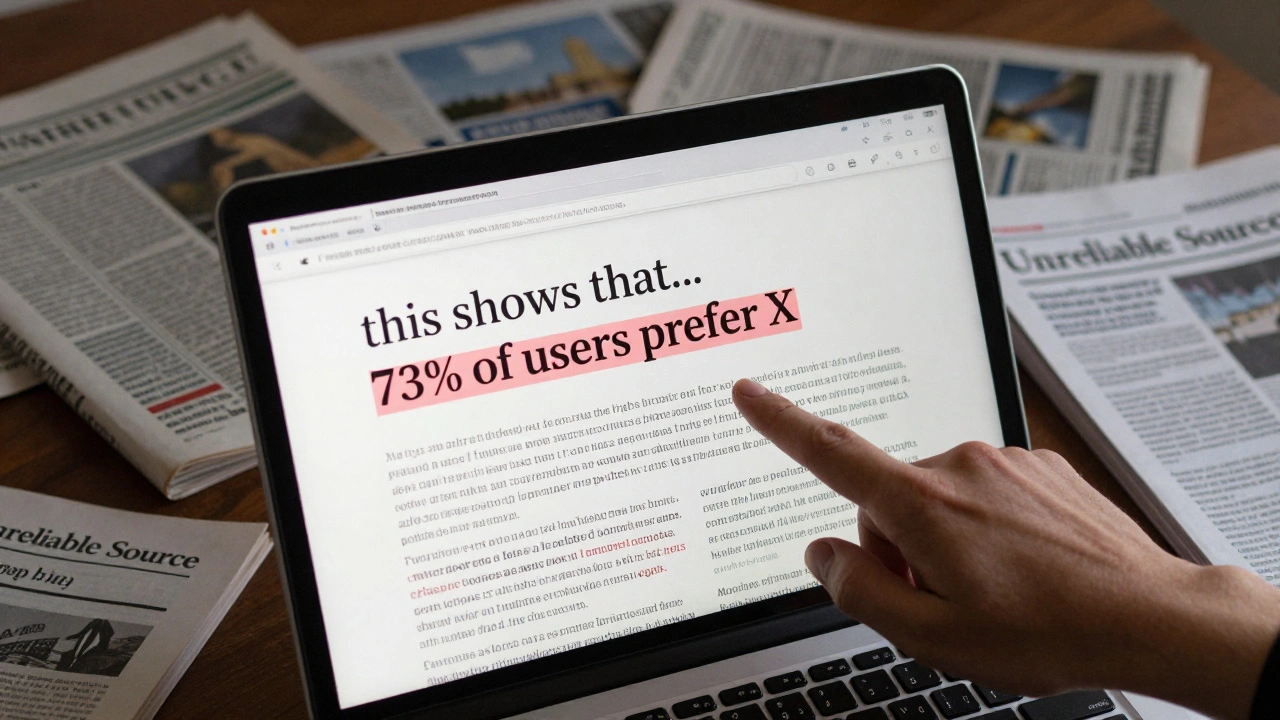
- Phrases like “this shows that,” “it’s clear that,” or “we can conclude” - these often signal interpretation, not summary
- Claims that sound too specific or too precise - like “73% of users prefer X” - without a cited source
- References to “studies,” “research,” or “data” that don’t link to actual publications
- Arguments that feel like opinions disguised as facts - “most experts agree” without naming any experts or sources
- Content that reads like a blog post, thesis, or personal essay
Here’s a real example: A Wikipedia article on climate change includes a paragraph saying, “While IPCC reports show rising global temperatures, the rate of increase has slowed since 2005, suggesting natural variability is now dominant.” That’s original research. The IPCC report doesn’t say that. No peer-reviewed paper says that. Someone took temperature data, compared two time periods, and made a judgment call. That’s not Wikipedia’s job.
Compare that to a version that says: “According to a 2020 study published in Nature, the rate of global temperature rise between 2005 and 2015 was 0.12°C per decade, lower than the 0.18°C per decade observed between 1990 and 2005 (Smith et al., 2020).” That’s fine. It cites a source. It doesn’t interpret beyond what the source says.
Why Original Research Undermines Wikipedia
Wikipedia’s credibility depends on its reliance on published sources. If anyone could add their own analysis, the encyclopedia would become a mix of truth, half-truths, and misinformation. Imagine if every person who believed vaccines cause autism added their “research” to the article. Or if every conspiracy theorist added their own timeline of “hidden events.” Wikipedia would collapse into chaos.
Even well-intentioned edits can be harmful. A student might compile data from three textbooks and write a “better summary.” A hobbyist might crunch numbers from public datasets and claim a new trend. Both think they’re helping. But without peer review, verification, or publication, their work doesn’t meet Wikipedia’s standard.
Wikipedia doesn’t require perfect sources - just reliable ones. Peer-reviewed journals, major newspapers, academic books, and official reports from trusted institutions are acceptable. Blogs, personal websites, forums, and self-published material are not. If your source isn’t credible, your analysis isn’t either.

How to Remove Original Research
Removing original research is simple - if you know what to look for. Here’s how to do it right:
- Identify the passage that seems to go beyond summarizing. Ask: Is this claim made directly by a reliable source?
- Check the citation. Does the source actually say what the edit claims? Often, the citation is misused or irrelevant.
- Replace the original research with a direct summary from a reliable source. If no source supports the claim, remove it.
- Leave an edit summary: “Removed original research. No reliable source supports this claim.”
- If the edit was made by a new user, leave a polite note on their talk page explaining the policy.
Don’t argue. Don’t accuse. Just state the policy and point to the source. Most editors will understand - especially if you show them exactly where the violation occurred.
For example, if someone writes: “Many believe that the Roman Empire fell because of lead poisoning from pipes,” and cites a 1980s magazine article, you can replace it with: “The theory that lead poisoning contributed to the fall of the Roman Empire has been widely debated. A 2018 review in the Journal of Archaeological Science found no conclusive evidence linking lead pipes to systemic lead poisoning among Roman elites (Jones, 2018).”
You didn’t delete the idea - you moved it into context, with a credible source.
What to Do When Someone Reverts Your Edit
If your edit gets reverted and you’re confused, don’t get defensive. Check the edit summary. Look for phrases like “original research,” “unsourced,” or “notability.” Then ask yourself: Did I make a new claim? Did I interpret data? Did I rely on a weak source?
Instead of reverting back, go to the article’s talk page. Say: “I added this because I thought it was supported by [source]. Can you help me understand why it was removed?” Often, the answer will be: “That source doesn’t say that. Here’s what it actually says.”
Use this as a learning opportunity. Wikipedia’s community is full of experienced editors who want to help you edit better - if you approach them respectfully.

How to Contribute Without Breaking the Rules
You can still make meaningful contributions without doing original research. Here’s how:
- Add missing citations to existing claims
- Fix outdated or incorrect references
- Improve clarity by rewriting vague statements using direct quotes from sources
- Remove unsupported claims entirely
- Update articles with new, published information from reliable outlets
For example, if a Wikipedia page on AI mentions “many experts believe AI will replace most jobs by 2040,” and you find a 2025 McKinsey report that says “AI could automate 30% of tasks by 2030,” replace the vague claim with the specific, cited data.
You didn’t add your opinion. You didn’t analyze trends. You just replaced a guess with a fact - and that’s exactly what Wikipedia needs.
Common Misconceptions About Original Research
Many editors think original research means “not citing sources.” But you can cite sources and still commit original research. You can cite five studies, summarize them, and then say: “Together, these suggest a new pattern.” That’s still original research.
Others think if something is true, it belongs on Wikipedia. But Wikipedia isn’t a truth detector. It’s a repository of published knowledge. If a fact hasn’t been published by a reliable source, it doesn’t belong - even if it’s correct.
And no, “everyone knows this” doesn’t count. Pop culture, urban legends, and common beliefs are not reliable sources. If you can’t find a book, journal, or major news outlet that says it, it’s not Wikipedia material.
Final Thought: Be the Gatekeeper, Not the Publisher
Wikipedia doesn’t need more authors. It needs more editors - people who can find the best sources, verify claims, and remove what doesn’t belong. Original research isn’t just against policy. It’s a threat to the entire project’s integrity.
When you spot it, remove it. When you’re unsure, ask. When you’re tempted to add your own insight, pause. Ask: Has this been published? Has it been peer-reviewed? Is it in a reliable source?
If the answer is no - don’t add it. Find a source that says it. Or leave it out. Either way, you’re helping Wikipedia stay what it’s meant to be: a trusted summary of human knowledge - not a sandbox for new ideas.
What’s the difference between original research and synthesis on Wikipedia?
Synthesis means combining information from multiple reliable sources to explain a topic - but only if no new interpretation is added. Original research happens when you go beyond what the sources say and draw your own conclusions. For example, listing what three studies found about climate change is synthesis. Saying those studies prove a new trend is original research.
Can I use Wikipedia to publish my own research?
No. Wikipedia is not a platform for publishing new findings. If you’ve done original research, publish it in a peer-reviewed journal first. Once it’s published and cited by other reliable sources, then someone else can summarize it on Wikipedia - not you.
Is it original research if I use public data to make a chart?
Yes, if the chart shows a trend, pattern, or conclusion not already published in a reliable source. Even if the data is public, interpreting it to support a new claim counts as original research. Wikipedia only includes charts and graphs that are published by credible sources.
What sources are considered reliable for Wikipedia?
Reliable sources include peer-reviewed academic journals, major newspapers, books from reputable publishers, government reports, and established magazines. Avoid blogs, personal websites, forums, self-published material, and social media. The key is independent, authoritative publication - not just availability.
Why does Wikipedia care so much about this rule?
Because Wikipedia is one of the most visited websites in the world. If it allowed original research, it would become a breeding ground for misinformation, bias, and false claims. The rule ensures that everything on Wikipedia has been vetted by the broader academic or journalistic community - not just one editor’s opinion.