
Most journalists don’t realize how much of their beat research is already mapped out-right inside Wikipedia. Not the articles themselves, but the hidden structure beneath them: category trees. These aren’t just random tags. They’re organized, hierarchical networks that show how topics connect, branch, and overlap. If you’re trying to find new angles, spot gaps in coverage, or understand the scope of a beat, Wikipedia’s category system is one of the most underused tools in journalism.
What Wikipedia category trees actually are
Every Wikipedia article belongs to one or more categories. These categories aren’t just labels-they’re nested. For example, the article "Police brutality" sits inside "Police misconduct", which sits inside "Law enforcement in the United States", which sits inside "Crime in the United States", and so on. This creates a tree: a parent-child relationship that shows how broad topics break down into specifics.
These trees are built by editors over years. They follow consistent naming conventions. They’re updated when new events happen. And they’re publicly visible. You don’t need special access. You don’t need a subscription. You just need to know where to look.
Go to any Wikipedia article. Scroll to the bottom. Under "Categories," you’ll see a list. Click one. Now you’re inside a category page. That page shows all the articles in that category-and also subcategories. Keep clicking. You’ll see the full structure unfold.
Why category trees beat keyword searches for beat mapping
Think about how most journalists find topics. They Google. They use news aggregators. They follow hashtags. But those methods give you fragments. They show you what’s trending today, not what’s structured over time.
Category trees show you the full landscape. For example, if you cover local government, searching for "city council" might give you recent meetings or scandals. But browsing the category tree for "Local government in the United States" reveals subcategories like:
- City councils by state
- County governments
- Municipal elections
- City managers
- Public hearings
- Ballot measures
Each of these is a potential beat or story angle. Some might be covered well. Others might be ignored. That’s your opportunity.
Keyword searches answer: "What’s being written now?" Category trees answer: "What should be written?"
How to map your beat using Wikipedia’s category tree
Here’s a simple, step-by-step method to turn Wikipedia categories into a beat map:
- Start with your core topic. Pick the broadest term that describes your beat. For example: "Education policy." Go to the Wikipedia article for that term.
- Click the top-level category. At the bottom of the page, click the most relevant category-like "Education policy in the United States."
- Map the subcategories. Write down every subcategory you see. Don’t skip the obscure ones. "Special education law," "Charter school funding," "School board elections"-these are all story pipelines.
- Go deeper. Click into each subcategory. Look for more layers. You might find "School board elections in Ohio" under "School board elections in the United States." That’s your local angle.
- Identify gaps. Look for categories that are empty or have only one article. That’s a signal. Either no one’s covering it, or it’s too new. Either way, it’s worth investigating.
- Compare to your current coverage. Cross-reference your beat map with your own story archive. What’s missing? What’s overdone? Adjust your editorial calendar accordingly.
Do this once a quarter. Category trees change. New subcategories appear after major events. For example, after the 2020 protests, "Police accountability" became a subcategory under "Law enforcement reform." If you weren’t tracking that shift, you missed a beat before it even went mainstream.
Real example: Mapping the housing crisis beat
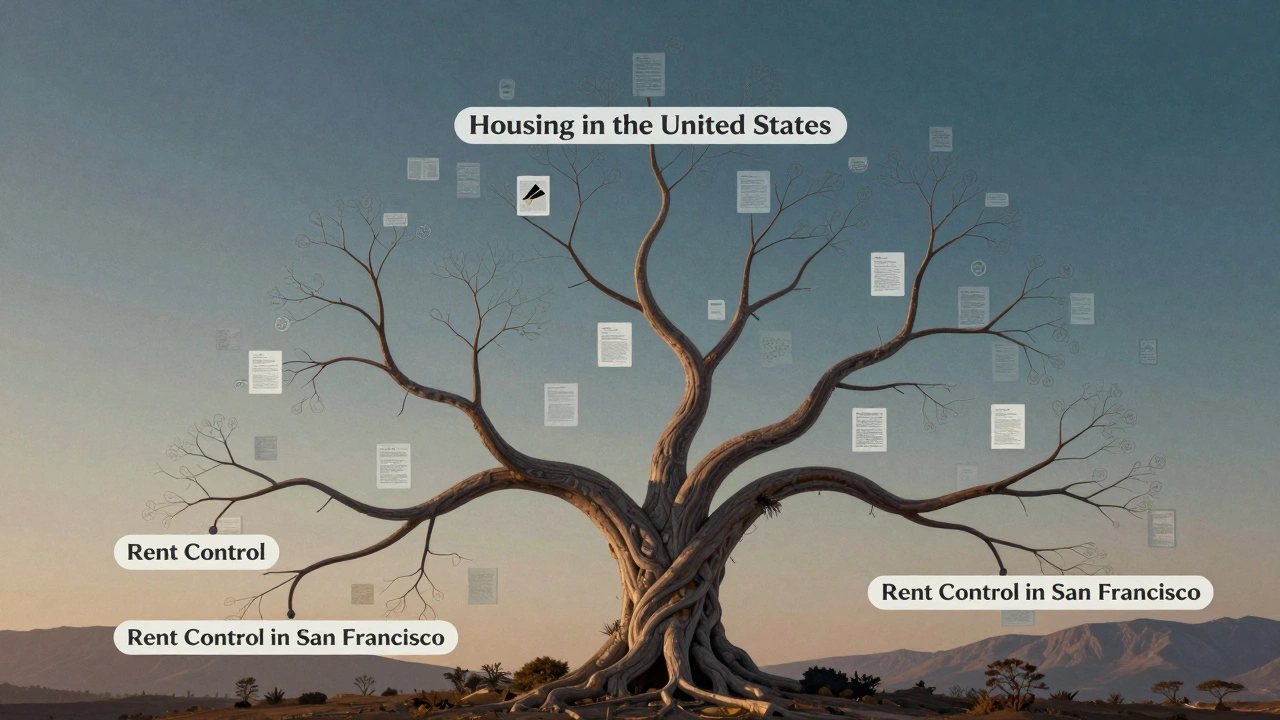
Let’s say you’re covering housing in your city. You start with the article "Housing crisis in the United States".
The main category is "Housing in the United States". Clicking that shows:
- Housing policy
- Public housing
- Homelessness in the United States
- Real estate in the United States
- Housing discrimination
- Rent control
- Eviction crisis
Clicking "Rent control" leads to subcategories like:
- Rent control in California
- Rent control in New York
- Rent control in Oregon
Clicking "Rent control in California" reveals:
- Rent control in Los Angeles
- Rent control in San Francisco
- Rent control in Berkeley
Now you have a clear hierarchy. You can assign reporters: one covers state-level policy, another tracks city-by-city changes, a third follows legal challenges to rent control laws. You can also see that "Rent control in San Diego" has no dedicated subcategory-and only two articles. That’s a red flag. Is it being ignored? Or is it just not a big issue there? Either way, it’s worth a call to the city clerk.
What to watch out for
Wikipedia isn’t perfect. Category trees can be messy. Some are outdated. Others are biased. Some editors add too many categories. Others remove them too aggressively.
Here’s how to avoid traps:
- Check the edit history. Click "View history" on a category page. If it was created or modified recently, it’s likely fresh. If it hasn’t changed in five years, it might be stale.
- Compare with other sources. Use the category tree as a starting point, not a final answer. Cross-check with government data, academic research, or local advocacy groups.
- Don’t trust empty categories. If a category has zero articles, it might be a dead end. But if it has one article and it’s from 2012, that’s a red flag. Something’s missing.
- Watch for overgeneralization. "Politics" is a category. "Politics in the United States" is better. "Local politics in Wisconsin" is even better. Go as specific as you can.
How this changes your editorial planning
Most newsrooms plan beats by geography or department: "City Hall," "School Board," "Police." That’s fine. But it’s narrow. Category trees force you to think in systems.
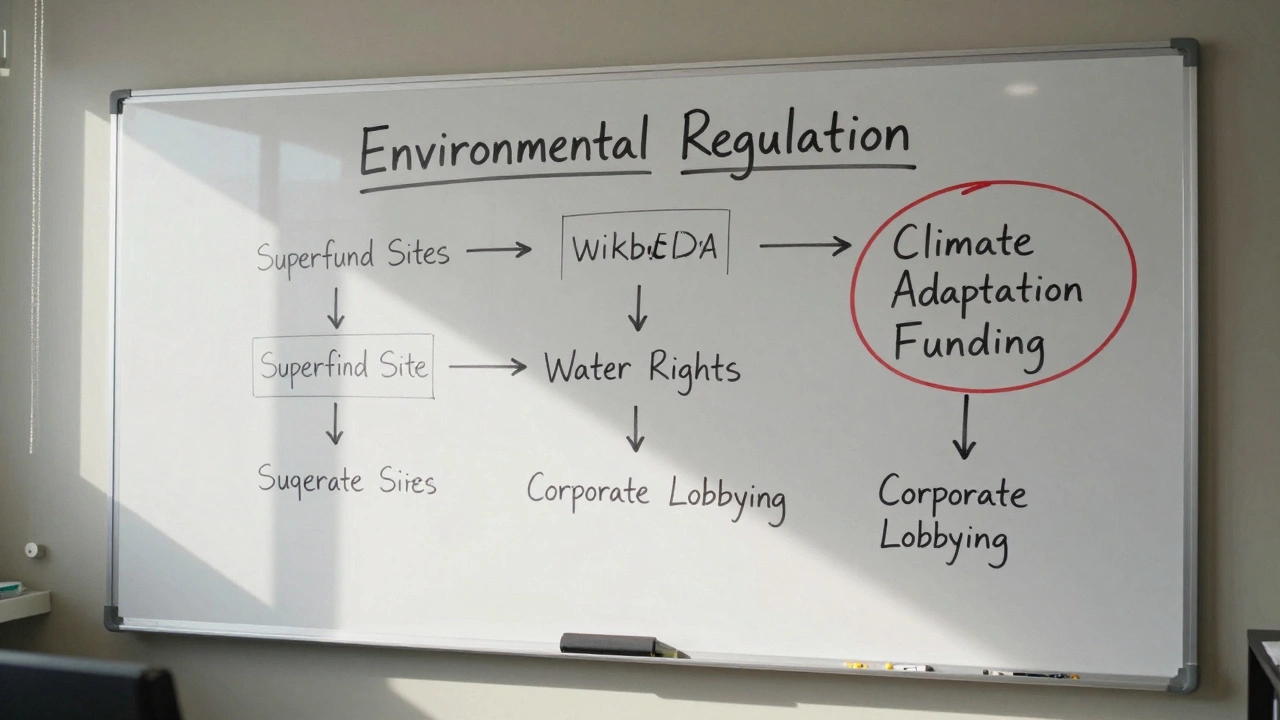
For example, if you map the category tree for "Environmental regulation," you don’t just get "EPA" or "air quality." You get:
- Environmental justice
- Industrial pollution in low-income neighborhoods
- Superfund sites by state
- Water rights disputes
- Climate adaptation funding
- Corporate lobbying in environmental agencies
These aren’t just stories. They’re interconnected. Covering one opens doors to others. That’s how you build deep, lasting journalism-not just reactive reporting.
Use the category tree to build a beat map on a whiteboard. Print it. Put it on your desk. Share it with your team. When someone says, "We should do a story on X," check the map. Is it already covered? Is it a branch you’ve ignored? Is it a new node that’s growing?
Tools to help you navigate Wikipedia categories faster
Manually clicking through categories works-but it’s slow. Here are a few tricks to speed it up:
- Use the "Category tree" gadget. Go to Wikipedia’s preferences, enable "Category tree" under the "Gadgets" tab. Now, on any category page, you’ll see a collapsible tree view on the right side. It shows the full hierarchy in one click.
- Search category names directly. Type "Category: [topic]" into Wikipedia’s search bar. For example: "Category: School board elections". You’ll jump straight to the category page.
- Bookmark your key categories. Save the most useful category pages in your browser. If you cover education, bookmark "Category: Education in the United States" and all its major subcategories.
- Use Wikipedia’s API for bulk exports. If you’re tech-savvy, you can use the Wikipedia API to pull all subcategories under a parent. No coding needed-tools like WikiCategoryTree let you paste a category and export a list.
Even without tools, just spending 20 minutes once a month exploring a category tree gives you more insight than a week of scrolling through Twitter.
What this means for the future of journalism
Newsrooms are shrinking. Reporters are doing more with less. You can’t cover everything. But you can cover what matters-deeply, systematically, and without wasting time.
Wikipedia category trees are a free, public, constantly updated database of how the world organizes knowledge. Journalists used to rely on phone books, press releases, and tip lines. Now, the structure of human understanding is right there-organized, searchable, and free.
If you’re not using it, you’re working harder than you need to. And you’re missing stories your competitors are already seeing.
Start with one beat. Map it. See what’s there. See what’s missing. Then tell your editor why you need to cover it.
Can Wikipedia category trees be trusted for journalism research?
Wikipedia isn’t a primary source, but its category trees are reliable for mapping structure, not facts. The hierarchy reflects how editors have organized topics over time, not opinions. Use the trees to find angles and gaps, then verify with official data, interviews, or documents. Never cite a category as evidence-use it as a compass.
How often do Wikipedia category trees change?
They change constantly. Major events-like a new law, scandal, or movement-often trigger new categories within days. For example, after the 2023 AI Act passed in the EU, "Artificial intelligence regulation in the European Union" became a subcategory under "Technology policy." Check your key categories every 6-8 weeks to stay current.
What if my topic doesn’t have a Wikipedia category?
If your beat is too new or too local, it might not have a category yet. That’s actually a good sign. It means you’re ahead of the curve. Start by creating a category page yourself. Go to "Category: [your topic]" and click "Create category." Add a brief description and link to relevant articles. Other editors will refine it. You’re not just reporting the story-you’re helping shape how it’s understood.
Can I use this method for international beats?
Yes. Wikipedia’s category system works globally. For example, "Healthcare in Brazil" has subcategories like "Public health policy," "Private hospitals," and "Sistema Único de Saúde." The same method applies. Just make sure you’re using the language version of Wikipedia relevant to your beat-e.g., es.wikipedia.org for Spanish-speaking regions.
Do I need to know how to code to use this?
No. Everything described here works with a web browser. You don’t need Python, APIs, or tools. The category tree gadget, direct searches, and manual browsing are enough for 95% of journalists. If you want to automate it later, that’s optional.