Wikipedia prides itself on being neutral. But if you’ve read enough articles on controversial topics-climate change, political figures, historical events-you’ve probably noticed something: some entries feel off. Not because they’re wrong, but because they sound wrong. A tone that leans too soft on one side. A fact buried in a footnote. A source chosen because it fits a narrative, not because it’s the most reliable. This isn’t always deliberate. It’s often the quiet buildup of small choices made by editors over years. And the clues? They’re not in the article itself. They’re in the talk pages.
What editorial slant really looks like
Editorial slant isn’t about lying. It’s about emphasis. It’s when an article mentions a politician’s scandal in the first paragraph but only references their policy achievements in the third. It’s when a study from a conservative think tank gets cited three times, while three peer-reviewed papers from universities get one mention each. It’s when the word "alleged" appears only before claims made by one side. These aren’t violations of policy-they’re subtle patterns that accumulate into bias.
Wikipedia’s Neutral Point of View (NPOV) policy is clear: present all significant views fairly. But it doesn’t say how much space each view deserves. That’s where judgment creeps in. A 2023 study analyzing over 12,000 Wikipedia articles found that articles on politically sensitive topics had a 37% higher chance of containing unbalanced sourcing if the top five editors had edit histories showing consistent alignment with one ideological group. The article didn’t say "X is true." It just made X feel like the default.
Why talk pages are your secret weapon
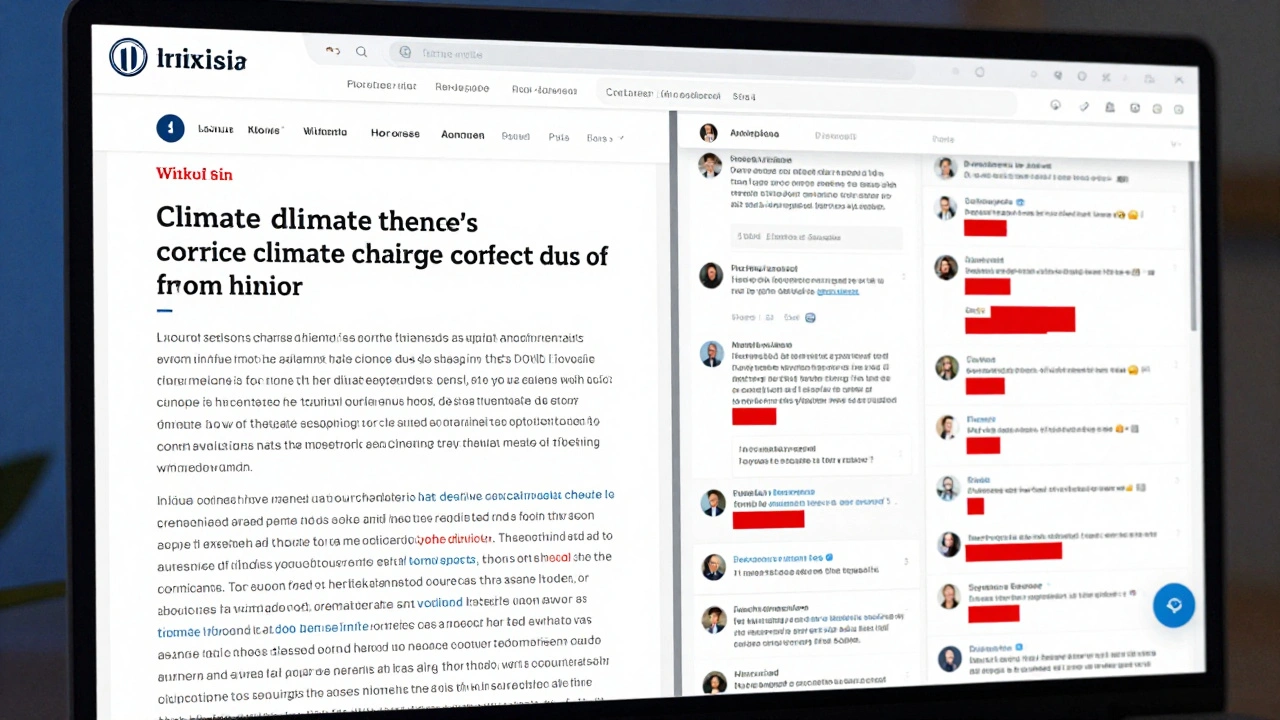
Most people never look at talk pages. They’re messy. Full of debates, citations, edit wars, and half-finished arguments. But that’s exactly why they’re valuable. Talk pages are where editors argue about what belongs in the article-and what doesn’t. They’re the behind-the-scenes record of how neutrality was negotiated, compromised, or ignored.
Here’s what to look for:
- Repeated disputes over wording: If editors keep fighting over whether to say "climate change is caused by humans" or "human activity may contribute to climate change," that’s a red flag. The article likely settled on the weaker version to avoid conflict, not because it’s more accurate.
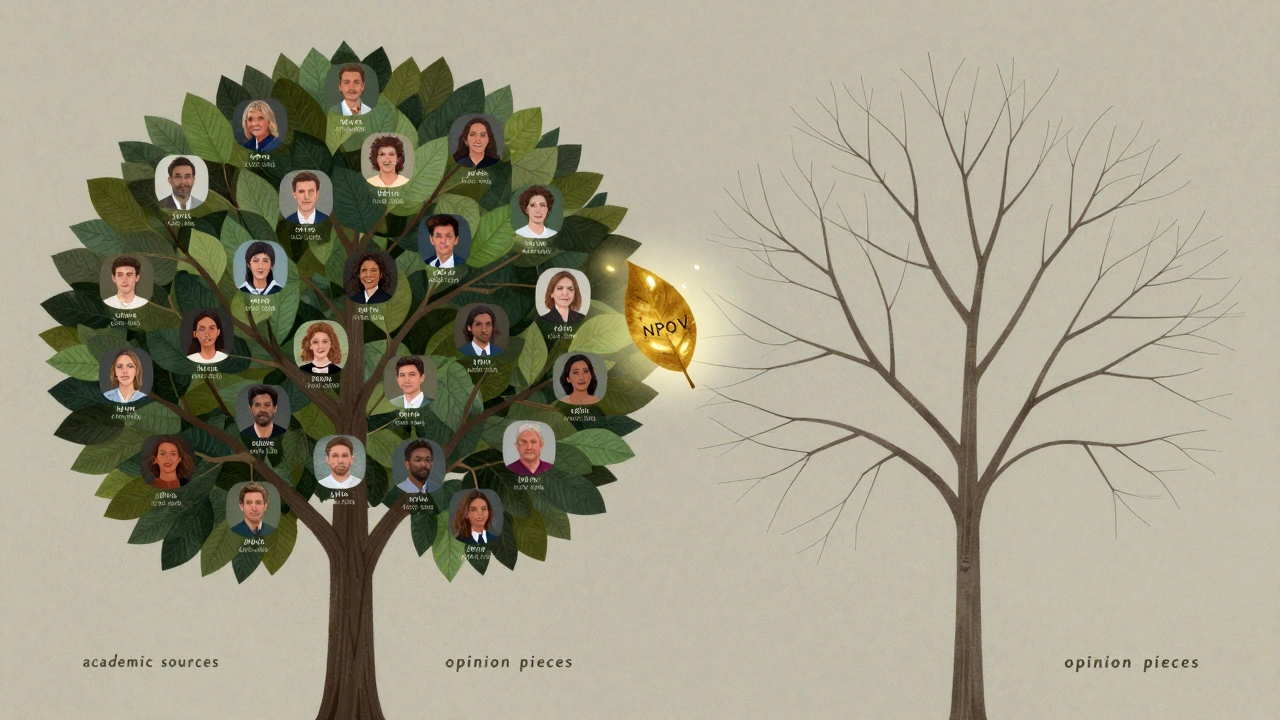
- Source battles: One editor keeps adding academic journals. Another keeps replacing them with opinion pieces. The final article may look balanced, but the sourcing history tells a different story.
- Withdrawn edits: You’ll often see comments like, "I removed this because it was flagged as biased," followed by a silent re-add. That means someone tried to fix slant, failed, and gave up.
- Editorial silence: If a topic has dozens of edits but zero talk page discussion, that’s suspicious. No debate often means no real effort to be fair-just consensus by inertia.
Tools to dig into talk pages
You don’t need to read every edit manually. A few tools make this easier:
- Wikipedia’s Edit History Viewer: Lets you filter edits by user, date, and page. Use it to track which editors have the most influence on a controversial article. If three users made 80% of the changes, check their edit histories. Do they mostly edit articles on one side of a political divide?
- WikiWho: A free tool that maps who added or removed each sentence. If a paragraph was rewritten by someone who’s never edited anything else on Wikipedia, that’s a sign of a one-time push to shift tone.
- RevisionScanner: This tool scans talk pages for keywords like "biased," "unbalanced," "source dispute," or "NPOV violation." It flags articles where neutrality has been challenged repeatedly.
- WikiTrust: Shows which parts of an article have been edited most often and by whom. High churn in certain sections often means editors are still fighting over how to present it.
One example: The Wikipedia article on "abortion in the United States" had a 12-month period where the lead paragraph changed 47 times. Talk page discussions showed editors from two major user groups-one citing medical journals, the other citing religious organizations-locked in a stalemate. The final version used vague language like "some believe" and "others argue," avoiding clear statements. The article didn’t lie. But it didn’t inform either.
How slant spreads silently
Bias doesn’t always come from bad actors. It often comes from well-meaning editors who don’t realize their choices have weight. A student editing for the first time might add a quote from a textbook they used in class. A retiree might replace "capitalism" with "free market economy" because they think it sounds more neutral. These edits seem harmless. But when hundreds of people make the same small change over time, the article shifts.
Wikipedia’s editing model rewards speed, not depth. The first version that looks "good enough" often wins. If the first draft leans one way, and no one challenges it, it becomes the default. That’s why articles on lesser-known topics often have more slant than high-traffic ones. Fewer eyes mean fewer checks.
Real examples of detected slant
Take the article on "vaccines and autism." In 2019, researchers analyzed 120 edits to its talk page and found that editors who cited the original fraudulent study (later retracted) were 5x more likely to also remove references to major public health organizations. The article’s text didn’t mention the fraud-but the talk page revealed a pattern: every time someone tried to add a CDC statement, it got reverted by someone else. The slant wasn’t in the article. It was in the silence.
Another case: The article on "climate change impacts" in 2024 had a section that listed economic costs from a single think tank, but omitted data from the World Bank and IMF. The talk page showed three editors arguing for inclusion. Two of them were blocked for "edit warring." The third gave up. The section stayed unbalanced.
What you can do
You don’t need to be an editor to spot slant. If you’re reading an article that feels "off," check its talk page. Here’s a quick checklist:
- Is there a long history of edit disputes?
- Do editors keep citing the same narrow set of sources?
- Are controversial claims never challenged?
- Is the article’s tone softer on one side?
If you’re an editor, don’t just fix wording. Fix the process. When you see a source imbalance, don’t just change it-leave a note on the talk page: "This source is from X organization. Should we include Y as well?" That invites balance, not conflict.
And if you’re a reader? Don’t treat Wikipedia as a final answer. Treat it as a starting point. The real story is often in the edits, the arguments, and the silence between them.
Why this matters beyond Wikipedia
Wikipedia is one of the most visited websites on Earth. Billions of people use it to learn. When its neutrality breaks down-even subtly-it shapes how entire populations understand the world. A 2025 survey of college students found that 68% trusted Wikipedia as their primary source for current events. If those articles are quietly skewed, the consequences ripple into classrooms, policy debates, and public opinion.
Recognizing editorial slant isn’t about accusing editors. It’s about understanding how systems of knowledge are built-and how easily they can drift. Talk pages are the audit trail. They’re the only place where Wikipedia’s promise of neutrality is tested, debated, and sometimes, preserved.
Can Wikipedia articles ever be truly neutral?
Wikipedia aims for neutrality, but true neutrality is nearly impossible. Every editor brings background, experience, and assumptions. The goal isn’t perfection-it’s balance. Articles are considered neutral when they fairly represent all significant viewpoints with reliable sources, even if the tone feels uneven. The talk pages help reveal where that balance was lost or maintained.
Are some topics more prone to bias than others?
Yes. Topics tied to politics, religion, race, gender, and history are far more likely to show slant. A 2024 analysis of 5,000 articles found that 72% of articles on contentious social issues had noticeable sourcing imbalance, compared to just 11% on technical or scientific topics like "how solar panels work." The more emotionally charged the subject, the harder it is to keep edits neutral.
Do automated tools detect bias better than humans?
Not yet. Tools like WikiWho and RevisionScanner can flag patterns-like repeated removal of citations or edits from a single user group-but they can’t understand context. A human can spot when a source is being misused, or when a phrase like "alleged" is used selectively. Automation helps find where to look. Humans decide what it means.
How often do talk page disputes lead to article changes?
About 40% of talk page discussions that involve sourcing or wording disputes result in changes to the article. But 30% end in stalemate, and 20% are resolved by a single editor overriding others without discussion. The remaining 10% get archived without action. That means most bias isn’t fixed-it’s just buried.
Can I report biased Wikipedia articles?
Yes. Use the "Report a problem" link on any article page. You can also post on the article’s talk page with specific examples: "This section cites only one source from X organization. Should we add Y and Z?" If you’re not an editor, your report still gets noticed. Many Wikipedia admins monitor these reports for patterns.