Imagine you are writing a report on the latest inflation rates or the efficacy of a new vaccine. You find a Wikipedia article that looks detailed and well-referenced. But do you trust it? The difference between a useful summary and a misleading claim often lies in the reliable data sources cited in the footnotes. For economic and health topics, where numbers can change rapidly and public perception is high, verifying these sources isn't just good practice-it's essential.
Wikipedia is not a primary source. It is a tertiary source that aggregates information from secondary sources. Your job as a reader or researcher is to look past the text and examine the references. If an article claims that "GDP growth slowed by 0.5% in Q2," you need to know if that figure comes from the U.S. Bureau of Economic Analysis (BEA) or a random blog post. Here is how to navigate the reference list to ensure you are building your understanding on solid ground.
Understanding the Hierarchy of Reliability
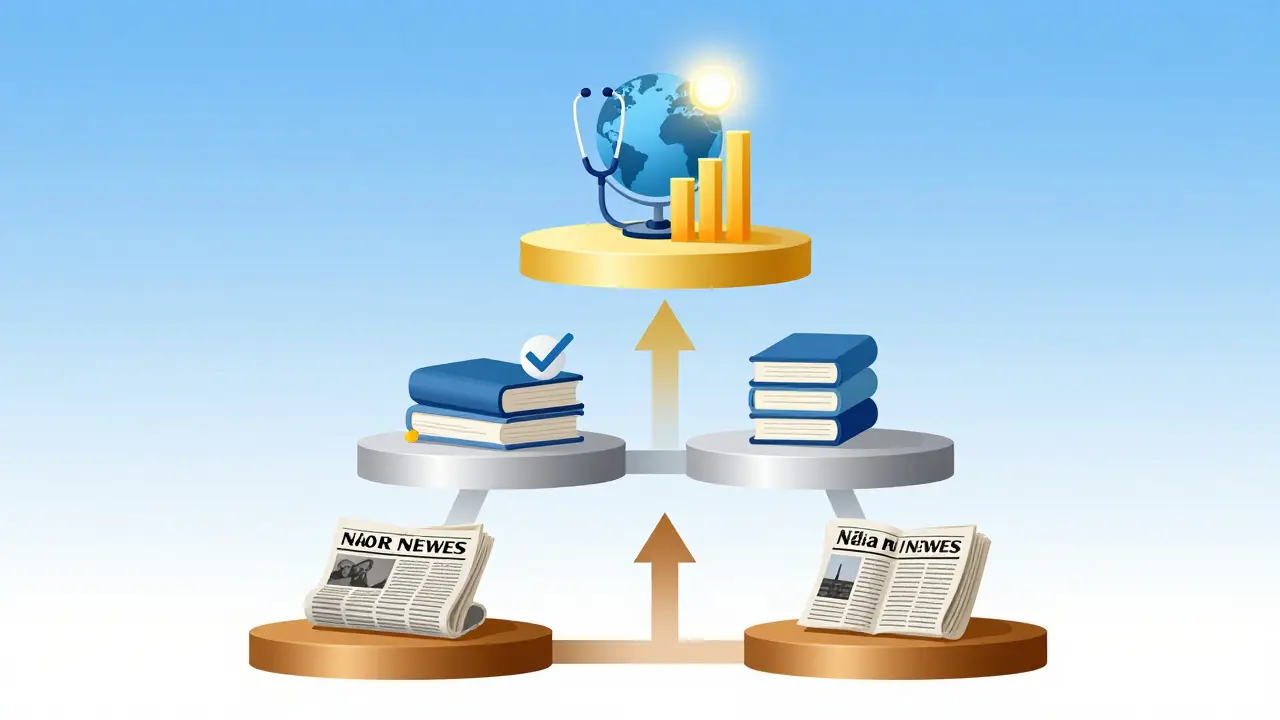
Not all citations are created equal. In academic and journalistic standards, sources are ranked based on their independence, peer review status, and track record for accuracy. When reading a Wikipedia page on economics or health, you will typically encounter three tiers of sources:
- Primary Data Agencies: These are government bodies like the World Health Organization (WHO), the Centers for Disease Control and Prevention (CDC), or national statistical bureaus. They collect raw data directly. This is the gold standard for factual claims about disease prevalence or economic output.
- Peer-Reviewed Journals: Publications like The Lancet, JAMA, or the American Economic Review. Articles here have undergone scrutiny by experts before publication. They are ideal for interpreting complex studies or establishing consensus views.
- Major News Outlets: Reputable organizations like The New York Times, Bloomberg, or Reuters. These are acceptable for recent events or breaking news but should be used cautiously for long-term trends unless they cite primary data themselves.
If a Wikipedia article relies heavily on tier-3 sources for historical trends, treat the information with caution. Always try to trace back to the original dataset if possible.
Economic News: Spotting the Numbers Game
Economic articles on Wikipedia often cover topics like GDP, unemployment rates, and inflation indices. The risk here is misinterpretation of timeframes or methodology changes. For example, the calculation of CPI (Consumer Price Index) has been updated over the decades. An older source might use a different basket of goods than a current one.
When verifying an economic claim, follow these steps:
- Check the Date of the Source: Ensure the citation matches the specific quarter or year mentioned in the text. A 2015 article citing 2020 data is a red flag.
- Verify the Agency: Does the link go directly to a .gov site or an international organization like the IMF? If the link goes through a news aggregator, click through to the original press release.
- Look for Methodology Notes: Reliable economic entries usually include a section on how the data is calculated. If this is missing, check if the cited source explains the methodology.
For instance, if an article states that "unemployment hit a historic low," verify if this refers to the headline rate or the broader U-6 measure, which includes part-time workers who want full-time jobs. The distinction matters significantly for accurate analysis.
Health News: Navigating Studies and Consensus
Health topics on Wikipedia are particularly sensitive because individual studies can be contradictory. One paper might say a supplement reduces heart risk, while another finds no effect. Wikipedia editors strive to present the scientific consensus rather than single-study anomalies.
To evaluate health-related content, focus on meta-analyses and systematic reviews rather than single trials. A meta-analysis combines data from multiple studies to provide a more robust conclusion. If a Wikipedia entry cites only one small-scale study for a major health claim, the reliability drops significantly.
Also, pay attention to conflicts of interest. While Wikipedia requires neutral point of view, the sources themselves may have biases. A study funded by a pharmaceutical company is not inherently wrong, but it warrants closer scrutiny compared to research funded by independent institutions like the National Institutes of Health (NIH).
Practical Tools for Verification
You don't need to be a librarian to check these sources. Here are practical ways to validate the information you find:
| Source Type | Best For | Common Pitfall | Verification Tip |
|---|---|---|---|
| Government Agencies (CDC, BEA) | Raw statistics, official definitions | Data lag (numbers released months later) | Check the 'last updated' date on the agency's page |
| Peer-Reviewed Journals | Causal relationships, medical consensus | Jargon-heavy language, paywalls | Read the abstract first; look for 'Conclusion' sections |
| Major News Outlets | Recent events, policy changes | Sensationalized headlines | Compare with at least two other reputable outlets |
Use browser extensions or search engines to identify the publisher behind a URL. If a link leads to a PDF hosted on a university server, it’s likely a credible academic paper. If it leads to a personal blog with no author credentials, proceed with skepticism.

Common Red Flags in Citations
Even experienced readers can miss subtle issues. Keep an eye out for these warning signs when scanning the reference list of a Wikipedia article:
- Dead Links: If half the references are broken, the article may be outdated or poorly maintained.
- Circular Referencing: When a source cites another Wikipedia article as its main evidence. This is a weak form of sourcing.
- Over-reliance on Press Releases: Corporate or political press releases are promotional materials, not neutral data sources.
- Lack of Context: A statistic without a clear timeframe or demographic scope (e.g., "mortality rate increased" without specifying age group or region).
If you spot these issues, consider checking the talk page of the Wikipedia article. Often, editors discuss disputes over sources there, giving you insight into why certain data points are contested.
Building Your Own Verification Habit
Developing a habit of source-checking takes time, but it pays off in confidence. Start by picking one claim per week from a topic you care about-maybe the latest housing market trend or a new flu shot recommendation. Trace the citation back to its origin. Ask yourself: Who collected this data? How was it measured? Is there a conflicting study?
This process transforms you from a passive consumer of information into an active analyst. You’ll start to see patterns in how information is packaged and presented. You’ll also become better at identifying when a source is stretching the truth to fit a narrative.
Remember, the goal isn’t to distrust Wikipedia, but to understand its mechanics. It is a collaborative tool that reflects the best available knowledge at any given moment. By mastering the art of verifying reliable data sources, you ensure that what you read-and what you share-is grounded in fact, not speculation.
Is Wikipedia a reliable source for academic papers?
Generally, no. Most universities and journals prefer you to cite the original peer-reviewed article or government report rather than the Wikipedia page itself. However, Wikipedia is excellent for finding those primary sources quickly. Use it as a starting point, then verify the details against the original documents.
How do I tell if a health study cited on Wikipedia is recent enough?
Check the publication date of the journal article. In fast-moving fields like infectious disease or digital health, studies older than five years may be outdated. For slower-evolving topics like basic anatomy or chronic disease management, older foundational studies remain relevant. Always look for newer meta-analyses that might supersede older findings.
What should I do if two sources on Wikipedia contradict each other?
This is common in evolving fields. Look at the weight of evidence. Does one side cite a large-scale meta-analysis while the other cites a single small study? Usually, the larger, more rigorous study carries more weight. Check the article's talk page to see if editors have discussed the discrepancy. If unresolved, present both views with context in your own work.
Are government data sources always unbiased?
They are generally considered the most objective because they are bound by statutory requirements to report data accurately. However, political pressure can sometimes influence how data is presented or highlighted. To mitigate this, compare data from multiple countries or international organizations like the OECD or WHO to see if trends align across different reporting bodies.
How much time does it take to properly verify a Wikipedia article?
It depends on the depth you need. A quick sanity check of key figures might take 10-15 minutes. A deep dive involving tracing multiple citations to primary sources could take an hour or more. For critical decisions, invest the extra time. For general curiosity, spot-checking the most controversial claims is usually sufficient.