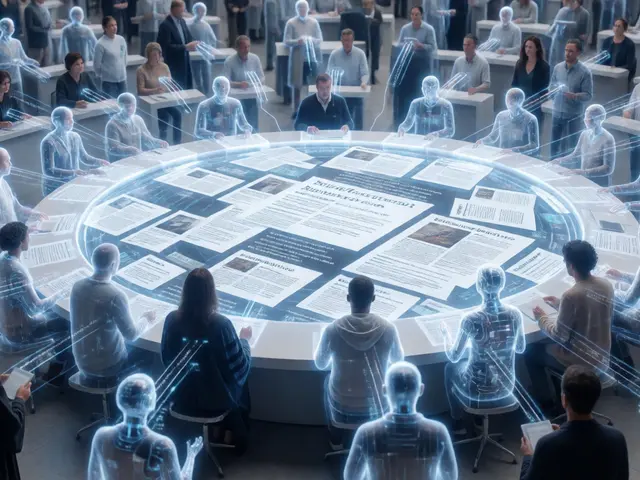
You might think Wikipedia is just a website you click on when you’re too lazy to look something up. But if you peel back the interface, you find a massive, unpaid workforce keeping the world’s largest encyclopedia running. This isn’t just about nerds correcting typos in their spare time. It’s a complex ecosystem of volunteer-driven content creation that mirrors traditional newsrooms but lacks the paychecks, unions, and safety nets.
The term Labor Journalism usually refers to reporting on workers’ rights and workplace conditions. When applied to Wikipedia, it exposes a stark reality: the people writing the news history are often burning out without ever seeing a dime. If you’ve ever wondered why certain articles are stale or why editors quit, you need to understand the mechanics of this digital sweatshop.
The Myth of the Free Lunch (and Free Labor)
Most users interact with Wikipedia as consumers. We read, we cite, we leave. We rarely ask who did the work. For years, the narrative was simple: volunteers contribute because they love knowledge. That’s true, but it’s incomplete. Love doesn’t pay for server costs, and passion doesn’t prevent emotional exhaustion.
Consider the sheer volume of labor. As of 2024, English Wikipedia had over 6 million articles. Every single one required research, writing, editing, and citation checking. Who did that? Mostly unpaid individuals. Some are students looking for extra credit. Others are retirees filling their days. But a significant chunk are professional researchers or journalists who contribute on nights and weekends, effectively subsidizing a global information utility with their own leisure time.
This dynamic creates an imbalance. The value generated by these contributors is immense-estimated in the billions of dollars annually if valued at market rates for editorial work. Yet, the recognition often feels hollow compared to the effort invested. You spend ten hours fact-checking a controversial political biography, only to have someone change a comma and claim credit for "maintenance." That friction is where the labor crisis begins.
Burnout Is Not Just a Buzzword
If you hang around editor talk pages long enough, you’ll hear the same complaints repeated like broken records. People are tired. They’re tired of fighting vandals. They’re tired of bureaucratic disputes over minor formatting issues. They’re tired of being treated like robots by automated bots that revert good-faith edits based on rigid algorithms.
Burnout in this context isn’t clinical depression, though it shares symptoms. It’s a state of chronic physical and emotional exhaustion caused by prolonged stress, specifically related to community conflict and workload management. Unlike a traditional journalist who has an editor to shield them from the worst of public backlash, a Wikipedia editor faces the internet head-on.
Take the case of high-profile articles. When a celebrity dies or a major election happens, traffic spikes. Editors rush to update pages. In those moments, the community can turn toxic. Accusations of bias fly fast. Personal attacks follow close behind. A volunteer working for free has no obligation to endure abuse, yet many do, driven by a sense of duty to accuracy. Eventually, the cost outweighs the reward. They log off, delete their watchlists, and never return.
Data supports this anecdotal evidence. Studies on online communities show that contributor retention drops sharply after six months. Why? Because the initial excitement fades, leaving only the grind. Without institutional support-like mental health resources or mediation teams-the attrition rate climbs. The platform relies on new blood to replace those who leave, creating a perpetual cycle of training and loss.
Governance: Who Rules the Roost?
So, who manages all this unpaid labor? Enter the Wikimedia Foundation. This nonprofit organization owns the domain name and runs the servers, but it doesn’t write the content. Its role is closer to landlord than employer. It provides the infrastructure, funds the software development, and handles legal issues.
The governance structure, however, remains a point of contention. Wikipedia operates on a model of consensus. Decisions are made through discussion, not decree. Sounds democratic, right? In practice, it can be messy. Power tends to concentrate among long-time administrators and bureaucrats-users with special tools who can delete pages, block users, and protect articles.
Critics argue this creates a class system. Newcomers face steep learning curves and strict enforcement of policies they barely understand. Veterans, conversely, enjoy autonomy and respect. This hierarchy affects labor distribution. Administrators spend less time writing and more time moderating. Their labor shifts from content creation to community policing. Meanwhile, regular editors bear the brunt of the creative work while navigating a labyrinth of rules designed to prevent chaos.
The tension between centralization and decentralization is palpable. The Foundation pushes for modernization-better mobile apps, visual editors, structured data. Volunteers often resist changes that threaten their established workflows. These clashes aren’t just technical; they’re ideological. They reflect differing views on what labor should look like in a digital age. Should efficiency trump tradition? Should accessibility dilute rigor?
The Digital Newsroom Analogy
To understand the stakes, compare Wikipedia to a traditional newsroom. Both rely on deadlines, sources, and verification. Both deal with bias and accountability. But the differences highlight the precarious nature of Wikipedia’s labor model.
| Feature | Traditional Newsroom | Wikipedia Community |
|---|---|---|
| Compensation | Salary, benefits, insurance | Unpaid, intrinsic motivation |
| Hierarchy | Editor-in-chief, section editors | Flat-ish, admin/bureaucrat tiers |
| Accountability | Employer, ombudsman, corrections policy | Community consensus, noticeboards |
| Training | Formal education, mentorship | Self-taught, wiki-love gestures |
| Exit Cost | Loss of income, career setback | Low barrier, easy abandonment |
Notice the exit cost. In a newsroom, quitting means losing your paycheck and your professional network. On Wikipedia, you can vanish overnight. No HR department notices your absence. No colleague covers your beat. This low barrier to exit makes the workforce highly volatile. Stability is rare. Continuity is fragile.
Furthermore, traditional journalists have unions. They negotiate contracts. They strike. What does a Wikipedia editor have? A user page and maybe a barnstar-a digital badge awarded for helpfulness. Cute, sure. But it doesn’t cover rent. The lack of collective bargaining power leaves individual volunteers vulnerable to exploitation by both the platform’s demands and hostile actors within the community.
Why Does This Matter for Journalism?
Journalists use Wikipedia constantly. It’s often the first stop for background checks on politicians, companies, or events. But if the source itself is built on unstable, unpaid labor, how reliable is it really? And what happens when the volunteers stop showing up?
We’re already seeing signs of strain. Niche topics suffer most. While pop culture articles get constant updates due to fan interest, obscure scientific fields or local history entries stagnate. Who will edit the article on 18th-century textile mills if no undergraduates are forced to do so for class assignments? The pipeline of new editors is drying up in some areas.
Moreover, the quality of journalism depends on the quality of its sources. If Wikipedia becomes outdated or biased due to editor fatigue, downstream effects ripple through media coverage. Reporters citing Wikipedia without verifying primary sources propagate errors. The circularity of information flow worsens when the base layer erodes.
There’s also an ethical dimension. Should tech giants profit from ad revenue while relying on free labor? The Wikimedia Foundation claims non-profit status, which mitigates this critique somewhat. But other platforms mimic the model-crowdsourced reviews, open-source code, citizen science projects. All face similar sustainability challenges. Understanding Wikipedia’s struggles offers a blueprint for managing digital commons elsewhere.
Pathways Forward: Sustainability and Support
What needs to change? First, acknowledge the labor. Stop calling it "volunteering" if it requires professional-level skills. Recognize the expertise involved. Provide better tools to reduce friction. Automate repetitive tasks so humans can focus on judgment calls, not formatting wars.
Second, improve governance transparency. Make decision-making processes clearer to newcomers. Reduce the intimidation factor. Create mentorship programs that actually stick. Pair new editors with veterans who guide rather than gatekeep.
Third, explore hybrid models. Could grants fund part-time coordinators for specific topic areas? Imagine a paid "community manager" for medical articles, ensuring consistency and recruiting experts. This wouldn’t turn Wikipedia into a corporation, but it would stabilize critical sections.
Finally, foster a culture of empathy. Remind users that behind every edit is a human being. Encourage kindness. Discourage toxicity. Small gestures go a long way in sustaining morale. After all, you can’t force someone to care. You can only make it easier for them to keep caring.
Is Wikipedia really run entirely by volunteers?
Yes, the vast majority of content creation and editing is done by unpaid volunteers. However, the Wikimedia Foundation employs staff for software engineering, legal support, fundraising, and community outreach. These employees maintain the platform but generally do not write encyclopedic content themselves.
Why do so many Wikipedia editors quit?
Common reasons include burnout from community conflicts, frustration with bureaucratic rules, lack of recognition, and the time commitment required to stay active. High-stress environments, such as contentious political articles, accelerate turnover.
Does Wikipedia pay its top contributors?
No, standard contributors are not paid. Some institutions, like universities or libraries, may compensate staff members who contribute as part of their job duties. Grants sometimes fund specific projects, but individual editors typically receive no direct monetary compensation for their edits.
How does governance affect content quality?
Governance structures determine how disputes are resolved and how policies are enforced. Strict adherence to neutral point of view (NPOV) and verifiability helps maintain quality, but rigid enforcement can discourage participation. Effective governance balances order with flexibility, encouraging diverse contributions.
Can AI replace Wikipedia volunteers?
AI can assist with drafting and translation, but it currently struggles with nuanced judgment, sourcing complex arguments, and resolving editorial disputes. Human oversight remains crucial for verifying facts and maintaining neutrality, especially in controversial topics.