
Ever tried refreshing a Wikipedia page during an election night and wondered why the numbers didn't update instantly? You aren't alone. Unlike news sites that chase the breaking story, Wikipedia is a free online encyclopedia that relies on volunteer editors to maintain neutral, sourced articles. Its approach to covering political elections is distinct, balancing speed with accuracy in a way that often confuses readers expecting real-time news feeds. The core promise of Wikipedia is neutrality, not immediacy. When you look at an article for a major election, you are seeing a snapshot of what the community has agreed upon as factual, backed by reliable sources. This means the data might lag behind a TV broadcast by hours or even days, but it is rarely wrong. Understanding this distinction is key to using the platform effectively for research rather than just following the drama.
The Reality of "Live" Updates
Many users assume Wikipedia functions like a ticker tape. In reality, Election Night Coverage is the process where volunteers manually update infoboxes and result tables based on verified media reports. There is no automated algorithm pulling data from state boards of election directly into the public view. Instead, human editors monitor major news outlets like the Associated Press or Reuters. Once a candidate is called by these wire services, an editor updates the page. This manual process creates a natural delay. If a state finishes counting at 2 AM, the Wikipedia page might not reflect those final figures until a volunteer wakes up, verifies the source, and edits the text. For close races, this can lead to periods of uncertainty where the page displays provisional numbers. Readers should treat Wikipedia's election pages as a historical record in formation, not a live scoreboard. The value lies in the stability of the information once it is posted, not in its speed of arrival.Understanding the Sourcing Policy
The backbone of any Wikipedia article is its citation list. For elections, the sourcing policy is strict. Editors must use Reliable Sources are publications or institutions with a reputation for fact-checking and editorial oversight. This typically includes major newspapers, academic journals, and official government documents. Blogs, social media posts, and partisan websites are generally considered unreliable unless they are quoting an official statement directly. Why does this matter? Because it prevents misinformation from spreading through the most visited encyclopedia in the world. If a rumor starts circulating on social media about a recount, it won't appear on Wikipedia until a major newspaper confirms it. This filter ensures that when you read a fact on Wikipedia, it has passed through multiple layers of verification. However, it also means that niche local elections might have sparse coverage if national outlets don't report on them extensively.How Election Maps Are Created
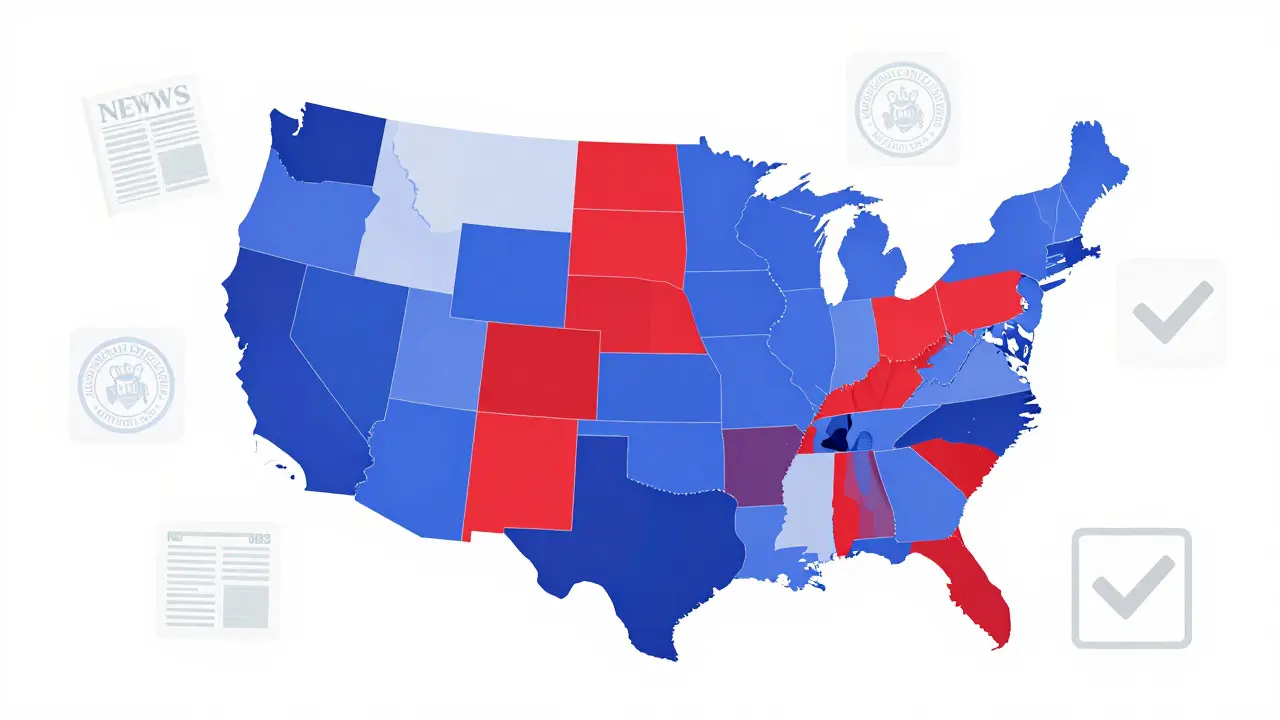
Visuals play a huge role in understanding election outcomes. The maps you see on Wikipedia are not generated automatically. They are custom-created by volunteers using geographic data. These maps usually show the winner by county or district, color-coded to represent different parties. The creation of these maps involves several steps:- Data Collection: Editors gather vote counts from official state or county websites.
- Geographic Matching: The data is matched to specific geographic boundaries (like counties).
- Rendering: Specialized tools or templates generate the SVG images.
- Review: Other editors check the map for errors before publishing.
Neutrality vs. Speed: The Editorial Trade-off
Critics often argue that Wikipedia is too slow to cover fast-moving events. Supporters counter that speed without accuracy is useless. This tension defines how the platform handles elections. The goal is to present a Neutral Point of View, which is an editorial guideline requiring articles to represent all significant points of view fairly. In an election context, this means avoiding language that favors one candidate over another. Words like "landslide" or "upset" are used cautiously, only when supported by multiple independent sources. This standard protects the integrity of the record. Imagine if every opinion piece from the day was added to the page. The article would become a chaotic mix of bias and fact. By sticking to a neutral tone, Wikipedia provides a clean baseline for researchers, students, and journalists who need to know the facts without the noise of immediate reaction. It’s a slower process, but it yields a more durable product.Common Misconceptions About Election Data
There are a few myths that persist about how Wikipedia handles votes. First, many think the site gets data directly from voting machines. That’s not true; it comes from press releases and news reports. Second, some believe that a single editor controls the content. In reality, changes are visible to everyone, and controversial edits are often reverted quickly by the community. Third, people assume that "draft" status means the article is unfinished garbage. Often, draft articles contain preliminary data that will be moved to the main page once stable. To get the best experience, keep these tips in mind:- Check the "References" section to see where the numbers come from.
- Look at the "History" tab to see when and who made recent changes.
- Don’t panic if a number changes; it likely reflects a correction based on new data.
- Use the "Talk" page to see discussions among editors about disputed facts.

Comparing Wikipedia to Traditional News Outlets
How does Wikipedia stack up against a typical news website? The differences are stark. News sites prioritize speed and narrative. They want to tell you who won first. Wikipedia prioritizes accuracy and comprehensiveness. It wants to give you the full picture, including turnout percentages, demographic breakdowns, and historical comparisons.| Feature | Wikipedia | Traditional News Site |
|---|---|---|
| Update Speed | Hours to days after official calls | Minutes after polls close |
| Sourcing Standard | Strictly reliable, third-party sources | Varies; may include exclusive scoops | Tone | Neutral, factual, encyclopedic | Narrative-driven, analytical | Data Depth | Detailed historical and demographic data | Focused on current event impact | Transparency | Full edit history and talk pages | Editorial decisions often opaque |
Best Practices for Using Wikipedia During Elections
If you rely on Wikipedia for election info, adopt a few habits to make sure you’re getting the most out of it. First, always click on the citations. It takes ten seconds to verify that the number matches the source. Second, watch for "Edit wars." If a number keeps changing back and forth, check the Talk page to see what’s going on. Usually, there’s a simple explanation, like conflicting reports from two states. Also, remember that Wikipedia covers global elections. If you’re interested in local municipal races, check if a dedicated article exists. If not, you might find the data in a broader regional article. The structure is hierarchical, so knowing how to navigate from a national overview to a local detail is a useful skill. Finally, consider contributing. If you see an error, fix it. Just cite a reliable source, and you’ll be helping improve the public record for millions of others.Frequently Asked Questions
Is Wikipedia accurate for election results?
Yes, generally very accurate. While it may lag behind real-time news, the data is sourced from reliable media outlets and official records. Errors are corrected quickly by the volunteer community, making it a trustworthy long-term reference.
Why do Wikipedia election pages update slowly?
Updates are manual. Volunteers must wait for official calls from major news agencies, verify the information, and then edit the page. This process prioritizes accuracy over speed, ensuring that only confirmed facts are published.
Who decides which sources are allowed?
The community of editors decides based on established guidelines. Reliable sources are those with professional editorial control and a track record of accuracy. Disputes about sources are resolved on the article's Talk page through discussion and consensus.
Can I trust the maps on Wikipedia?
Yes, but check the date. Maps are created by volunteers using verified data. If a map looks wrong, it may be outdated or under revision. Always cross-reference the map with the table of numbers provided in the same article to ensure consistency.
What happens if editors disagree on a result?
They discuss it on the Talk page. If they can't agree, they usually revert to the last version that had clear sourcing. In extreme cases, a neutral administrator might step in to lock the page temporarily until the dispute is resolved with better evidence.