
Wikipedia doesn’t ban blogs or self-published content outright-but it also doesn’t treat them like peer-reviewed journals. If you’ve ever tried to cite your own blog post or a Medium article in a Wikipedia edit, you’ve probably seen it get rejected. That’s not because Wikipedia hates personal voices. It’s because Wikipedia’s job is to summarize what experts and institutions agree on, not to give everyone an equal platform.
What Counts as a Self-Published Source?
A self-published source is anything created and distributed by the person or organization that wrote it, without independent editorial review. That includes:
- Personal blogs (WordPress, Blogger, Substack)
- Self-published books on Amazon Kindle Direct Publishing
- YouTube videos where the creator controls everything
- LinkedIn articles or Twitter threads with no third-party fact-checking
- Company websites that only promote their own products or claims
These aren’t inherently bad. Many experts use blogs to share insights. But Wikipedia needs to know: Is this source trusted by others? Not just because the author says so.
Why Wikipedia Rejects Most Self-Published Content
Wikipedia’s core rule is verifiability. Every claim must be backed by a reliable source that readers can check. The second rule is no original research. You can’t use a blog to introduce a new theory, even if it’s brilliant.
Imagine someone writes a blog claiming they discovered a new species of frog in their backyard. They post photos, detailed notes, and a 3,000-word essay. It’s thorough. It’s passionate. But unless a biology journal, a university press, or a reputable science news outlet like National Geographic or Scientific American has covered it, Wikipedia can’t use it. Why? Because the blog is the source of the claim-and Wikipedia can’t verify the claim using the claim itself.
This isn’t about silencing voices. It’s about avoiding circular logic. Wikipedia doesn’t want to become a directory of personal opinions dressed up as facts.
When Self-Published Sources Are Allowed
There are exceptions. Wikipedia does allow self-published material-but only under strict conditions.
First, if the author is an established expert in their field. A professor who writes a blog about climate science might be cited-but only if their expertise is already recognized by independent institutions. For example, if Dr. Elena Ruiz, a tenured climatologist at Stanford, writes a blog post summarizing recent IPCC findings, her blog might be used to illustrate her interpretation of the data. But you still need to cite the IPCC report itself as the primary source. Her blog just adds context.
Second, if the source is the only available record of an event. Let’s say a local artist holds a protest art installation in a small town. No newspaper covered it. No TV station filmed it. But the artist published detailed photos, videos, and a written statement on their personal website. In that case, Wikipedia might cite the artist’s site as a primary source-but only to document the event itself, not to make broader claims about its cultural impact. You’re not using the blog to prove significance. You’re using it to prove existence.
Third, for autobiographical details about living people. If someone writes on their own website that they graduated from Harvard in 2018, Wikipedia can use that as a source-but only if it’s the only available proof and it’s not controversial. Even then, editors prefer third-party confirmation like a university alumni page or a news profile.
Blogs: The Gray Area
Blogs are the most common source of confusion. Not all blogs are equal. A blog run by a single person sharing their weekend cooking experiments? Not reliable. A blog hosted by a major news outlet like The New York Times or BBC? That’s fine-it’s part of a professional editorial structure.
What makes a blog reliable? Three things:
- Editorial oversight - Does someone fact-check, edit, or remove posts? Independent blogs rarely do.
- Reputation - Has the blog been cited by other reliable sources? If major outlets reference it, that’s a signal.
- Author credentials - Is the writer known in their field? A medical blog by a licensed doctor with hospital affiliations carries more weight than one by a random person with a passion for health.
For example, the blog Science-Based Medicine is written by medical professionals and regularly cited by Wikipedia because it’s peer-reviewed in practice-even though it’s self-published. The community trusts it because its authors are experts, and their content is consistently referenced by journals and universities.
How Wikipedia Editors Spot Problematic Sources
Wikipedia editors don’t guess. They follow a checklist:
- Is the source independent of the subject? (A company’s own website can’t be used to prove its product is the best.)
- Has it been cited by other reliable sources? (Google Scholar, news archives, academic databases.)
- Is the author qualified? (Do they have formal credentials or a track record?)
- Is the content neutral? (Does it sound like an advertisement or a rant?)
- Is the publication stable? (Is the blog still active? Has it been around for years?)
Editors also look at the URL. A blog on example.com raises eyebrows. A blog on nytimes.com/blogs doesn’t. The domain matters.
What Happens When You Try to Add a Blog as a Source?
If you add a blog link to a Wikipedia article, here’s what usually happens:
- Another editor notices it and adds a
{{fact}}tag, asking for a better source. - Someone might replace it with a citation from a newspaper, academic paper, or book.
- If you argue back, you’ll be asked to provide evidence that the blog meets Wikipedia’s reliability standards.
- If you can’t, your edit will be reverted.
It’s not personal. It’s policy. And it’s consistent. Wikipedia has rejected self-published sources on topics ranging from quantum physics to celebrity gossip.

What Should You Use Instead?
If you’re trying to support a claim on Wikipedia, here’s what works:
- Books published by university presses (Oxford, MIT Press)
- Peer-reviewed journals (Nature, JAMA, IEEE)
- Major newspapers (The Guardian, Le Monde, The Washington Post)
- Reputable magazines (The Atlantic, Wired, Scientific American)
- Official reports from governments, universities, or NGOs (WHO, CDC, UNESCO)
If you wrote a blog post and want it to be used on Wikipedia, your best move isn’t to cite it directly. It’s to get a reputable outlet to cover your work. Once The New York Times or NPR mentions your research or project, then Wikipedia editors will happily link to their article-and your work gets the exposure you want, without breaking policy.
Why This Policy Matters
Wikipedia is one of the most visited websites in the world. Millions of students, journalists, and professionals rely on it for quick, accurate information. If it started accepting every blog, tweet, or YouTube video as proof, it would become a mess of conflicting claims.
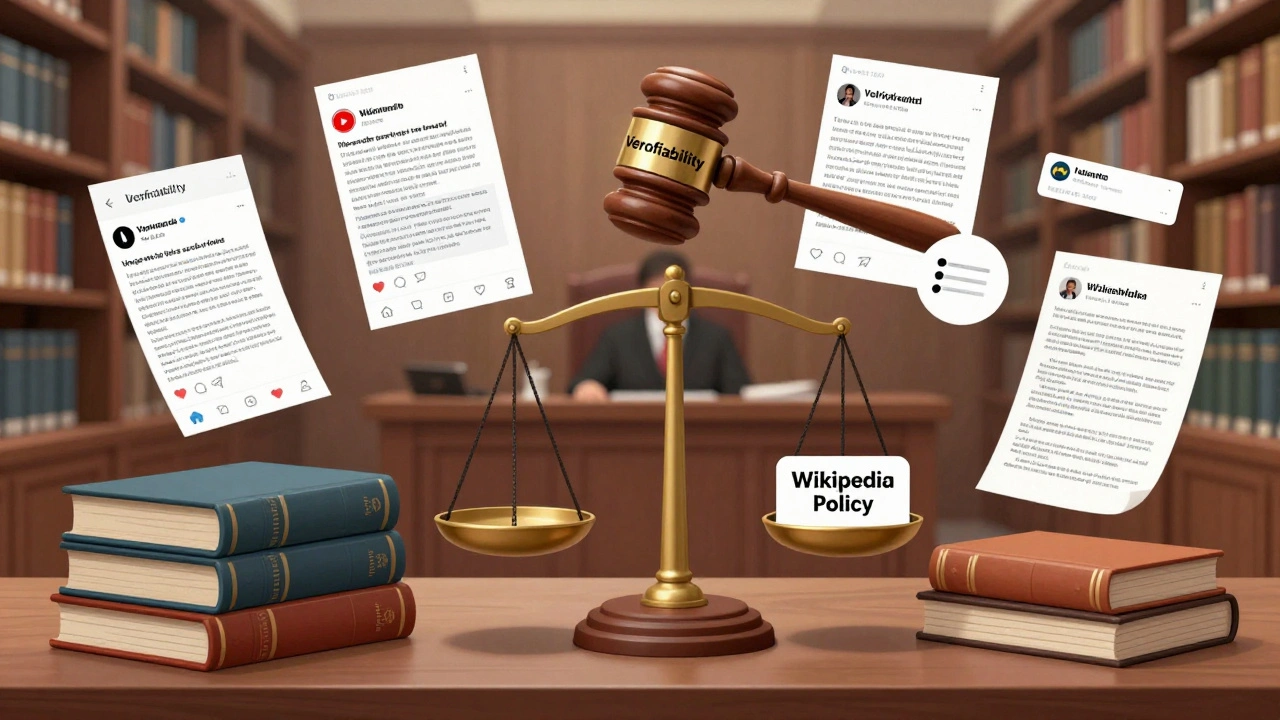
Think of it like a courtroom. Anyone can say something. But only testimony backed by credible witnesses, documents, and cross-examination gets accepted as evidence. Wikipedia isn’t a free-for-all. It’s a library that values rigor over popularity.
That’s why, even in 2025, with AI-generated content and viral TikTok trends flooding the internet, Wikipedia still holds the line. It doesn’t ignore new voices-it just demands they prove themselves through the same standards as everyone else.
Final Thought: It’s Not About Silencing-It’s About Trust
Wikipedia doesn’t hate bloggers. It doesn’t hate self-published authors. It just knows that trust isn’t earned by self-declaration. It’s earned by recognition from others.
If your work is important enough to be on Wikipedia, it will be covered by someone else first. And when that happens, you’ll get the citation you want-without having to push your own link.
Can I cite my own blog on Wikipedia?
Generally, no. Wikipedia considers your own blog a self-published source, which is not considered reliable unless you’re a recognized expert and the blog is cited by independent, reputable outlets. Even then, you should cite the original source your blog references, not your blog itself.
Are all blogs banned on Wikipedia?
No. Blogs hosted by reputable organizations like The New York Times, BBC, or Wired are acceptable because they have editorial oversight. Even independent blogs can be used if they’re written by recognized experts and widely cited by other reliable sources. The key is independence and reputation, not the platform.
Why does Wikipedia care where a source comes from?
Because Wikipedia’s goal is to summarize verified knowledge, not publish opinions. A source’s reliability is judged by whether it has editorial standards, fact-checking, and independent recognition-not by how popular or well-written it is. This prevents misinformation from spreading under the guise of personal insight.
Can I use a self-published book on Amazon as a source?
Only in rare cases. If the book is the only available record of a specific event (like a personal memoir about a local incident), it might be used as a primary source. But it cannot be used to make broader claims about history, science, or public figures unless it’s been reviewed and cited by independent, reliable sources.
What’s the difference between a reliable blog and an unreliable one?
A reliable blog has editorial oversight, is written by someone with recognized expertise in the field, has a track record of being cited by reputable media or academic sources, and avoids promotional or biased language. An unreliable blog is usually personal, unedited, and lacks external validation.
If you’re writing for Wikipedia, focus on building credibility outside of it. Get published in established outlets. Let others validate your work. Then, when Wikipedia editors see your name in The Guardian or Nature, they’ll know your contribution is worth including.