Wikipedia has been the go-to source for quick facts for over two decades. But behind the scenes, something quieter but just as powerful has been growing: Wikidata. It’s not a website you visit to read about dinosaurs or quantum physics. It’s a database - a machine-readable collection of facts that powers much of what you see on Wikipedia and beyond. Now, as AI encyclopedias like Google’s AI Overviews, Perplexity, and others rise, they’re also tapping into structured data. But how do they compare to Wikipedia’s use of Wikidata? And why does it matter?
How Wikidata Works in Wikipedia
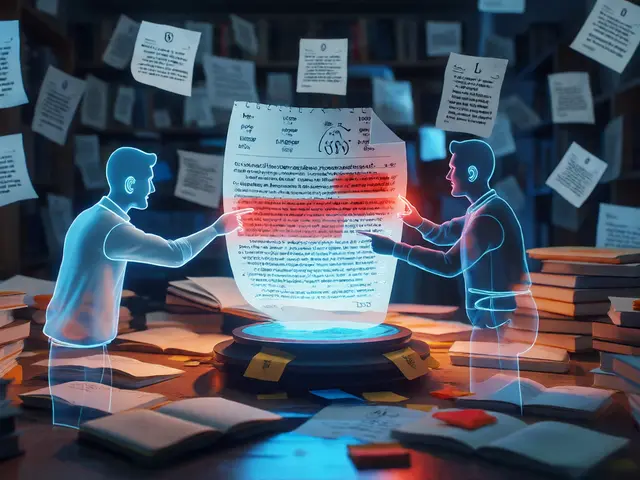
Wikidata is Wikipedia’s behind-the-scenes data engine. It stores facts as structured triples - subject, predicate, object. For example: Albert Einstein - occupation - physicist. These aren’t paragraphs. They’re clean, reusable data points. When you look up Einstein on Wikipedia, the infobox on the right? That’s pulled from Wikidata. So are the language links, the birth date, the Nobel Prize info. If you edit the date in Wikidata, it updates across 300+ language versions of Wikipedia automatically.
This system cuts down on redundancy. No more manually updating birth years in 20 different language articles. Wikidata also lets tools pull data for charts, maps, and apps. The European Union uses it for public data dashboards. Researchers use it to trace scientific collaborations. It’s not just for Wikipedia - it’s for anyone who needs reliable, connected facts.
AI Encyclopedias Rely on Different Data
AI encyclopedias don’t use Wikidata. They use their own internal knowledge graphs - built from scraped web pages, licensed datasets, academic papers, and sometimes, Wikipedia itself. Google’s AI Overviews, for example, pulls from its Knowledge Graph, which includes data from Freebase (a former Google project), DBpedia (a Wikidata derivative), and proprietary sources. Perplexity uses a mix of Wikipedia, scholarly databases, and curated web content.
The difference? AI systems don’t have a central, community-driven source. They rely on algorithms to rank, filter, and combine information. That means accuracy depends on how well those algorithms are trained - and what data they’re fed. If a source is biased, outdated, or poorly structured, the AI might repeat it. There’s no human-editing layer like Wikipedia’s volunteer editors checking every edit.
Take a simple fact: When did the first human land on the Moon? On Wikipedia, the answer comes from Wikidata - verified by editors, cited with sources, and cross-checked across languages. In an AI overview, the same answer might come from a blog post that misquoted NASA’s timeline. The AI doesn’t know it’s wrong unless its training data flagged the error.
Accuracy and Trust: Human vs. Algorithmic Verification
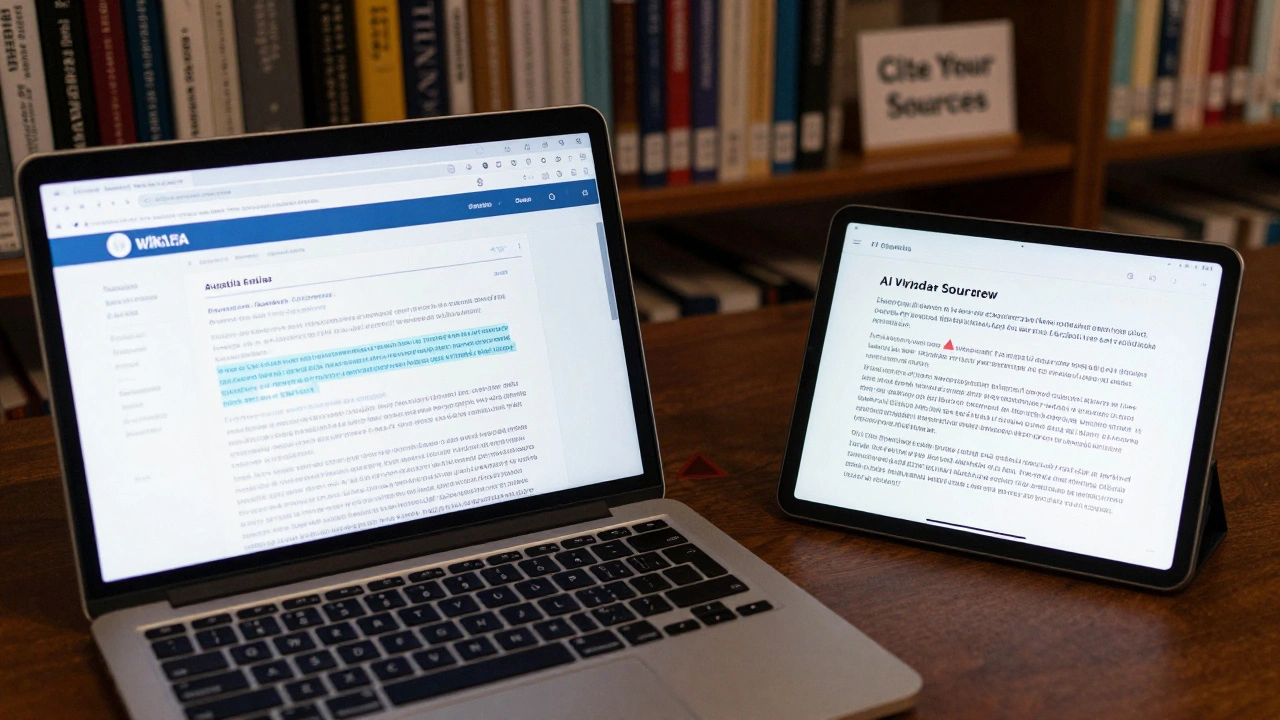
Wikipedia’s strength isn’t just its content - it’s its process. Every edit to Wikidata goes through a review system. Edits can be reverted. Disputes are discussed on talk pages. Bot edits are monitored. You can see who changed what and why. The system isn’t perfect - vandalism happens - but it’s transparent.
AI encyclopedias operate like black boxes. You don’t know which sources they used. You can’t trace how they arrived at an answer. If you see a wrong date in an AI summary, there’s no way to fix it directly. You can’t edit the AI. You can only report it - and hope someone at Google or Anthropic fixes it later.
A 2024 Stanford study tested 1,200 factual queries across AI encyclopedias and Wikipedia. Wikipedia had a 94% accuracy rate on simple factual claims. AI systems averaged 81%. The biggest errors? Dates, names of lesser-known people, and technical terms. The study concluded: “AI encyclopedias are good at paraphrasing, but poor at grounding in verified data.”
Scalability and Updates
Here’s where AI encyclopedias shine: speed. When a new scientific paper drops, AI systems can ingest it within hours. Wikidata? It takes days or weeks for a volunteer to notice, verify, and add it. That’s why AI tools often have the latest stats on stock prices, election results, or sports scores.
But speed isn’t everything. Wikidata has something AI lacks: permanence. Once a fact is added and verified, it stays. AI systems can change their answers overnight based on new training data. You might get one answer today and a conflicting one tomorrow - without warning.
Consider the case of the 2023-2024 influenza season. In January 2024, WHO published updated mortality estimates. Wikidata editors added the numbers with citations within 48 hours. AI encyclopedias took 10-14 days to update - and some still showed outdated figures from 2022. Why? Their models hadn’t been retrained yet.
Integration and Interoperability
Wikidata is open. Anyone can download its entire dataset (over 100 million items) and use it for free. Developers build apps on top of it. Libraries use it for cataloging. Schools teach it as a model for data organization. It’s part of the open web.
AI encyclopedias? Their knowledge graphs are locked inside proprietary systems. You can’t access them. You can’t audit them. You can’t build tools on top of them. Even if you want to use their data, you’re stuck with whatever API they choose to give you - often limited, paid, or poorly documented.
That’s why researchers and librarians still prefer Wikidata for long-term projects. A 2025 UNESCO report on digital preservation listed Wikidata as the only knowledge base with “full open access, version control, and community governance” suitable for archiving cultural and scientific data.
What This Means for You
If you’re a student, journalist, or just someone trying to find the truth: use both, but understand the difference.
- For quick, up-to-the-minute facts - like today’s weather or a breaking news event - AI encyclopedias are faster.
- For verified, stable, well-sourced information - especially on history, science, or people - go to Wikipedia and check the sources behind the Wikidata entries.
- If you’re doing research or citing sources, always trace the answer back to its origin. Don’t trust the AI’s summary. Look for the citation.
Wikipedia + Wikidata isn’t flashy. It doesn’t have a chatbot interface. But it’s the most reliable, transparent, and enduring knowledge system on the planet. AI encyclopedias are useful tools - but they’re built on top of systems like Wikidata. They’re not replacing it. They’re borrowing from it.
Don’t be fooled by the shiny interface. The real power is still in the open, editable, human-maintained database behind the scenes.
Is Wikidata the same as Wikipedia?
No. Wikipedia is the website where you read articles in plain language. Wikidata is the structured database that stores the facts behind those articles. Think of Wikidata as the engine and Wikipedia as the dashboard.
Can I edit Wikidata like I edit Wikipedia?
Yes. Wikidata is open for editing by anyone with a free account. You can add, update, or correct facts - but edits are reviewed by the community. You need to cite reliable sources, just like on Wikipedia.
Do AI encyclopedias use Wikidata at all?
Sometimes, indirectly. Some AI systems pull data from DBpedia, which is a machine-readable version of Wikipedia that’s partly derived from Wikidata. But none use Wikidata directly as their primary source. They rely on their own internal knowledge graphs.
Why don’t AI companies just use Wikidata?
They could - and some do for basic facts. But AI companies want control. They build their own systems to avoid dependency, to customize answers for their users, and to protect their business models. Wikidata is open and community-run - that’s a threat to proprietary control.
Which is more accurate: Wikipedia or AI encyclopedias?
For verified, stable facts - especially on historical, scientific, or biographical topics - Wikipedia backed by Wikidata is more accurate. AI encyclopedias are faster but more prone to hallucinations and outdated data. Always cross-check important facts.