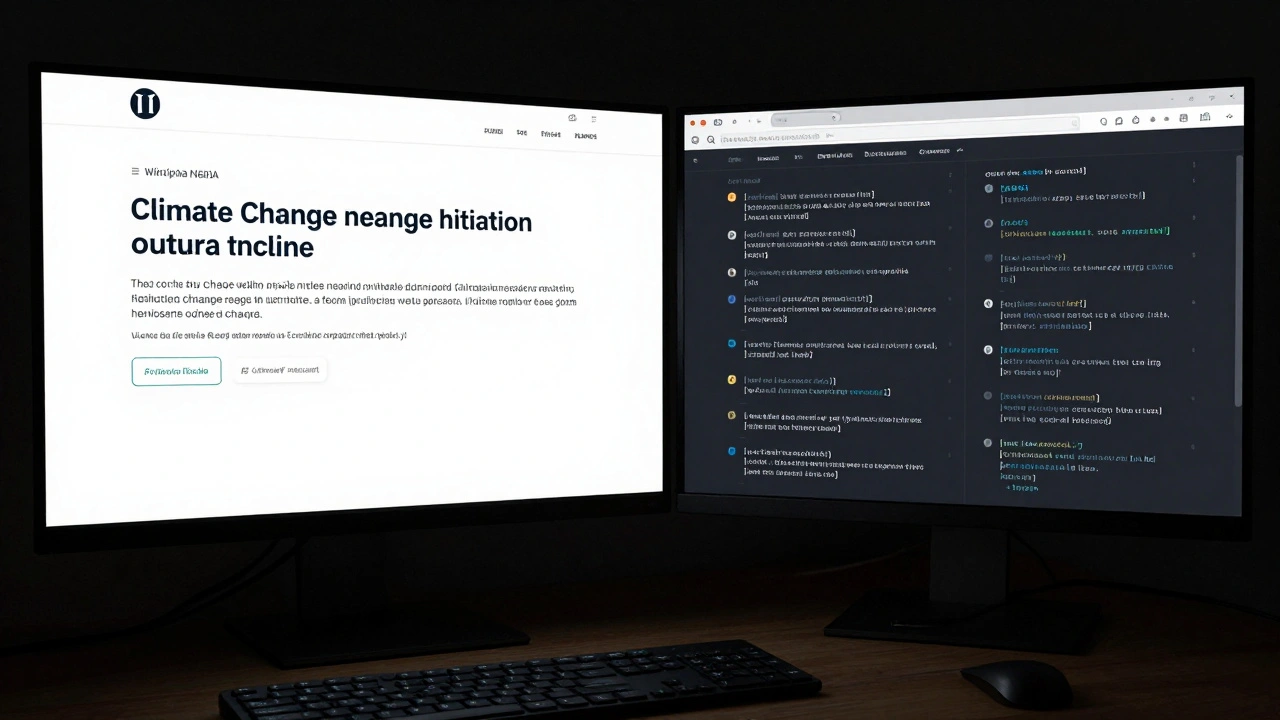
When you click on a Wikipedia article, you see the final version-the clean summary, the neutral tone, the cited facts. But that article didn’t just appear out of nowhere. Behind every Wikipedia entry is a hidden world of debate, revision, and negotiation that happens on something most readers never see: the talk page.
What Exactly Is a Wikipedia Talk Page?
Every Wikipedia article has a matching talk page. You can find it by clicking the "Talk" tab at the top of any article. It’s not part of the final encyclopedia. It’s the workspace where editors argue, ask questions, and build consensus. Think of it like the backstage of a theater-no audience sees it, but the show wouldn’t run without it.
These pages are where editors debate whether a fact belongs in the article, if a source is reliable, or if a section is too biased. They’re also where new contributors ask for help, where disputes get resolved, and where the article’s tone and structure are slowly shaped over time.
For example, the talk page for "Climate Change" has over 12,000 archived discussions. It’s not just a log-it’s a living record of how the article evolved from a vague overview into one of the most rigorously vetted entries on Wikipedia. That’s not luck. That’s the talk page doing its job.
How Talk Pages Decide What Stays and What Gets Removed
Wikipedia doesn’t have editors with final authority. Instead, it relies on consensus. And consensus is built on talk pages.
Let’s say someone adds a claim like: "A 2023 study proves that eating blueberries improves memory by 40%." If that claim isn’t backed by a peer-reviewed source, someone will comment on the talk page: "This study isn’t published anywhere. Source is a blog. Remove?"
That’s not just a suggestion. It’s a trigger. Other editors jump in. Someone finds the original study. Turns out it was a small survey with 30 participants, not a clinical trial. Another editor points out the journal it was published in has questionable peer review. Within hours, the edit is reverted. The claim gets flagged as "unsourced" and eventually removed.
This process isn’t fast. It’s messy. But it’s deliberate. Wikipedia’s reliability comes from this friction. Talk pages act as a filter. Without them, the article would be full of rumors, marketing claims, and personal opinions.
The Hidden Rules That Guide Talk Page Discussions
There are unwritten rules on talk pages that most new editors don’t know. These aren’t official policies-they’re norms that have developed over 20 years of editing.
- Don’t edit war. If someone reverts your change, don’t just revert it back. Comment first.
- Use "We" instead of "You." Saying "You’re wrong" sounds hostile. Saying "We should check the source" invites collaboration.
- Tagging matters. Editors use templates like {{citation needed}} or {{POV}} to flag issues without arguing. These tags are signals, not insults.
- Long threads get archived. If a discussion goes past 50 comments, someone will move it to an archive so the current talk page stays readable.
These rules exist because Wikipedia is made by volunteers. People have jobs, families, and limited patience. If a talk page turns into a flame war, contributors leave. The system survives because it’s designed to be civil-even when people disagree strongly.

Who Actually Runs These Conversations?
It’s not a small group of experts. It’s a rotating cast of thousands. But some people show up more than others.
On popular articles like "World War II" or "COVID-19," you’ll find the same names popping up again and again. These aren’t Wikipedia staff. They’re regular people-teachers, librarians, retired engineers-who’ve spent years learning how to edit well. They’re called "regulars" or "persistent editors." They know the policies, the sources, and the history of the article.
They don’t have special powers. But they do have credibility. If someone with 5,000 edits says, "This source is unreliable," other editors listen. That’s not because they’re an authority-it’s because their track record shows they’re careful.
On smaller articles, the conversation might be just two or three people. But even then, the same rules apply. A single well-reasoned comment can change the direction of an article.
How Talk Pages Make Articles More Reliable Than Traditional Encyclopedias
Traditional encyclopedias like Britannica rely on a small team of paid experts. Wikipedia relies on hundreds of anonymous volunteers.
Which one is more accurate? A 2005 study in Nature compared 42 science articles from Wikipedia and Britannica. The average number of errors per article was nearly identical. Wikipedia had 3.86 errors per article. Britannica had 2.92.
But here’s the catch: Wikipedia fixes mistakes faster. A wrong date in Britannica might sit for years. On Wikipedia, someone notices it within hours. Why? Because the talk page is always active.
Take the article on "The 2020 U.S. Presidential Election." In November 2020, results were being updated live. Editors on the talk page debated whether to call Biden the "president-elect" before the Electoral College voted. They cited state certifications, news reports, and legal precedent. The article changed dozens of times over 48 hours. By the time the official result was announced, the Wikipedia version was already aligned with reality.
That’s not magic. That’s the talk page working exactly as designed.
What Happens When Talk Pages Fail
Talk pages aren’t perfect. Sometimes they break.
On controversial topics-like vaccines, politics, or historical revisionism-talk pages can get flooded with bad-faith editors. They don’t want to improve the article. They want to push a narrative. They post fake sources, repeat debunked claims, and leave dozens of comments to bury real discussion.
When that happens, Wikipedia has tools. Articles can be semi-protected so only experienced editors can change them. Talk pages can be locked. Disputes can be escalated to mediation pages.
But the real defense is community. When bad-faith editors show up, the regulars recognize them. They don’t engage. They document. They tag. They wait for others to join in. And eventually, the noise fades. The article reverts to its neutral, sourced state.
This is why Wikipedia survives attacks. It’s not because it’s perfect. It’s because the talk page is a self-correcting system.
Why You Should Check the Talk Page (Yes, Really)
Most people never look at a talk page. But if you want to understand how much you can trust an article, you should.
Here’s how to do it in three steps:
- Go to any Wikipedia article.
- Click the "Talk" tab.
- Look for these signs:
- Many archived discussions → The article has been around a while and has been debated thoroughly.
- Tags like {{citation needed}} or {{POV}} still active → The article might be incomplete or biased.
- Recent comments from experienced editors → The article is being actively maintained.
- No recent activity → The article might be outdated or ignored.
For example, the talk page for "The Great Pyramid of Giza" has over 2,000 archived discussions. It’s been edited by archaeologists, historians, and Egyptologists. The article is stable. Reliable.
Now check the talk page for "The Best Pizza in New York." It’s full of personal opinions, no citations, and edits from anonymous users. The article? It’s a mess. But now you know why.
The Bigger Picture: Wikipedia as a Living System
Wikipedia isn’t a static database. It’s a social system. The talk page is its nervous system.
Every edit, every comment, every citation check is a tiny signal. Together, they create something more accurate than any single expert could produce. The article you read isn’t written by one person. It’s written by dozens, sometimes hundreds, of people who care enough to argue about it.
That’s why Wikipedia works. Not because it’s perfect. But because it’s open. Because it listens. Because it’s always being questioned, tested, and improved-even when you’re not looking.
The next time you use Wikipedia, remember: the article you see is just the surface. The real work happened quietly, behind the scenes, on the talk page. And that’s what makes it trustworthy.
Can anyone edit a Wikipedia talk page?
Yes, anyone can edit a talk page-even unregistered users. But serious discussions usually involve registered editors with a history of contributions. Anonymous edits are often ignored if they’re off-topic or disruptive. The system relies on reputation, not credentials.
Are talk page discussions archived permanently?
Yes. Every discussion that reaches a conclusion or becomes too long is moved to an archive. These archives are searchable and remain part of the article’s history. They’re not deleted-they’re just hidden to keep the current talk page clean. You can access them by clicking "Archives" at the bottom of the talk page.
Do Wikipedia editors get paid for working on talk pages?
No. All Wikipedia editing, including talk page discussions, is done by volunteers. Some editors work for institutions like universities or libraries, but they’re not paid by Wikipedia. Their motivation is usually a belief in free knowledge, intellectual curiosity, or a desire to correct misinformation.
Why do some articles have very little talk page activity?
Low activity usually means one of two things: the article is stable and uncontroversial, or it’s neglected. Simple topics like "The color blue" or "The number 7" often have little debate because there’s little to argue about. But if a topic is important and has no talk page activity, it might be outdated or under-maintained. Always check the last edit date.
Can I start a discussion on a talk page if I’m not an expert?
Absolutely. Wikipedia encourages new editors to participate. If you have a question, notice a missing citation, or think something is wrong, post it. Use polite language, cite your sources, and be open to feedback. Many experienced editors started exactly that way.
If you want to understand how Wikipedia works, don’t just read the articles. Look at the conversations behind them. That’s where the real story is.