Before we get into the weeds, here is the quick version: policies are created through community consensus, edited via a rigorous discussion process, and protected by administrators to prevent 'edit wars' from destroying the rules of the game.
- Consensus-driven: No single person decides the rules; it takes a broad agreement from the community.
- Iterative process: Policies evolve through talk pages and RFCs (Requests for Comment).
- Layered protection: Semi-protection and full protection keep trolls from changing the rules.
- Enforcement: Rules are applied by editors and admins through the use of warnings and blocks.
What Exactly is a Wikipedia Policy Page?
In the world of crowdsourcing, a policy is more than just a guideline. Wikipedia policy pages is a specialized set of pages that define the fundamental principles and rules governing the creation and maintenance of the encyclopedia. Unlike a standard article about a celebrity or a city, these pages dictate how content should be handled. If an article is the "what," the policy page is the "how."
You can think of these as the laws of the land. For example, the Neutral Point of View (NPOV) policy ensures that articles aren't written as biased propaganda. Without these rules, the site would likely collapse under the weight of political disputes and advertising spam. These policies are managed by the Wikimedia Foundation is the non-profit organization that operates Wikipedia and provides the technical infrastructure, but the foundation rarely writes the policies. The community does that.
The Birth of a Policy: Writing and Consensus
You can't just wake up, decide that "all articles about cats must be written in poetry," and change the policy. That would be a quick way to get your account banned. Writing a policy requires consensus, which is the heart of Wikipedia's governance. This isn't a simple majority vote-it's a process of talking until most people agree or a workable compromise is found.
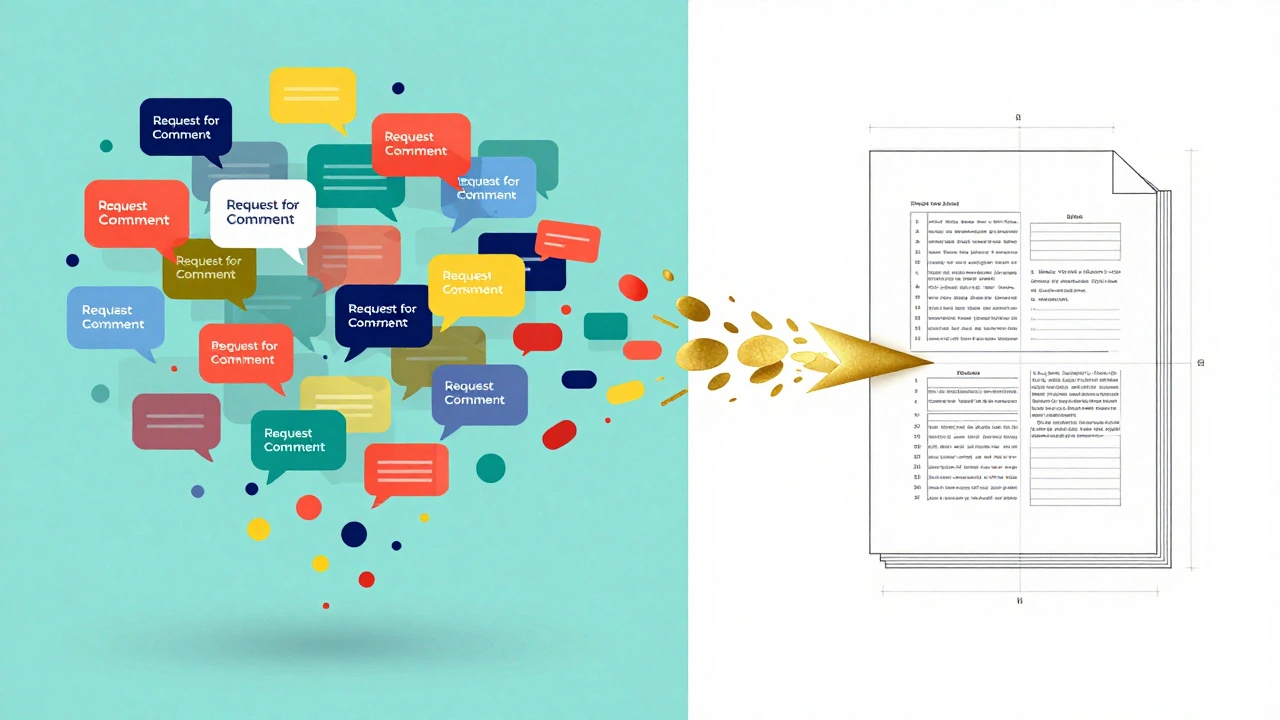
The process usually starts on a Talk Page is a meta-page attached to every Wikipedia article or policy where editors discuss potential changes. If a group of editors feels a rule is outdated-say, the way sources are cited for AI-generated content-they start a thread. If the conversation gets too big or too heated, it turns into a Request for Comment (RFC) is a formal process used to gather community feedback on a specific proposal or dispute. An RFC acts like a public hearing. People from all over the world chime in, arguing for and against the change, citing previous precedents and logic.
Once a consensus is reached, a designated editor (usually someone with a high trust level) updates the policy page to reflect the new agreement. This ensures that the transition from "idea" to "rule" is transparent and documented.
Editing the Rules: The Iterative Cycle
Policies aren't written in stone. They are treated like software-they have versions and updates. Because the internet changes so fast, a policy written in 2005 about "reliable sources" might not work for a world of social media and deepfakes. The editing process is an iterative loop: observation, discussion, implementation, and review.
When editors suggest changes, they often use a process called "wikification," where they turn a messy discussion thread into a clean, structured policy article. They use a specific hierarchy to organize these rules:
- Policies: The hard rules. Breaking these can lead to account blocks.
- Guidelines: Strong recommendations. These are helpful but have more wiggle room.
- Best Practices: Helpful tips that experienced editors use to make pages better.
| Level | Flexibility | Consequence of Breach | Example |
|---|---|---|---|
| Policy | Low (Strict) | Admin action/Block | Verifiability |
| Guideline | Medium | Warning/Reversion | Manual of Style |
| Best Practice | High | Minor edit/Suggestion | Template use |
Protecting the Constitution: How Pages are Locked
If policy pages were open for anyone to edit at any time, the site would be in a state of constant war. This is where Page Protection is a feature that limits who can edit a page to prevent vandalism or disruptive editing comes into play. Admins use different levels of protection to keep the rules stable.
First, there is Semi-protection. This means only "autoconfirmed" users (accounts that are at least four days old and have made a minimum number of edits) can edit. This stops the "drive-by" vandals who create an account just to delete a paragraph of a rule. Then there is Full Protection. In this case, only Administrators is experienced editors granted technical tools to protect pages, block users, and delete content can make changes. Full protection is usually reserved for the most critical policies or pages currently undergoing a massive, contentious debate.
Why protect a policy page? Because a single malicious edit to a page like "Verifiability" could technically signal to thousands of bots and editors that the rules have changed, leading to a mass deletion of citations. It's a security measure to ensure that only consensus-backed changes actually hit the live page.
The Role of the Arbitration Committee
Sometimes, consensus fails. Two groups of editors might fundamentally disagree on how a policy should be interpreted, and no amount of talking on a Talk Page fixes it. When this happens, the case goes to the Arbitration Committee (ArbCom) is the "Supreme Court" of Wikipedia, tasked with resolving systemic disputes and deciding on behavioral issues.
The ArbCom doesn't decide what the facts are in an article; they decide how the community should behave and how policies should be applied. If an editor is using a policy as a weapon to harass others, the ArbCom can issue a ban. Their decisions are the final word on policy interpretation, effectively acting as the legal precedent for future disputes. This prevents the community from spinning in circles forever.
Common Pitfalls in Policy Evolution
Writing rules for millions of people isn't easy. One common problem is "policy bloat," where the rules become so complex and numerous that new editors are terrified to touch anything. When a new person joins and sees a 50-page manual on how to add a comma, they might just give up. This is why there is a constant push for simplification and the creation of "Quick Start" guides.
Another issue is the "power user" bias. Because policies are written by those who spend the most time on the site, the rules can sometimes reflect the preferences of a small, dedicated elite rather than the broader user base. To combat this, Wikipedia often holds site-wide polls or open surveys to gauge how the average contributor feels about a proposed change.
Can anyone change a Wikipedia policy?
Technically, yes, if the page isn't protected. However, any change made without community consensus is typically reverted almost immediately. To make a lasting change, you must propose the edit on the associated talk page and get agreement from other editors.
What happens if I break a policy?
It depends on the severity. For minor slips, you'll get a polite warning on your talk page. For repeated violations or severe cases (like plagiarism or hate speech), an administrator may block your account or your IP address from editing.
Who decides when a page needs protection?
Administrators usually decide. They look for patterns of "edit warring"-where two people keep undoing each other's changes-or a sudden spike in vandalism. Once the situation stabilizes or a consensus is reached, the protection is usually lifted.
What is the difference between a policy and a guideline?
A policy is a mandatory rule that must be followed (e.g., you cannot use original research). A guideline is a strong recommendation to keep things consistent (e.g., using a specific date format), and there is more room for discretion.
Does the Wikimedia Foundation write the policies?
No. The foundation manages the servers and the legal side of the non-profit, but the editorial policies are created and maintained by the volunteer community. The foundation generally avoids interfering in editorial disputes.
Next Steps for New Contributors
If you're feeling overwhelmed by the rules, don't be. You don't need to memorize every policy page before you make your first edit. The best way to learn is by doing. Start with small fixes-typos or adding a missing citation-and pay attention to the edit summaries left by other users. If someone reverts your work, check your talk page. Most experienced editors are happy to explain which policy you might have missed.
For those who want to get deeper into the governance side, try participating in a low-stakes RFC or browsing the "Village Pump," which is the community's general forum. Understanding how the rules are made is the first step toward becoming an administrator or a member of a specialized task force.