Wikipedia isn’t just a collection of articles. From a library science standpoint, it’s one of the most complex, real-time information systems ever built. Millions of edits, thousands of contributors, and billions of page views every month all happen within a structure designed to make knowledge findable, reliable, and usable. That structure didn’t happen by accident. It was shaped by principles borrowed from over a century of library and information science.
Classification Systems in the Digital Age
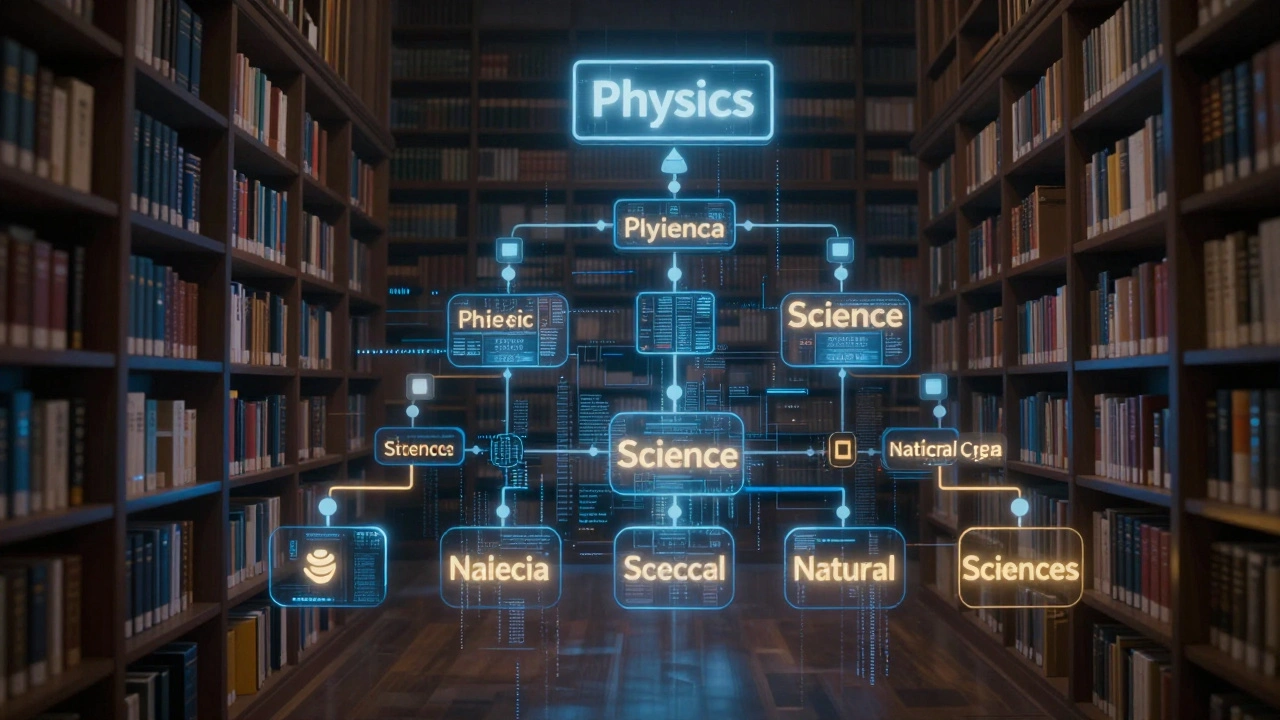
Traditional libraries use classification systems like Dewey Decimal or Library of Congress to group books by subject. Wikipedia doesn’t use these exact systems, but it follows the same logic. Every article belongs to a topic, and topics are nested under broader categories. A page about "Quantum Entanglement" isn’t just floating alone-it’s linked to "Physics," then "Science," then "Natural Sciences." This hierarchy mirrors how a library shelf arranges books from general to specific.
But here’s the difference: Wikipedia’s categories are user-generated and constantly changing. A librarian would catalog a book once, with careful review. On Wikipedia, a volunteer might add a category like "Climate Change Mitigation" to an article on solar panels, and another editor might later move it to "Renewable Energy Technologies." This fluidity is messy, but it’s also adaptive. The system evolves as knowledge does.
Metadata: The Invisible Backbone
Every Wikipedia article has hidden metadata-information about the information. That includes page titles, revision histories, talk pages, templates, and interwiki links. These aren’t just technical details. They’re the tools that let users and machines navigate the system.
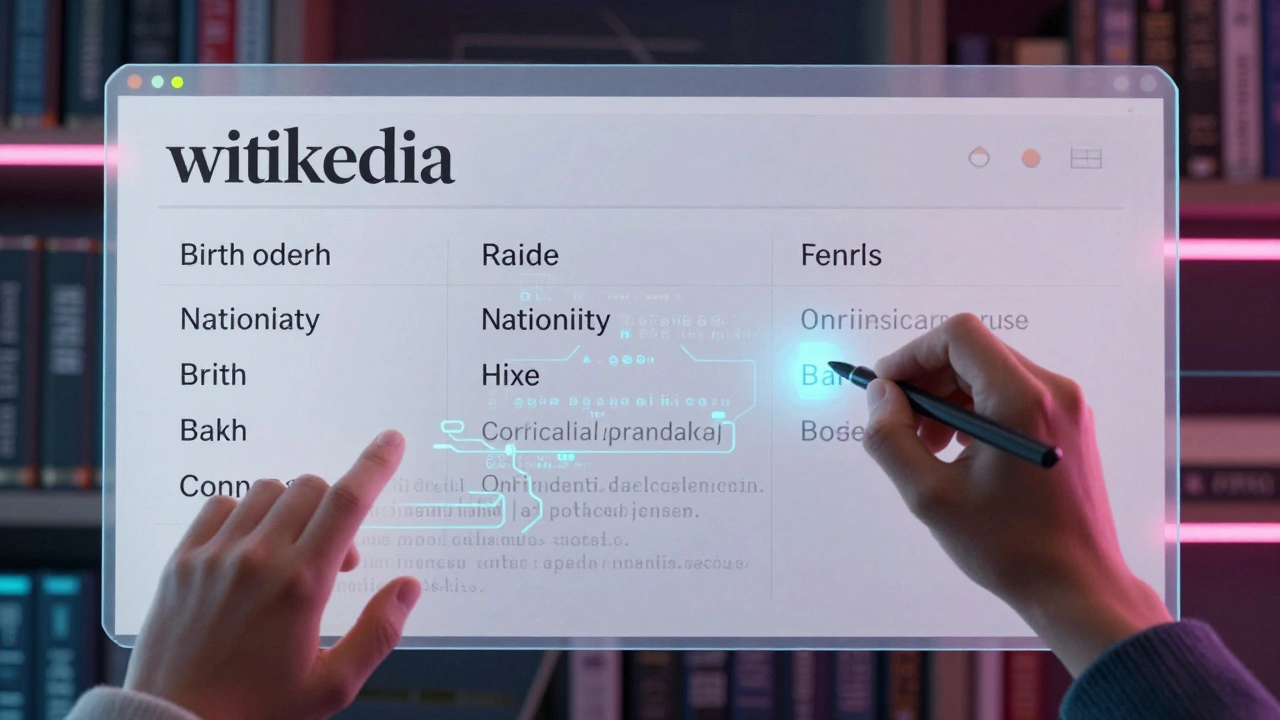
Take the "Infobox"-those boxes at the top of articles with names, dates, locations, and other facts. That’s controlled metadata. It’s standardized across thousands of articles. An infobox for a person always includes birth date, nationality, occupation. An infobox for a city includes population, area, government type. This consistency makes it possible for search engines, apps, and researchers to pull structured data out of Wikipedia. It’s like a library card catalog, but automated and global.
And then there’s the "References" section. Every citation is a link back to a trusted source. Library science has long emphasized authoritative sources. Wikipedia’s reliance on citations isn’t just about credibility-it’s about traceability. If you want to verify a claim, you don’t have to guess. You follow the trail.
Controlled Vocabulary and Disambiguation
What do you do when two things have the same name? A library has a catalog rule: if two books have the same title, you add the author’s name. Wikipedia does the same with disambiguation pages.
Search for "Apple" and you don’t get one article. You get a disambiguation page listing: Apple Inc., Apple (fruit), Apple Records, Apple (band), and so on. Each link goes to the correct article. This is a direct application of controlled vocabulary-a core concept in information science where terms are standardized to avoid confusion.
Wikipedia also uses redirects. If you type "UK," you’re automatically sent to "United Kingdom." If you search for "Covid-19," you land on "COVID-19." These aren’t just convenience features. They’re precision tools. They ensure that no matter how a user spells or phrases something, they still find the right information.
Authority Control and Editorial Governance
Libraries have catalogers, archivists, and subject specialists who ensure consistency. Wikipedia has administrators, editors, and policies. The five pillars, neutral point of view, verifiability, no original research-these aren’t random rules. They’re library science principles repackaged for the digital crowd.
For example, "verifiability" means you can’t just write something because you believe it. You need a published source. That’s the same as a librarian refusing to catalog a book without a publisher or ISBN. And "no original research"? That’s the academic equivalent of not allowing unpublished theses into a university archive.
Wikipedia’s edit history is like a library’s circulation log-but public and permanent. You can see who added what, when, and why. That transparency builds trust. It also allows for accountability. If a biased edit slips in, the community can roll it back. This isn’t perfect, but it’s far more robust than most people assume.
Access and Equity: A Library’s Mission
Libraries were built to give everyone access to knowledge, regardless of income or background. Wikipedia does the same. It’s free. It’s in over 300 languages. It works on a basic phone. No subscription. No paywall.
But access isn’t just about cost. It’s about usability. Wikipedia’s interface is simple. Search works fast. Links are clear. Articles are written in plain language-not academic jargon. That’s intentional. A librarian doesn’t hand a student a 500-page thesis when they’re asking for a basic explanation. Wikipedia does the same. It translates complex topics into digestible formats.
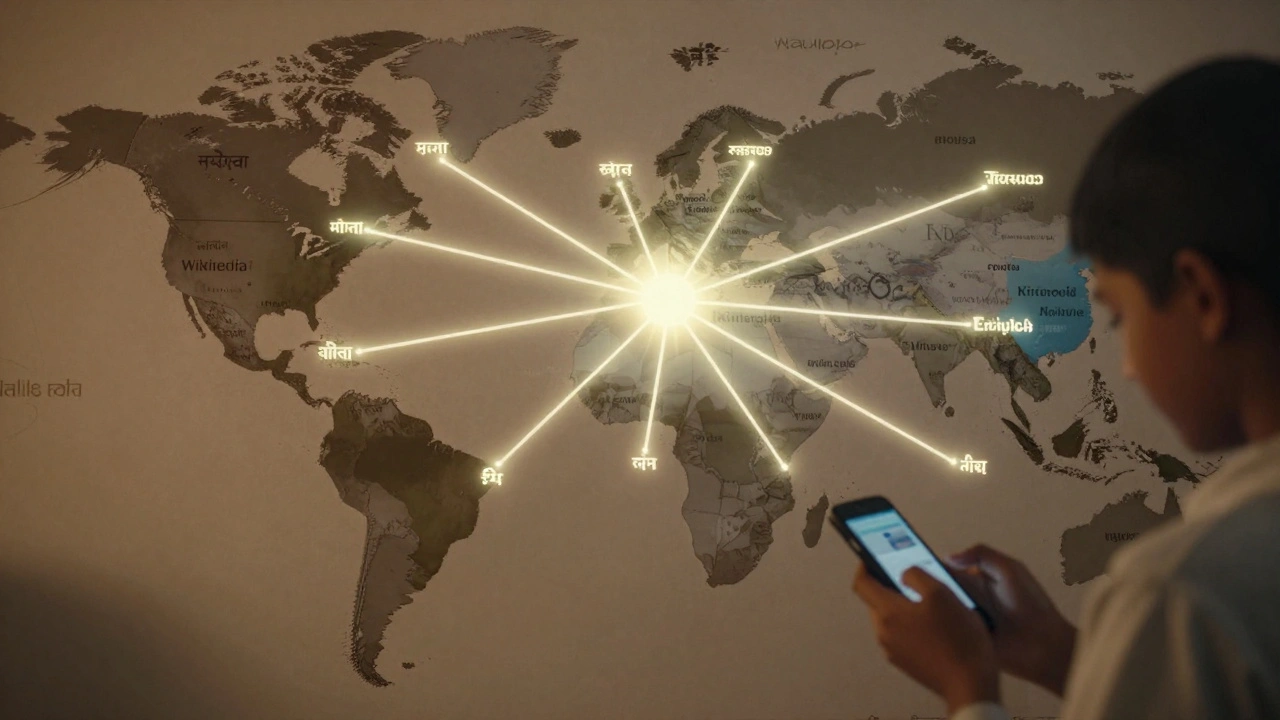
And it’s global. A student in rural India can read about quantum physics in Hindi. A teenager in Nigeria can learn about the French Revolution in Yoruba. That scale of accessibility is unprecedented. No physical library, no matter how large, could match it.
Challenges: Bias, Gaps, and the Human Factor
Wikipedia isn’t flawless. It has gaps. Articles about women in science, Indigenous knowledge systems, and non-Western history are often underdeveloped. That’s not because the knowledge doesn’t exist-it’s because the contributors don’t reflect the world’s diversity. Library science has long struggled with this same issue. Collections were built by white, male librarians for decades, and the gaps still show.
Wikipedia’s bias isn’t malicious. It’s structural. Most editors are male, tech-savvy, and from Western countries. That skews content. A 2023 study found that articles on topics primarily of interest to women are 30% less likely to be rated as "high quality"-not because they’re less accurate, but because they’re less frequently edited by the dominant contributor group.
And then there’s the problem of "edit wars." When two groups fight over how to describe a political event, the article can become a battleground. Libraries avoid this by having trained professionals make final decisions. Wikipedia relies on consensus. Sometimes that works. Sometimes it doesn’t.
Wikipedia as a Living Archive
Think of Wikipedia as a living archive. Unlike a printed encyclopedia, it doesn’t freeze in time. It updates as events unfold. When a new president is elected, the article updates within hours. When a scientist publishes a breakthrough, the article changes within days.
This real-time nature makes it a unique tool for researchers. Historians use it to track how public understanding of events shifts over time. Sociologists study edit patterns to see how communities form around knowledge. Librarians use it to teach information literacy-how to evaluate sources, spot bias, trace claims.
It’s not a replacement for academic journals. But it’s a powerful gateway. Most people don’t start with a peer-reviewed paper. They start with Wikipedia. And that’s okay-if they know how to use it.
What Library Science Teaches Us About Using Wikipedia
If you’re using Wikipedia for research, treat it like a library reference desk-not a final source. Look at the references. Check the edit history. See if the article has been flagged for bias or lack of sources. Compare it with other entries on the same topic.
Library science gives you the tools: evaluate authority, check currency, assess scope, verify accuracy. Wikipedia doesn’t make those steps unnecessary. It makes them visible.
Wikipedia works because it’s built on centuries of library practice-organized, structured, and constantly refined. It’s not magic. It’s methodology. And that’s why, despite its flaws, it remains one of the most successful information systems ever created.
Is Wikipedia considered a reliable source in academic research?
Wikipedia itself is not cited as a primary source in academic papers. But it’s widely used as a starting point to understand a topic, find key terms, and locate credible references through its citations. Many universities teach students to use Wikipedia to find scholarly sources, not to quote from it directly.
How does Wikipedia’s categorization compare to traditional library systems?
Traditional systems like Dewey Decimal use fixed, hierarchical codes assigned by trained catalogers. Wikipedia uses open, user-generated categories that can be added or changed by anyone. This makes Wikipedia more flexible but less consistent. Libraries prioritize stability; Wikipedia prioritizes adaptability.
Why do some Wikipedia articles have more detail than others?
Detail depends on editor interest and expertise. Articles on popular topics-like celebrities, technology, or major historical events-get more attention. Less-covered subjects, especially from non-Western cultures or marginalized communities, often have sparse content. This reflects the demographics of Wikipedia’s volunteer editors, not the importance of the topic.
Can Wikipedia be trusted for factual information?
For most general facts-dates, names, basic definitions-Wikipedia is accurate. Studies show its accuracy rivals that of traditional encyclopedias. But for specialized, technical, or controversial topics, errors can slip through. Always check the references and look for edit warnings at the top of the page.
How do librarians use Wikipedia in their work?
Librarians use Wikipedia to understand public knowledge gaps, identify trending topics, and teach information literacy. Many design workshops around evaluating Wikipedia articles. Some even contribute to improve underrepresented topics. It’s a tool for outreach, education, and community engagement-not just a source to avoid.