Wikipedia is supposed to be the free encyclopedia anyone can edit. But some topics don’t stay neutral for long. When it comes to Israel-Palestine, US politics, and Russia, the edit wars never really end. Thousands of volunteers try to keep things factual. Yet every change sparks another reversal, another block, another appeal. These aren’t just disagreements-they’re battlegrounds where history, identity, and power collide behind a simple edit button.
Israel-Palestine: A Conflict Written in Edits
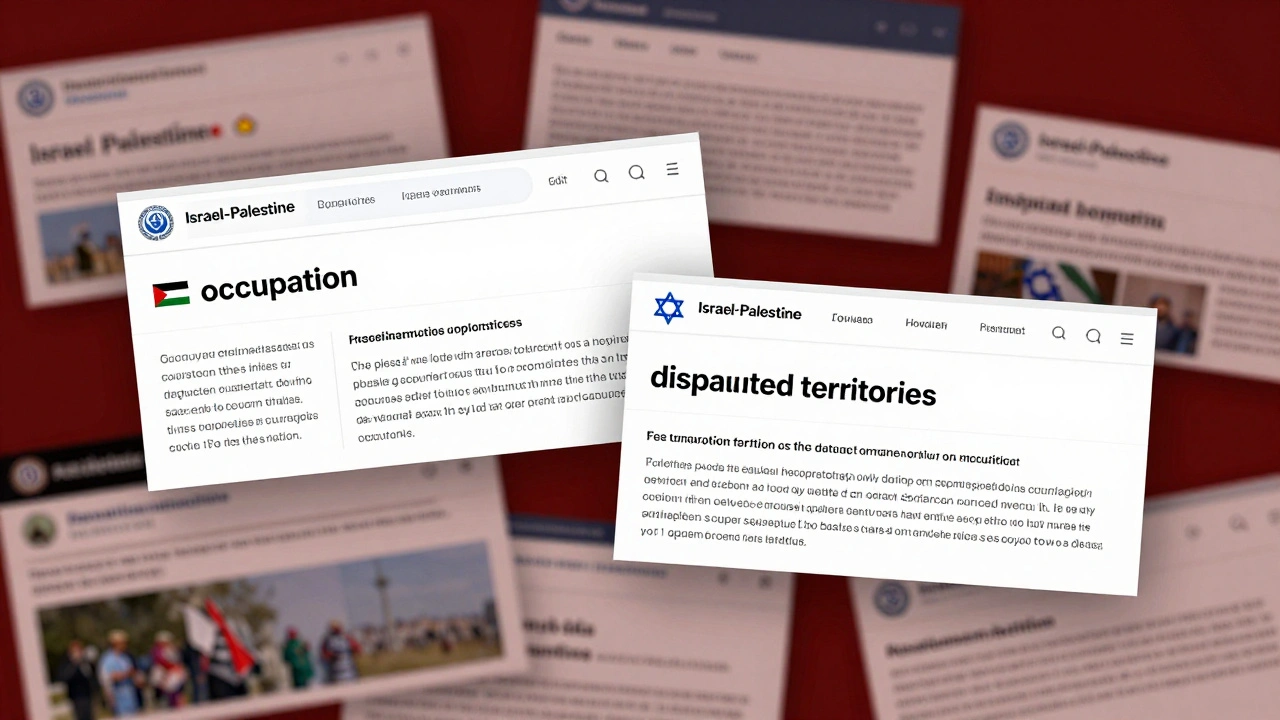
On Wikipedia, the Israel-Palestine page has over 12,000 revisions since 2005. That’s more than one edit every two hours, day and night. The dispute isn’t about typos. It’s about who gets to say what happened. Is it "occupation" or "disputed territories"? Is it "resistance" or "terrorism"? These aren’t just word choices-they’re legal and moral positions wrapped in language.
Editors from different regions, with different histories, log in and change the same sentence. A user in Ramallah might add "colonial settlement". Someone in Tel Aviv might revert it to "Jewish community". The Wikipedia Arbitration Committee has handled over 40 cases just on this topic. Some editors have been banned for years. Others rotate in and out, using sock puppet accounts to bypass restrictions.
Even basic facts get tangled. The number of Palestinian refugees? Sources vary between 5.5 million and 7 million. Which year did Israel annex East Jerusalem? 1967? 1980? The page lists both, with footnotes from the UN, Israeli government, and Palestinian Authority-all flagged as "contested". The result? A page that’s accurate, but unreadable. Readers see a wall of citations, not clarity.
US Politics: The Permanent Campaign
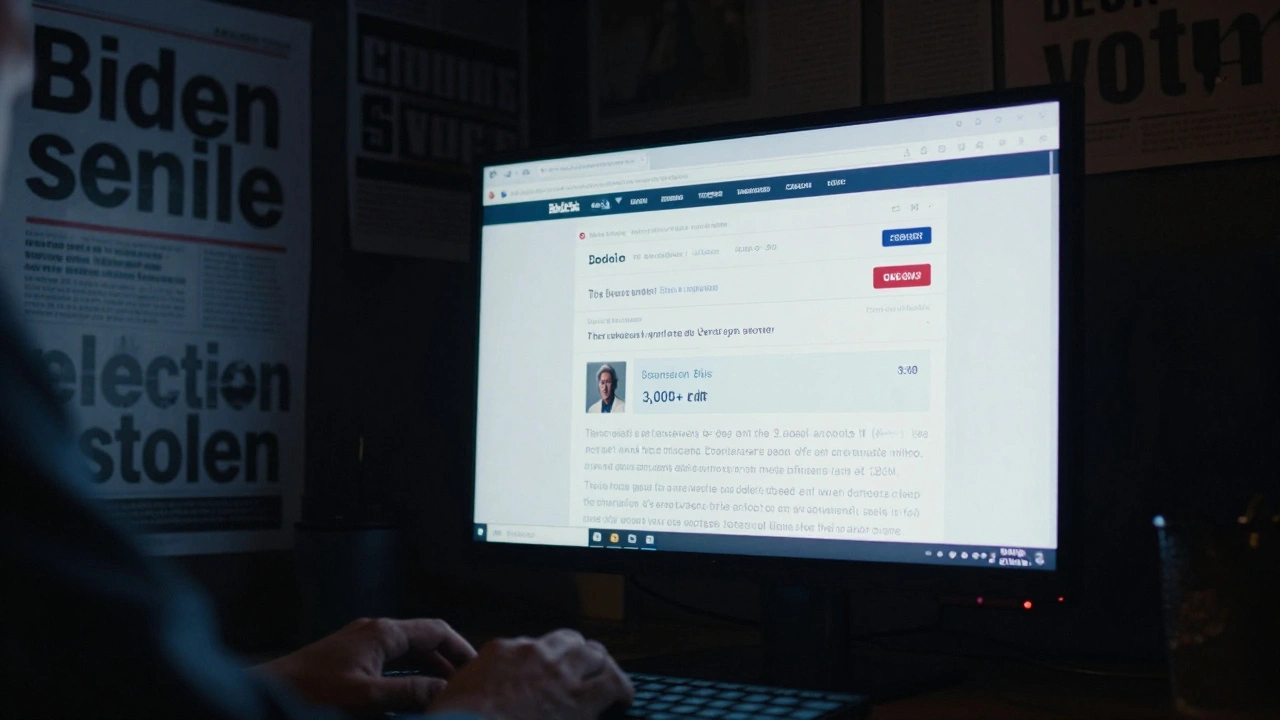
Wikipedia’s US politics pages are like live election campaigns. Every presidential candidate, every Supreme Court justice, every congressional bill gets a page. And every page is a target. In 2020, the Joe Biden page saw over 3,000 edits in a single week. Half of them were about unsubstantiated claims-"Biden is senile", "Biden stole the election". Most got reverted within minutes. But not all.
The problem isn’t just trolls. It’s partisan editors who believe they’re doing the right thing. A conservative editor might cite Fox News as a source for a claim about voter fraud. A liberal editor might use The New York Times to describe a policy as "harmful". Wikipedia’s policy says to use reliable, published sources. But who decides what’s reliable? The answer is: whoever gets there first, or has the most patience.
Some pages are locked down. The Donald Trump page has semi-protection: only autoconfirmed users can edit. That means you need to have made at least 10 edits and have an account older than four days. But even that doesn’t stop the churn. The page on the 2020 election has over 1,800 references. Most are from official government sites, major newspapers, and academic journals. But every time someone adds a fringe source, the whole page explodes into debate.
Wikipedia’s solution? Neutral point of view (NPOV). But NPOV doesn’t mean balance. It means representing all significant viewpoints proportionally. The challenge? Figuring out what’s "significant". Is a conspiracy theory that got 200,000 social media shares "significant"? Wikipedia says no. But someone always tries to add it anyway.
Russia: Censorship, Propaganda, and the Silent Editors
Wikipedia’s Russian-language version is a ghost town for sensitive topics. Since 2022, Russian authorities have blocked access to Wikipedia pages on the war in Ukraine, the annexation of Crimea, and opposition figures like Alexei Navalny. The Russian Wikipedia community responded by moving critical content to the English version-and by creating proxy sites. But that’s not the full story.
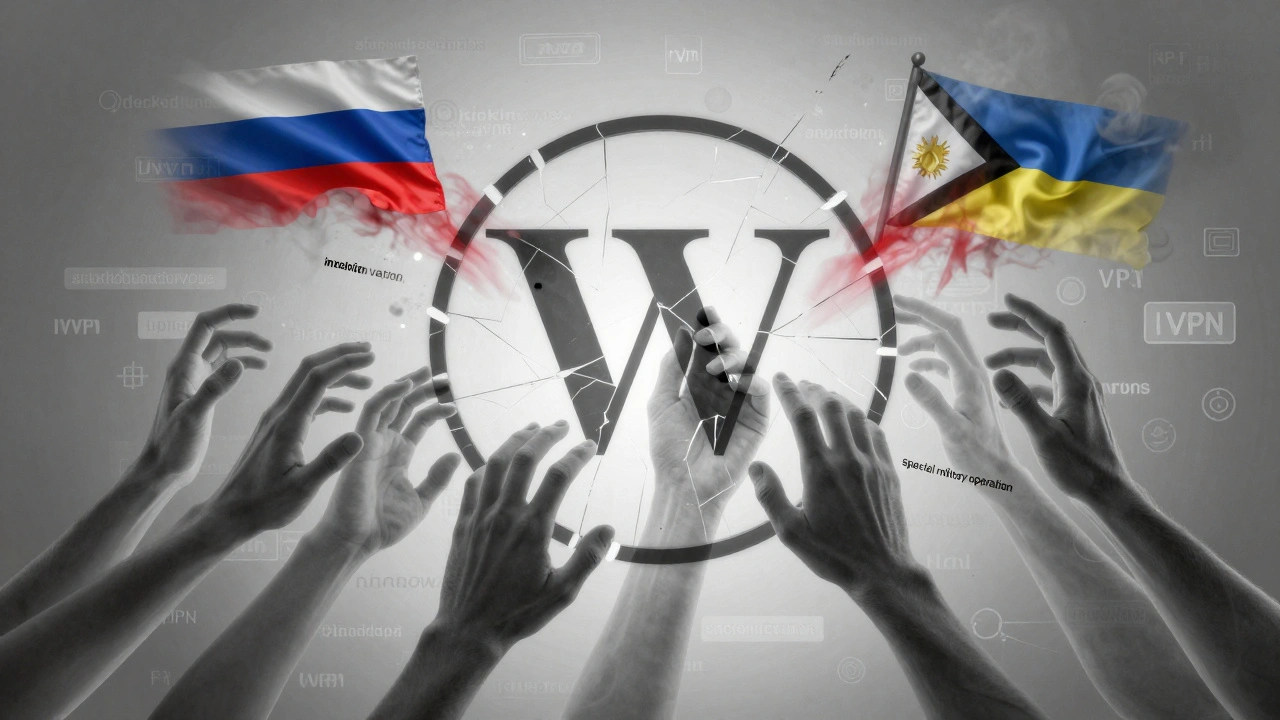
On the English page for "Russia-Ukraine War", edits come from three main groups: Ukrainian editors, Western academics, and Russian state-aligned editors using VPNs. The Russian editors don’t always identify themselves. They use neutral usernames like "User12345" or "MoscowResearcher". Their edits often replace "invasion" with "special military operation", or remove casualty figures from Ukrainian sources.
Wikipedia’s administrators have banned over 200 Russian IPs linked to state media. But new ones pop up daily. The English page now has a notice at the top: "This article is under heightened scrutiny due to disinformation campaigns. Verify all claims with independent sources." That notice has been added and removed five times since 2022. Each time, it triggers a new edit war.
Even basic facts about Russian history are contested. Was the Soviet Union an empire? A socialist state? A federation? The English page says "often described as an empire"-but the Russian version calls it "a voluntary union of republics". Neither is wrong. But both can’t be equally true in the same article. Wikipedia tries to reconcile them with footnotes and qualifiers. The result? A page that reads like a legal brief, not an encyclopedia.
Why Do These Disputes Keep Happening?
Wikipedia doesn’t have editors who are paid to be neutral. It has volunteers with strong opinions. And when a topic touches identity, trauma, or power, neutrality feels like betrayal. For many, editing isn’t about facts-it’s about justice.
There’s also a structural problem. Wikipedia relies on consensus. But consensus doesn’t work when one side refuses to acknowledge the other’s sources. A Palestinian editor might say: "The UN recognizes the occupation." A pro-Israel editor might say: "The UN has no authority to define borders." Neither will budge. The system breaks down.
And then there’s the media gap. Major outlets like Reuters or BBC write about events once. Wikipedia has to cover them forever. Every new headline-whether it’s a bombing, a vote, or a speech-triggers a new round of edits. The page never sleeps. The tension never fades.
What Happens When the Page Can’t Be Fixed?
Wikipedia has tools for this. Edit filters. Page protection. ArbCom rulings. But they’re slow. And they’re reactive. By the time a page gets locked, hundreds of edits have already been made. Readers have already seen the false version.
Some pages are now maintained by small teams of trusted editors. The Israel-Palestine page has a group of 12 admins who review every change. They meet weekly. They use a checklist: source reliability, neutrality, proportionality. They’ve reduced edit wars by 60% since 2021. But they’re overwhelmed. They can’t cover every page.
For users, the lesson is simple: don’t trust the top version. Always check the history tab. Look at the talk page. See who’s arguing, and why. Wikipedia isn’t broken. It’s working exactly as designed-democratic, messy, and deeply human.
What You Can Do
If you care about accuracy on Wikipedia, don’t just read. Edit-but carefully. Here’s how:
- Use only reliable sources: major newspapers, academic journals, official government reports.
- Don’t cite blogs, social media, or partisan websites.
- When in doubt, add a "citation needed" tag instead of changing the text.
- Use the talk page to discuss edits before making them.
- Respect edit warring bans. Don’t try to sneak in changes under a new account.
Wikipedia’s greatest strength isn’t its technology. It’s its people. But that strength turns into weakness when emotion overrides evidence. The real challenge isn’t fixing the page. It’s learning to disagree without destroying the process.
Why can’t Wikipedia just lock these disputed pages permanently?
Wikipedia’s core principle is open editing. Permanent locks go against that. Even highly disputed pages like "Israel-Palestine" or "United States" are only semi-protected-meaning experienced users can still edit. Full protection is rare and temporary, usually only for breaking news or vandalism spikes. The goal is to let knowledgeable editors fix problems, not to silence debate.
Are there any reliable sources Wikipedia uses for these topics?
Yes. Wikipedia prioritizes sources like the United Nations, the International Committee of the Red Cross, major newspapers (BBC, Reuters, The Guardian, Le Monde), academic journals, and official government publications. For US politics, sources include the Congressional Research Service and the Library of Congress. For Russia, independent outlets like Meduza and Radio Free Europe are often cited, even if blocked in Russia. The key is reliability, not popularity.
How do editors know if a source is "reliable"?
Editors follow Wikipedia’s guideline on reliable sources, which evaluates publications based on editorial independence, fact-checking, and reputation. A source like The New York Times is reliable because it has a long history of corrections and accountability. A blog post with no editor or anonymous author isn’t. It’s not about political bias-it’s about process. A source can be biased and still be reliable if it’s transparent and accountable.
Do edit wars affect how people use Wikipedia?
Yes. Studies show that users are less likely to trust Wikipedia articles on contentious topics. A 2023 study from Stanford found that readers of the Israel-Palestine page spent 40% more time checking citations than on neutral topics. Many leave without reading the full article. Some switch to other sources. That’s why Wikipedia now adds "disputed" tags and talk page summaries-to help users navigate the complexity.
Can I trust Wikipedia on these topics at all?
Yes-but with caution. Wikipedia is often the most accurate public summary of complex topics, precisely because so many eyes are on it. The problem isn’t the content-it’s the noise. Always check the references, read the talk page, and compare with other sources. Wikipedia doesn’t claim to be perfect. It claims to be the best collaborative summary available. For most users, that’s still true.