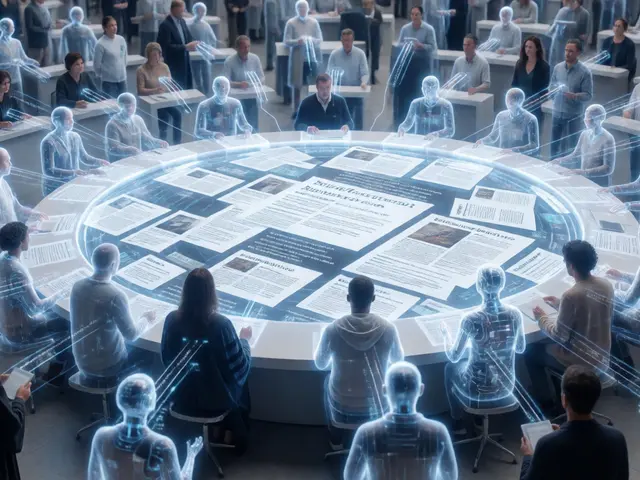
Ever clicked on a Wikipedia link only to find a little yellow box saying "This claim needs a better source"? That’s not a glitch. It’s the result of thousands of volunteers quietly arguing over whether a source is good enough. This isn’t about opinions-it’s about trust. And the system that makes it happen is called the Reliable Sources Noticeboard.
What the Reliable Sources Noticeboard Actually Does
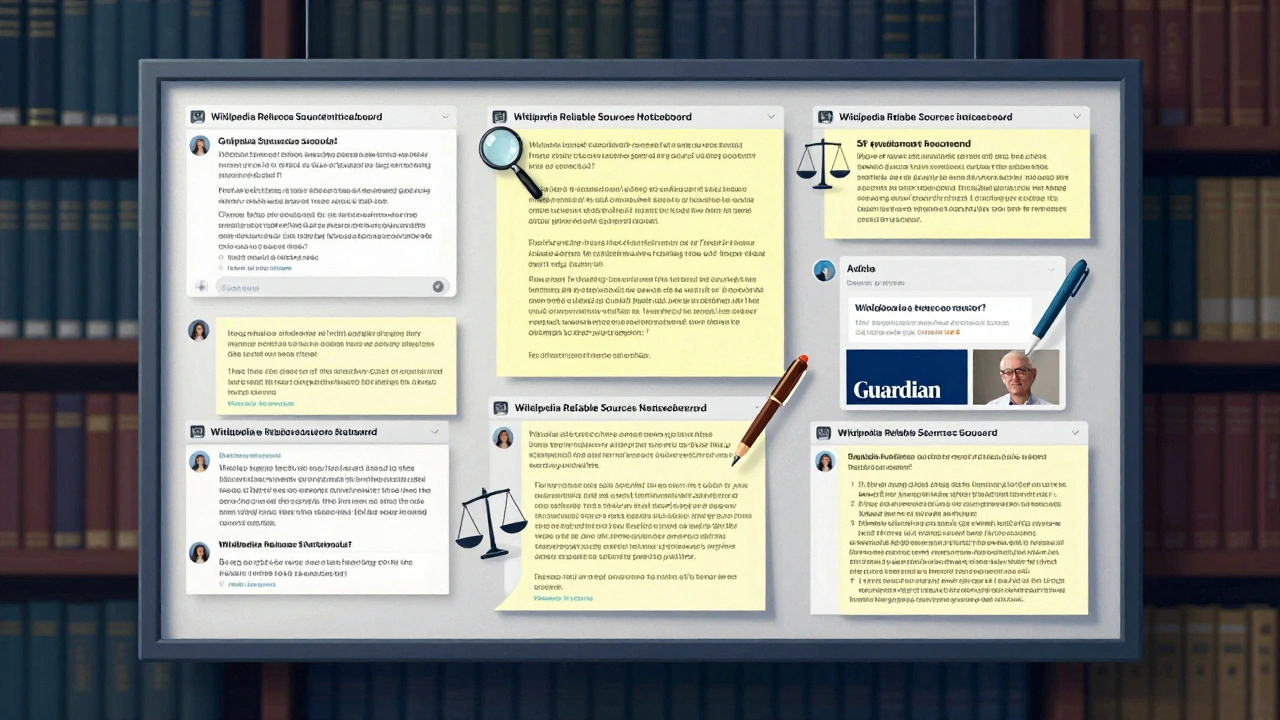
The Reliable Sources Noticeboard (RSN) is a discussion page on Wikipedia where editors debate whether a source is trustworthy enough to cite in articles. It’s not a rulebook. It’s not a committee. It’s a living, messy, public conversation where anyone can join. If someone adds a blog post as a reference for a medical fact, someone else might flag it. That’s when the RSN comes alive.
Editors don’t just say "this is bad." They explain why. Did the source have a conflict of interest? Was it peer-reviewed? Is it a primary source or a summary? Is the author qualified? These aren’t abstract standards-they’re practical checks that keep misinformation out of public knowledge.
For example, in 2023, a user tried to cite a self-published ebook by a retired engineer as proof that a certain diet reversed diabetes. The RSN thread lasted six days. Six editors weighed in. One pointed out the author had no medical training. Another checked the publisher’s history-it was a vanity press. A third pulled up the original clinical studies the book claimed to reference and found they didn’t support the claim. The source was removed. No one was banned. No one was punished. Just a clear, documented decision based on evidence.
How Sources Get Rated-Without a Rulebook
Wikipedia doesn’t have a fixed list of "approved" sources. Instead, editors follow a few guiding principles, refined over 20 years of real-world use:
- Primary sources like original research papers, court records, or official reports are strong-but only if they’re relevant. A 1987 medical journal article might be primary, but if newer studies contradict it, it’s not enough on its own.
- Secondary sources like peer-reviewed journals, major newspapers, or academic books are preferred. They’ve been filtered by editors, fact-checkers, or reviewers.
- Self-published sources (blogs, personal websites, YouTube videos) are generally not acceptable unless the author is a recognized expert in a field and the content is widely cited by reliable sources.
- News outlets vary. The New York Times and BBC are trusted. A local blog with no editorial oversight isn’t.
There’s no official ranking system. But over time, patterns emerge. For instance, The Lancet, JAMA, and The New England Journal of Medicine are almost always accepted for medical claims. Local tabloids or partisan outlets like Breitbart or The Daily Mail are often rejected unless used to report on their own claims (e.g., "This outlet reported X, which was later debunked by Y").
Who Runs the Noticeboard? (Spoiler: No One)
The RSN doesn’t have moderators, admins, or paid staff. It’s run by volunteers who care enough to show up. Some are academics. Some are librarians. Some are just careful readers who noticed a pattern of bad sourcing in articles they liked.
There’s no voting system. No majority wins. Consensus is built through discussion. If three experienced editors agree a source is unreliable and no one with expertise pushes back, the decision stands. If someone challenges it with a better argument, the group reconsiders.
That’s why the RSN works. It’s not about power. It’s about credibility. If you’re wrong, someone will call you out-with evidence. And if you’re right, you’ll get thanked.
Real Cases That Changed How Sources Are Viewed
Some RSN decisions have had lasting impact. In 2021, a user cited a 2005 article from The Guardian as proof that a certain climate model was "discredited." The RSN thread dug deeper. Turns out, the article was quoting a single scientist’s opinion, not a scientific consensus. The Guardian itself had published multiple follow-ups confirming the model’s validity. The source was rejected-not because it was a newspaper, but because it was being misused.
Another case involved a citation from a university press release. Press releases are often unreliable-they’re marketing tools. But when the press release was backed by a peer-reviewed paper from the same institution, editors accepted it. The key wasn’t the source type-it was the supporting evidence.
These aren’t isolated incidents. They’re part of a pattern: context matters more than label. A Wikipedia editor doesn’t say "CNN is bad." They say "this CNN article misrepresents the study it cites, and here’s the original paper to prove it."
Why This Matters Beyond Wikipedia
People think Wikipedia is just a reference site. But it’s become a mirror for how society decides what’s true. When a student uses a Wikipedia article to write a paper, they’re relying on a system that filters out junk before it reaches them. That filtering isn’t automated. It’s human.
Think about it: if you Google "does coffee cause cancer," you’ll get conflicting results. But if you go to Wikipedia’s page on coffee and cancer, you’ll see a summary backed by meta-analyses from reputable journals. That’s because someone spent hours checking sources, arguing on the RSN, and updating the article.
The RSN is the quiet engine behind the reliability of one of the most visited sites on Earth. It’s not perfect. But it’s transparent. You can see every argument, every source, every revision. That’s more than you can say for most news outlets or social media algorithms.
How to Use the RSN as a Reader
You don’t have to edit Wikipedia to benefit from the RSN. When you see a claim on Wikipedia, check the references. If a source looks sketchy, click the "View history" tab on the article and look for RSN discussions linked in the talk page. You’ll often find the full debate that led to the source being accepted or rejected.
Want to improve your own research? Use the RSN as a checklist:
- Is the source peer-reviewed? If not, why is it being used?
- Who wrote it? Are they an expert, or just someone with an opinion?
- Is the source trying to sell you something?
- Has this source been challenged before? Search "Reliable Sources Noticeboard" + the source name.
- Does the claim match what other reliable sources say?
These aren’t Wikipedia rules. They’re just good research habits.

What Happens When the System Fails
The RSN isn’t flawless. Sometimes, biased editors push their agenda. Sometimes, a controversial source slips through because no one noticed. That’s why Wikipedia has backup systems: edit wars are flagged, contentious articles are protected, and high-profile cases get reviewed by experienced editors.
One of the most famous failures was the 2018 "Pizzagate" conspiracy theory, which briefly appeared in a Wikipedia article citing fringe blogs. It was removed within hours after multiple editors flagged it on the RSN. But the damage was done-some people had already shared the article. That’s why the RSN now has a faster response protocol for high-risk topics like health, politics, and elections.
Still, the system works better than most. A 2022 study by the University of Oxford found that Wikipedia articles on medical topics were more accurate than those on WebMD and Healthline, largely because of the RSN’s source filtering.
| Source Type | Typical Acceptance | When It’s Rejected |
|---|---|---|
| Peer-reviewed journal | Almost always | If outdated, retracted, or misquoted |
| Major newspaper (NYT, BBC) | Usually | If reporting opinion as fact, or citing unverified claims |
| University press release | Only if backed by peer-reviewed paper | If it’s promotional or lacks data |
| Self-published blog | Very rarely | Almost always |
| Corporate website | Only for factual statements (e.g., company history) | For claims about products, science, or health |
Frequently Asked Questions
Can I trust Wikipedia if anyone can edit it?
Yes, for most factual topics. Wikipedia’s system relies on redundancy-thousands of eyes checking edits. The Reliable Sources Noticeboard ensures that claims are backed by verifiable evidence, not personal opinion. Studies show Wikipedia’s accuracy rivals or exceeds traditional encyclopedias on science, medicine, and history.
Why do some sources get rejected even if they’re real?
Because being real doesn’t mean being reliable. A government report might be official, but if it’s outdated or biased, it’s not useful for a neutral summary. Wikipedia doesn’t want the truth-it wants the best, most widely accepted version of the truth, backed by sources that have been vetted by experts.
Can I submit a source to the Reliable Sources Noticeboard?
Yes. Just go to the RSN page, click "Edit," and add your question under the appropriate section. Be specific: include the source, the claim it supports, and why you think it’s reliable or not. Others will respond. It’s public, open, and evidence-based.
What if I disagree with a decision on the RSN?
You can challenge it. The RSN is designed for debate. Find the discussion, add your evidence, and cite better sources. If you’re right, the community will change its mind. If you’re wrong, you’ll learn why. That’s how knowledge improves.
Is the RSN biased toward Western sources?
Historically, yes. But that’s changing. Editors from over 100 countries now participate. Non-Western academic journals, local newspapers, and regional studies are increasingly accepted when they meet the same standards. The goal isn’t to favor one region-it’s to favor reliable evidence, wherever it comes from.
What Comes Next
The Reliable Sources Noticeboard won’t fix misinformation overnight. But it’s one of the few systems on the internet that actually tries. It’s slow. It’s noisy. It’s not always fair. But it’s transparent-and that’s rare.
If you care about truth, you don’t need to edit Wikipedia. But you can use its tools. When you read something online, ask: "What’s the source? Is it reliable? Has it been checked?" That’s the real lesson of the RSN. Not just what Wikipedia does-but how you can do it too.