Wikipedia’s Request for Adminship (RfA) process in 2025 is not what it used to be. Back in 2010, a well-known editor could walk into an RfA with a few hundred edits and a polite message, and walk out with a checkmark. Today, candidates need more than just edit counts. They need a track record of conflict resolution, clear communication, and proof they can handle pressure without burning out. The success rate? It’s down to 17%-the lowest in over a decade.
What’s Changed in RfA Since 2020
In 2020, about 32% of RfA candidates succeeded. By 2023, that number had dropped to 21%. In early 2025, the trend continued. Of the 482 RfA nominations reviewed between January and March, only 82 passed. That’s 17%. Why? The community isn’t just asking if you can edit. They’re asking if you can lead.
Wikipedia’s admin role used to be about fixing vandalism and blocking spambots. Now, it’s about mediating disputes between editors who’ve been arguing for months over article tone, sourcing, or geopolitical framing. Admins are expected to know the nuances of neutral point of view in contentious topics-from climate change to gender identity to historical revisionism. One 2024 internal survey of active admins showed that 68% of their time was spent on discussion page moderation, not technical enforcement.
What Candidates Are Getting Asked Now
The questions on RfA pages have evolved. You won’t see much anymore like, “How many articles have you created?” Instead, you’ll see:
- “Can you describe a time you de-escalated a conflict between two editors with opposing views on a sensitive topic?”
- “How do you handle a user who repeatedly cites unreliable sources but insists they’re correct?”
- “What’s your stance on the use of AI-generated content in drafts, and how would you respond if a user started using it heavily?”
These aren’t hypotheticals. They’re drawn from real incidents. In 2024, a candidate was rejected after admitting they once deleted a well-sourced section because they “didn’t like the tone.” The community didn’t care about the edit. They cared about the lack of judgment.
Another common red flag? Candidates who say they want to be an admin “to help the project” without naming a single area they care about. Vague answers like “I love Wikipedia” get ignored. Specifics matter: “I’ve spent three years improving medical articles on rare diseases because my sister had one,” or “I monitor edits to articles on Indigenous history because I’m part of that community.”
Success Is No Longer About Edit Count
It used to be that if you had 5,000 edits, you were a shoe-in. Now, candidates with 15,000 edits have failed, while others with 2,000 edits passed because they showed depth, not volume.
What actually moves the needle?
- Conflict resolution experience: Have you helped resolve a long-running edit war? Documented it? Showed restraint?
- Community trust: Do editors you’ve never met know your name and trust your intentions? You can’t fake this.
- Transparency: Are you open about your biases? Do you say, “I’m from Canada, so I may have a different take on this treaty,” instead of pretending neutrality?
- Consistency: Have you been active for over a year without disappearing for weeks? Admins need to be reliable, not just enthusiastic.
A 2025 analysis of successful RfAs found that candidates who mentioned specific mediation efforts were 4.3 times more likely to pass than those who didn’t. Candidates who cited Wikipedia’s policies by name-like WP:NOTCENSOR or WP:BRD-also scored higher. It’s not about quoting them perfectly. It’s about showing you understand how they apply in messy real-world situations.
Community Expectations Are Higher Than Ever
Wikipedia’s user base has grown more diverse, and so have its expectations. In 2025, the community isn’t just looking for editors who can delete pages. They want admins who can:
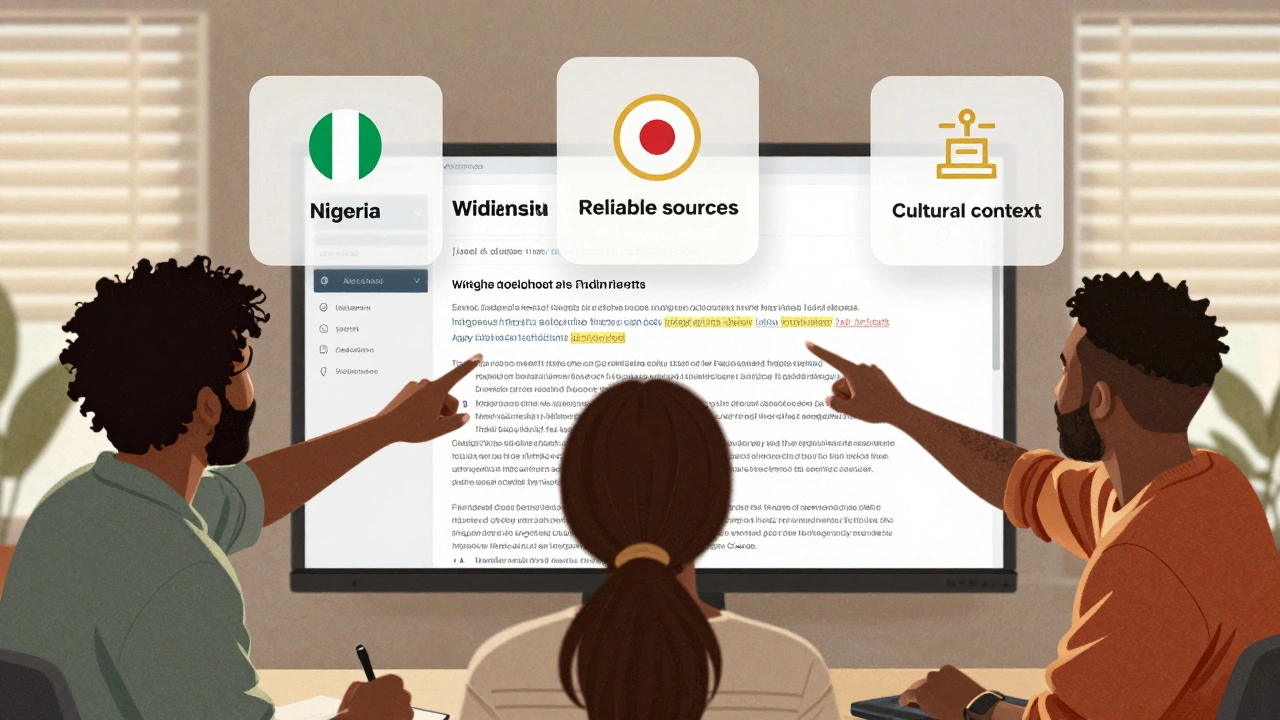
- Understand cultural context in sourcing (e.g., why a source from a Nigerian university might be more relevant than a U.S. newspaper on a topic about West Africa)
- Recognize systemic bias in article coverage (e.g., why 80% of biographies on Wikipedia are about men)
- Work with non-native English speakers without dismissing their edits
- Handle harassment reports with empathy, not bureaucracy
A 2024 study by the Wikimedia Foundation found that articles on topics related to marginalized communities had 37% more edit conflicts than others. Admins are now expected to step into those spaces-not just enforce rules, but help heal them.
There’s also a quiet but growing expectation: admins should be willing to step down if they’re overwhelmed. The community no longer sees burnout as a personal failure. It sees it as a system failure. Candidates who say, “I’m ready to take on more,” get questioned. Candidates who say, “I’ve had two long breaks in the last year because I needed to rest, and I’ve built better habits since,” get more respect.
The New Profile of a Successful Admin
The typical successful RfA candidate in 2025 looks like this:
- Has been editing for 3+ years
- Has participated in at least 3 formal mediation processes
- Has contributed to at least 2 community policy discussions
- Has received at least 15 endorsements from editors outside their usual circle
- Can name three Wikipedia policies and explain how they’ve applied them in practice
- Doesn’t say “I want to be an admin because I’m good at this.” Instead, they say, “I want to be an admin so I can help make this space safer for new contributors.”
And here’s the thing: most of them weren’t the most prolific editors. They were the most thoughtful.

Why So Many RfAs Fail
Failure isn’t usually about bad edits. It’s about poor communication. Candidates who:
- Answer questions with one-word replies
- Defend their past actions without reflection
- Ignore feedback or get defensive
- Claim they’re “just trying to help” without showing how
-are almost always rejected.
One 2025 RfA stood out because the candidate responded to every comment with a thoughtful paragraph, thanked critics by name, and admitted two mistakes they’d made in the past. They didn’t win because they were perfect. They won because they showed growth.
What This Means for New Editors
If you’re thinking about an RfA in 2025 or beyond, don’t rush it. The path isn’t about becoming a power editor. It’s about becoming a steady, reliable, and empathetic member of the community.
Start by:
- Joining a mediation team or helping with dispute resolution on talk pages
- Editing articles in underrepresented topics-not just to add content, but to understand how bias creeps in
- Reading past RfAs (even failed ones) to see what worked and what didn’t
- Asking veteran editors for feedback on your edits-not just for grammar, but for tone and fairness
- Waiting until you’ve been active for at least two years. Patience builds trust.
There’s no shortcut. The community doesn’t need more admins. It needs better ones.
What is the current success rate for RfA in 2025?
As of early 2025, the success rate for Request for Adminship (RfA) nominations on Wikipedia is approximately 17%. This is the lowest rate in over ten years, down from 32% in 2020. Out of 482 nominations reviewed between January and March 2025, only 82 candidates were granted admin rights.
What skills are most important for passing an RfA today?
Conflict resolution, transparency, and community trust matter more than edit count. Successful candidates can describe specific instances where they de-escalated disputes, acknowledged their own biases, and worked with editors from diverse backgrounds. They also understand how Wikipedia’s policies apply in real situations-not just recite them.
Do I need a high number of edits to become an admin?
No. While many admins have thousands of edits, edit count alone no longer guarantees success. Some candidates with as few as 2,000 edits have passed because they demonstrated deep involvement in community discussions, consistent behavior over time, and clear judgment in conflict situations. Quality of contribution matters far more than quantity.
Why are more RfAs failing now than in the past?
The community has raised its standards. Admins are no longer just enforcers-they’re mediators, mentors, and cultural gatekeepers. Candidates who answer questions poorly, ignore feedback, or lack self-awareness are rejected, even if they have strong technical skills. The focus is now on emotional intelligence and long-term reliability.
How can I prepare for an RfA if I’m not ready yet?
Start by engaging in mediation on talk pages, contributing to underrepresented topics, and reading past RfAs-both successful and failed ones. Ask experienced editors for feedback on your edits. Build relationships across different communities on Wikipedia. Wait at least two years before applying. The goal isn’t to become an admin-it’s to become someone the community trusts to be one.