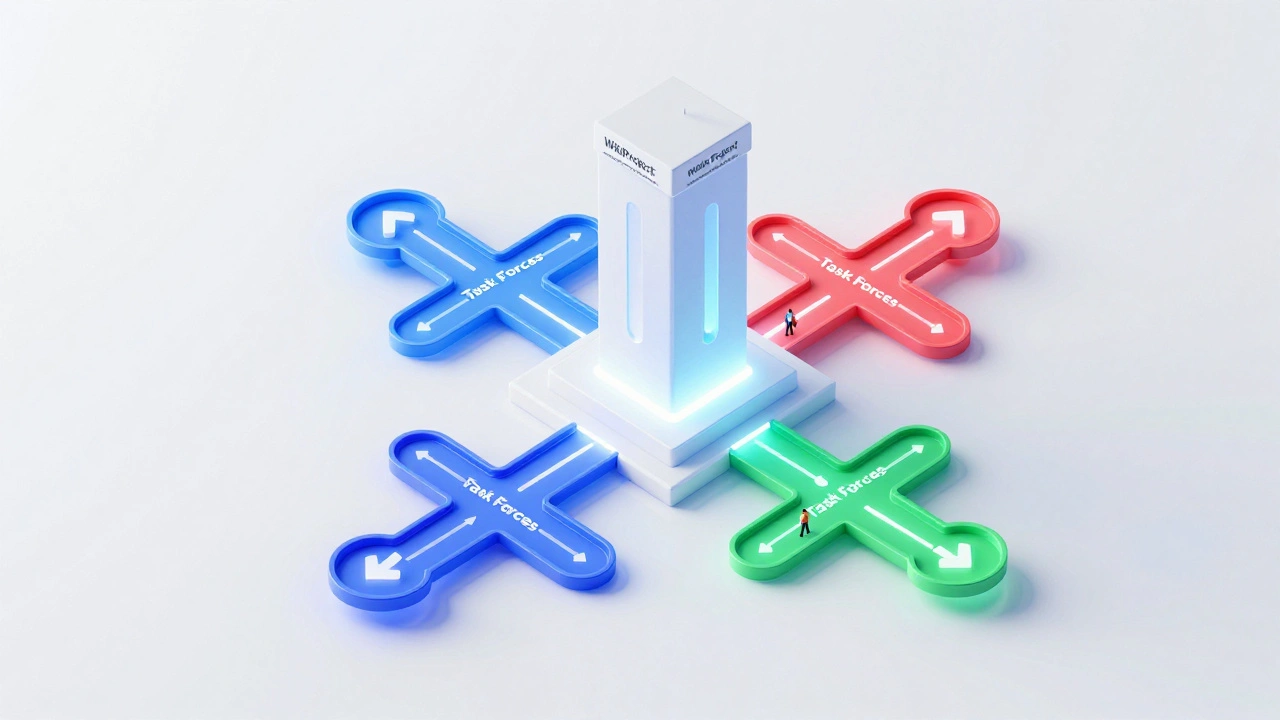
Imagine trying to edit an article about quantum physics without knowing the difference between a qubit and a quark. Now imagine doing it while someone else argues that the citation needs to be in APA format, not Chicago style. This chaos is exactly why Wikipedia is a free online encyclopedia written collaboratively by volunteers worldwide. It doesn’t just rely on random edits; it relies on structure. Specifically, it relies on WikiProjects are community-created groups that coordinate work on specific topics or types of articles. But even these massive projects can get unwieldy. That’s where Task Forces are specialized subgroups within WikiProjects that focus on narrow subjects or specific workflows. come in.
If you’ve ever wondered how Wikipedia manages to keep its millions of articles consistent, accurate, and well-sourced across every topic from ancient history to modern coding languages, the answer lies in these specialized workflows. Task Forces are the engine room of Wikipedia’s volunteer labor. They break down huge topics into manageable chunks, ensuring that experts talk to experts, rather than generalists guessing at details.
The Hierarchy: From WikiProjects to Task Forces
To understand task forces, you first need to understand their parent entity: the WikiProject. A WikiProject is essentially a club for editors who care about a broad subject. For example, the WikiProject Medicine is a collaborative effort to improve medical and health-related articles on Wikipedia. covers everything from anatomy to pharmacology. If everyone in that project tried to review every single edit related to medicine, they would burn out instantly. The volume is simply too high.
This is where the Task Force acts as a filter. Within WikiProject Medicine, you might find the Cardiology Task Force. Editors here only look at heart-related articles. They know the specific terminology, the key journals, and the common misconceptions. This specialization allows for deeper expertise and faster turnaround times. It turns a sprawling, unmanageable interest group into a focused team with clear goals.
The relationship is hierarchical but flexible. A Task Force belongs to a WikiProject, which often belongs to a larger umbrella initiative. This structure mirrors real-world organizational charts but operates without formal authority. No one is paid to run these groups. Instead, influence comes from reputation, consistency, and the quality of contributions.
Why Specialization Matters in Collaborative Editing
You might ask: why not just let anyone edit anything? After all, Wikipedia’s core principle is that "anyone can edit." While true, this openness creates a paradox. Without guidance, low-quality information spreads quickly. Task Forces solve this by creating Specialized Workflows are structured processes that guide editors through specific tasks like sourcing, formatting, or dispute resolution. tailored to niche subjects.
Consider the WikiProject Aviation is a community group dedicated to improving aviation-related content on Wikipedia.. An editor interested in commercial airlines has different knowledge than one obsessed with vintage aircraft mechanics. By splitting into task forces like "Commercial Aviation" and "Military Aircraft," the project ensures that technical details are checked by people who actually understand them. This reduces errors and increases trust in the final article.
Moreover, specialized workflows help standardize formatting. In fields like chemistry or law, there are strict rules for naming compounds or citing cases. A Task Force can create templates and guidelines that enforce these standards automatically. This isn’t about bureaucracy; it’s about clarity. When readers see consistent formatting, they perceive the information as more reliable, even if they don’t realize why.

How Task Forces Operate: The Mechanics of Collaboration
So, how does a Task Force actually work? There’s no boss handing out assignments. Instead, operation relies on self-organization and shared tools. Here’s what typically happens:
- Topic Selection: Members identify gaps or weaknesses in existing articles. Maybe an article on a famous physicist lacks recent citations. Or perhaps a new technology needs a stub created.
- Assessment: Articles are tagged with quality ratings (like "Stub," "Good Article," or "Featured Article") and importance levels. This helps prioritize work. High-importance, low-quality articles get attention first.
- Discussion Pages: Each Task Force has a discussion page where members debate changes, resolve disputes, and share resources. These pages act as digital watercoolers for experts.
- Templates and Banners: Task Forces use standardized banners on article talk pages to signal ownership and provide quick links to relevant guidelines. This makes it easy for outside editors to find the right people to consult.
For instance, the WikiProject Biography is a large-scale effort to ensure biographical articles meet neutrality and verifiability standards. uses detailed assessment criteria. If you’re writing about a living person, you’ll likely encounter the "Living People" Task Force, which enforces stricter sourcing rules to protect privacy and prevent defamation. Their workflow includes checking every claim against primary sources and removing unsourced anecdotes immediately.
Challenges in Maintaining Volunteer Momentum
Despite their effectiveness, Task Forces face significant hurdles. The biggest challenge is retention. Volunteers have lives, jobs, and families. Interest wanes. A Task Force might start with ten active members and drop to two within a year. This leads to bottlenecks, where critical reviews pile up because no one is available to check them.
Burnout is another issue. Editors who invest deeply in a niche topic often feel responsible for maintaining all related articles. When they stop contributing, the quality of those articles can decline rapidly. To combat this, successful Task Forces emphasize inclusivity. They encourage newcomers to take small steps, like fixing typos or adding one citation, rather than demanding full mastery of the subject.
Additionally, there’s the risk of echo chambers. When a small group controls a topic, they may inadvertently promote a specific viewpoint. Wikipedia’s core policy of Neutral Point of View (NPOV) is a fundamental guideline requiring articles to represent all significant viewpoints fairly. requires constant vigilance. Task Forces must actively seek diverse perspectives and welcome criticism from outside their circle.
| Feature | General WikiProject | Specialized Task Force |
|---|---|---|
| Scope | Broad (e.g., All History) | Narrow (e.g., Medieval European History) |
| Expertise Level | Mixed | Highly Specialized |
| Workflow Speed | Slower due to volume | Faster due to focus |
| Guideline Complexity | General policies | Detailed, topic-specific rules |
| Community Size | Large, diffuse | Small, tight-knit |

Real-World Impact: Case Studies in Efficiency
Let’s look at concrete examples. During major events, like natural disasters or political elections, Wikipedia experiences traffic spikes. Task Forces play a crucial role here. The WikiProject Current Events is a group focused on rapidly updating and verifying articles related to ongoing news stories. mobilizes editors to add reliable sources and remove speculation. Without this coordinated effort, articles could become cluttered with rumors or biased reporting.
Another example is the WikiProject Science is an umbrella project overseeing scientific disciplines on Wikipedia.. Under this umbrella, the "Physics Task Force" ensures that complex equations are rendered correctly using LaTeX syntax and that theoretical concepts are explained accessibly. They also monitor for pseudoscientific claims, which frequently appear in fringe topics. Their specialized workflow catches errors that general editors might miss entirely.
In software development contexts, the WikiProject Programming Languages is a collaborative group improving documentation for programming languages and technologies. works closely with developers. They verify code samples, update version histories, and clarify licensing terms. This precision matters because many programmers use Wikipedia as a quick reference. Incorrect information here can lead to bugs in real-world applications.
Getting Involved: How to Join a Task Force
If you want to contribute, joining a Task Force is straightforward. You don’t need permission. Simply visit the Task Force page, read the guidelines, and start editing. Most Task Forces appreciate any help, especially with routine maintenance tasks like categorizing articles or fixing broken links.
Here’s a simple checklist for getting started:
- Identify Your Interest: Choose a topic you know well or are passionate about learning.
- Find the Right Group: Use the WikiProject portal to locate relevant Task Forces. Look for active discussion pages.
- Read the Guidelines: Every Task Force has specific rules. Ignoring them can lead to conflicts.
- Start Small: Begin with minor edits. Build trust before tackling controversial topics.
- Engage Politely: Discuss changes on talk pages. Assume good faith from other editors.
Remember, the goal isn’t to dominate a topic but to improve it. Collaboration thrives when participants respect each other’s time and expertise.
What is the difference between a WikiProject and a Task Force?
A WikiProject is a broad community group focusing on a large subject area, such as "History" or "Science." A Task Force is a smaller subgroup within a WikiProject that focuses on a very specific sub-topic, like "Medieval History" or "Quantum Physics." Task Forces allow for deeper specialization and more efficient workflows.
Do I need special permissions to join a Wikipedia Task Force?
No, you do not need special permissions. Anyone with a Wikipedia account can participate in a Task Force. You simply need to follow the group's guidelines and contribute constructively. Active participation builds your reputation within the community.
How do Task Forces handle disagreements among editors?
Disagreements are handled through discussion on article talk pages. Task Forces encourage polite dialogue and adherence to Wikipedia's core policies, such as Neutral Point of View and Verifiability. If consensus cannot be reached, editors may escalate the issue to broader mediation processes.
Can Task Forces delete content from articles?
Task Forces themselves do not have administrative powers to delete content. However, experienced editors within a Task Force can propose deletions if content violates Wikipedia's policies, such as being unsourced or promotional. Final deletion decisions are usually made through established community processes like Articles for Deletion.
Why are specialized workflows important for Wikipedia's accuracy?
Specialized workflows ensure that complex topics are reviewed by individuals with relevant expertise. This reduces errors, improves consistency, and enhances the overall reliability of articles. General editors may lack the depth of knowledge needed to verify technical details, making Task Forces essential for quality control.