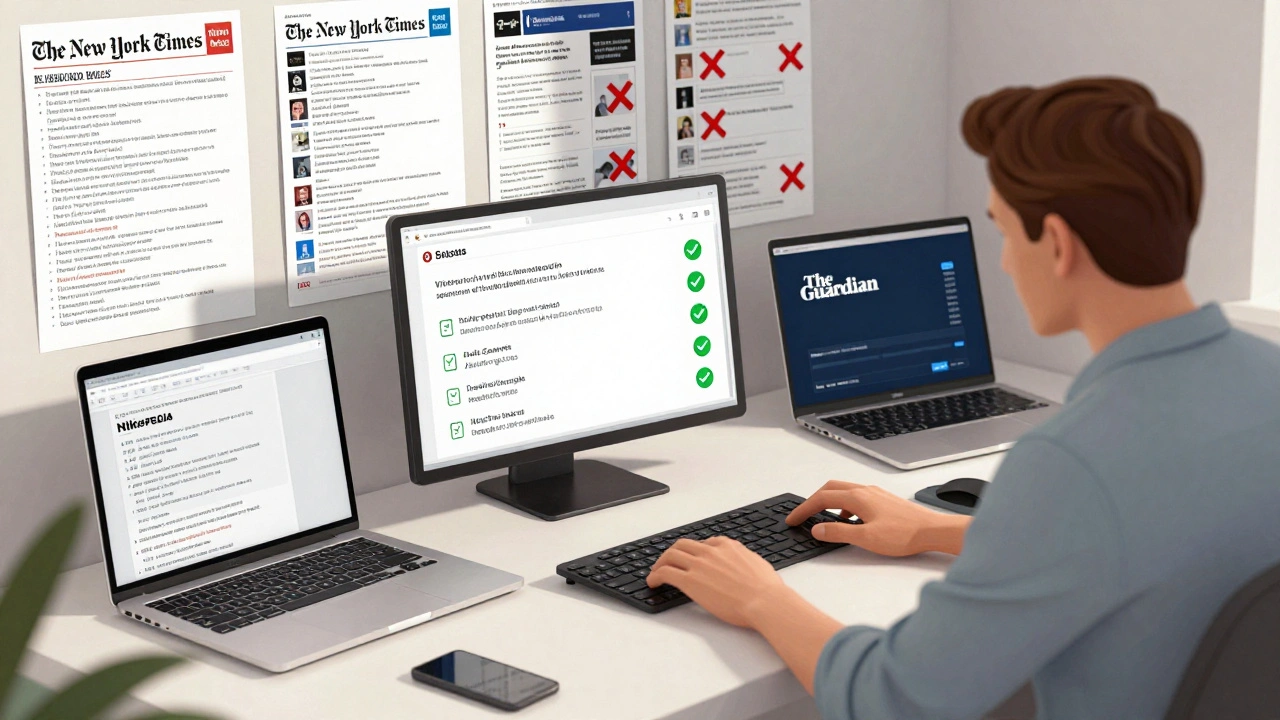
Wikipedia doesn’t just accept any article or fact. Every claim on the site needs to be backed by a source that’s trustworthy, independent, and published. But not all sources are created equal. That’s where source reliability tables come in - a practical tool used by editors to judge whether a publication can be trusted to support Wikipedia content.
Why Source Reliability Matters on Wikipedia
Wikipedia’s core rule is verifiability. That means readers should be able to check every fact against a published source. But here’s the catch: just because something is published doesn’t mean it’s reliable. A blog post, a press release, or a self-published book might be technically "published," but they’re not credible enough for Wikipedia.Think of it like a courtroom. Evidence needs to come from qualified witnesses, not random people shouting in the gallery. Wikipedia editors act like jurors. They need to know: Is this source known for fact-checking? Has it been around for years? Does it have a reputation for accuracy? Or is it a one-off site with no editorial standards?
Without source reliability tables, Wikipedia would be flooded with misinformation. Conspiracy theories, unverified rumors, and biased opinion pieces could slip in under the guise of "published content." That’s why the community built a system to filter out low-quality sources before they even get a chance to appear on a page.
How Source Reliability Tables Work
Source reliability tables aren’t official Wikipedia policies - they’re community-maintained guides. You’ll find them on pages like Wikipedia:Reliable sources/Perennial sources or Wikipedia:Reliable sources/Noticeboard. These tables list publications and assign them a reliability rating based on editorial standards, independence, and track record.Here’s how the ratings usually break down:
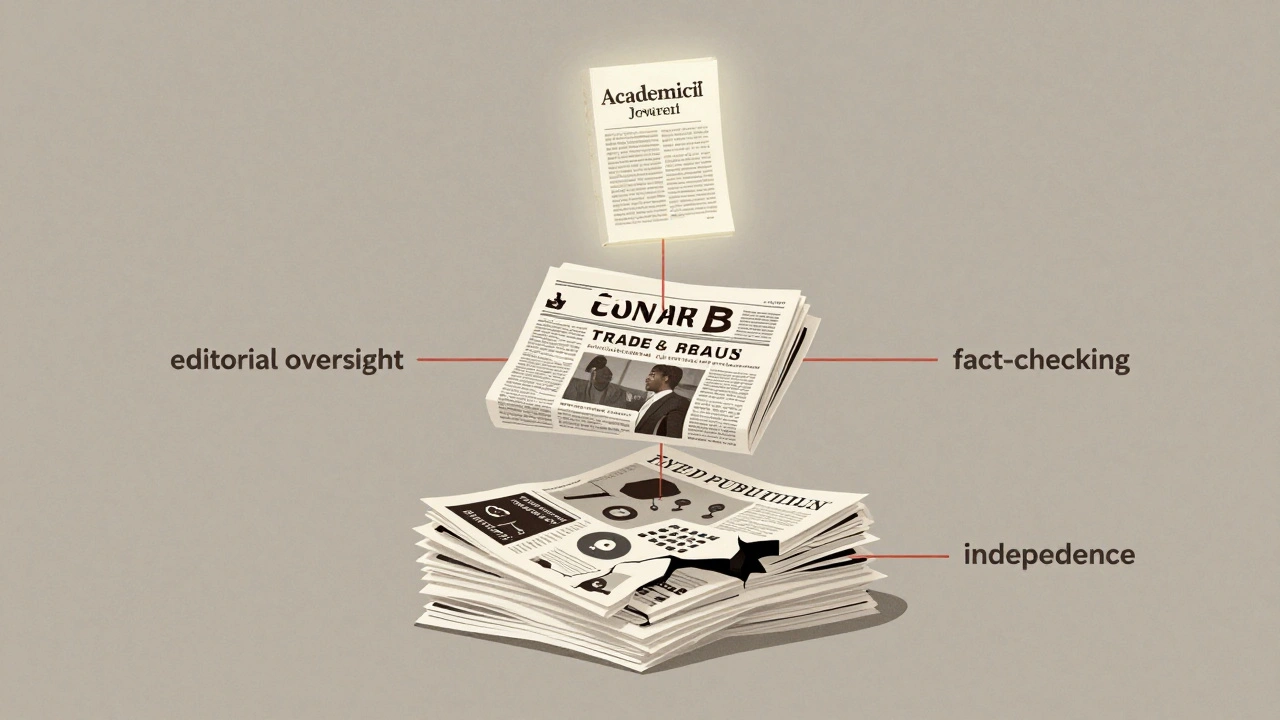
- High reliability: Major newspapers like The New York Times, The Guardian, or Le Monde. Academic journals with peer review. Books from university presses.
- Medium reliability: Local newspapers, trade magazines, or well-known blogs with editorial oversight. These can be used for niche topics but not for major claims.
- Low reliability: Self-published content, personal blogs, social media, press releases, or websites with no clear editorial process.
Editors don’t guess. They look up the source in these tables. If a publication isn’t listed, they ask for community input on the Reliable Sources Noticeboard. It’s not about popularity - it’s about process. A small-town newspaper with a full-time editor and fact-checking team might be rated higher than a viral TikTok account with a million followers.
Key Factors in Evaluating a Source
When editors assess a source, they ask five simple questions:- Who runs it? Is it a company, a university, or an individual? Independent organizations are more trustworthy than ones with a clear agenda.
- How is content selected? Does it have editors, fact-checkers, and a corrections policy? Or is everything posted instantly with no review?
- What’s its reputation? Has it been cited by other reliable sources? Has it ever been caught spreading false information?
- Is it independent? Does it take money from the subject it’s writing about? A pharmaceutical company’s own website isn’t a reliable source for drug safety claims.
- Is it current? A 20-year-old article might be outdated. Wikipedia prefers recent, up-to-date information unless the topic is historical.
For example, The Wall Street Journal is high reliability because it has a global newsroom, a corrections page, and a long history of accountability. But a website called "TechNewsDaily.com" with no author names, no about page, and ads everywhere? That’s low reliability - even if it looks professional.
Common Mistakes Editors Make
Even experienced editors slip up. Here are the most common errors:- Confusing popularity with reliability: A viral YouTube video or Reddit thread might get millions of views, but that doesn’t make it factual.
- Assuming all news sites are equal: A local tabloid might cover the same story as The Washington Post, but its standards are far lower.
- Using press releases as sources: Companies write press releases to promote themselves. Wikipedia needs third-party reporting on those claims.
- Ignoring context: A source might be reliable in one field but not another. A medical journal is trustworthy for science, but not for political analysis.
- Believing "it’s on the internet, so it must be true": This is the biggest trap. Just because something appears on a website doesn’t mean it’s accurate.
One real example: In 2023, an editor tried to cite a blog post from a self-published author to claim that a small town had banned a specific type of fertilizer. The blog had no citations, no author bio, and no contact info. The edit was reverted within an hour. The source didn’t meet even the lowest reliability bar.

How to Use Source Reliability Tables as a Reader
You don’t have to be an editor to use these tables. If you’re reading a Wikipedia article and want to check a claim, click the citation. Look at the source. Then ask yourself: Is this something a professional journalist or researcher would stand by?Wikipedia’s citations are usually linked to the exact sentence they support. If a claim about a company’s revenue comes from its own investor relations page, that’s a red flag. If it comes from Bloomberg or Reuters, that’s solid.
Try this: Next time you read a Wikipedia article, pick one fact you’re unsure about. Click the number next to it. Go to the source. If the source is a blog, forum, or company site - you’ve found a weak link. If it’s a newspaper or academic paper, you’ve found a strong one.
The Evolution of Wikipedia’s Source Policy
Wikipedia’s source reliability standards didn’t appear overnight. In the early 2000s, the site was full of unverified claims. Anyone could add anything. By 2005, the community realized they needed structure. The first reliable sources guidelines were drafted in 2006. Over the next decade, they evolved with input from thousands of editors.Major turning points:
- 2008: The policy was formalized to require third-party sources for controversial claims.
- 2012: The Reliable Sources Noticeboard was created to handle gray-area cases.
- 2017: The community started rejecting sources that were clearly partisan or promotional, even if they were "published."
- 2022: Social media and influencer content were explicitly classified as unreliable for factual claims.
Today, the policy is stricter than ever. The goal isn’t to censor - it’s to protect the integrity of the information. Wikipedia isn’t a platform for opinions or trends. It’s a reference tool. And references need to be trustworthy.
What Happens When a Source Is Challenged?
If you dispute a source used in a Wikipedia article, you can flag it. Go to the article’s talk page and say: "This source is unreliable because..." Then explain why. Maybe it’s a known conspiracy site. Maybe it has no editorial oversight. Maybe it’s self-published.Other editors will review your claim. If they agree, they’ll remove the citation and replace it with a better one. If they disagree, they might ask for more evidence. It’s not about who’s louder - it’s about who can show the best reasoning.
There’s a famous case from 2021 involving a claim about a fictional character’s "real-world origin." One editor cited a fan wiki. Another cited a peer-reviewed journal on pop culture history. The journal won. The fan wiki was removed. Why? Because the journal had authors, citations, and peer review. The fan wiki had none of that.
Alternatives to Source Reliability Tables
Some people think Wikipedia should just ban all non-academic sources. But that’s not practical. Not every topic has peer-reviewed papers. For example, if you’re writing about a local band, you won’t find academic journals - but you might find a well-respected music magazine with a long history.Wikipedia allows medium-reliability sources for niche topics. The key is matching the source to the subject. A local newspaper is fine for covering a city council meeting. It’s not fine for discussing quantum physics.
There’s also the concept of "secondary sources." Wikipedia prefers them over primary ones. A newspaper article analyzing a study is better than the study itself. Why? Because the article interprets the research, checks for errors, and puts it in context. Wikipedia isn’t a repository for raw data - it’s a summary of what experts agree on.
How to Build Your Own Source Reliability Checklist
You don’t need to memorize every publication. Here’s a simple 3-step checklist you can use anytime:- Look for an editorial team: Does the site list editors, writers, or a masthead? If not, it’s probably not reliable.
- Check for corrections: Does the site have a corrections or updates page? Reliable outlets admit mistakes.
- Search for reputation: Type the site’s name + "bias" or "reliability" into a search engine. Do credible outlets like Media Bias/Fact Check or Snopes mention it?
If you can’t answer yes to all three, assume it’s not reliable for Wikipedia purposes. This rule works for blogs, news sites, YouTube channels, and even podcasts.
Final Thoughts: Reliability Is a Process, Not a Label
Wikipedia’s source reliability system isn’t perfect. It’s messy, sometimes slow, and occasionally inconsistent. But it’s the best system we have. It’s built by people who care about accuracy, not clicks or views.What makes a source reliable isn’t its brand name - it’s its process. Who writes it? How is it checked? Who holds them accountable? Those are the real questions. And those are the questions Wikipedia editors ask every day.
If you’re reading Wikipedia, you’re using a resource that filters out noise. That filter exists because of these tables - and because of the editors who use them. Next time you cite a Wikipedia fact, remember: someone took the time to make sure it was true.
Can I use a Wikipedia article as a source for another Wikipedia article?
No. Wikipedia articles are tertiary sources - they summarize information from other sources. You must cite the original source that the Wikipedia article itself references. Using Wikipedia as a source creates a chain of unverified claims and violates verifiability policies.
Are academic journals always reliable?
Most are, but not all. Peer-reviewed journals from reputable publishers like Springer, Elsevier, or university presses are generally high reliability. However, predatory journals - those that charge authors to publish without proper review - are unreliable. Always check the journal’s reputation and publisher before citing.
Can I use a source from a country with low press freedom?
It depends. A state-run newspaper in a country with censorship is generally considered unreliable for factual claims. However, if the article reports on a verifiable event - like a public speech or official statistic - and other reliable sources confirm it, it can be used cautiously. Always cross-reference.
What about YouTube videos or podcasts?
They’re rarely acceptable as primary sources. Even expert-led YouTube channels or podcasts lack editorial oversight and permanence. If a video cites a published study, link to the study - not the video. If the video is an interview with an expert, it’s only usable if the expert is well-known and the transcript is archived in a reliable place.
How often are source reliability tables updated?
They’re updated continuously by editors. New publications are added when they prove consistent reliability. Outlets that lose credibility - like those caught spreading misinformation - are downgraded or removed. The process is open and transparent, with discussions on the Reliable Sources Noticeboard.