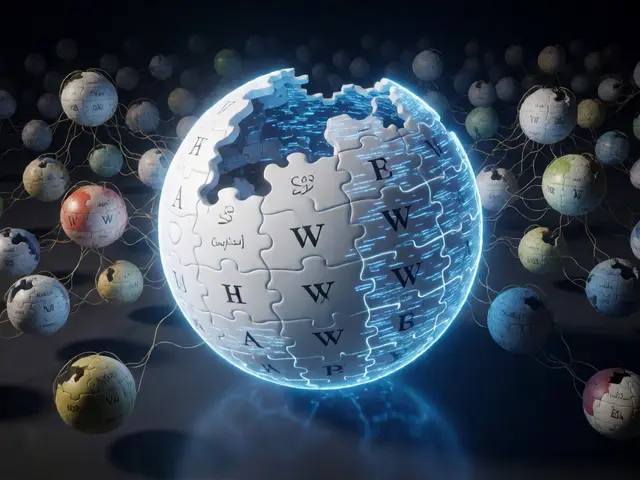
You might think that large language models (LLMs) learn everything from the chaotic, messy soup of social media posts and random blog comments. But there is a hidden backbone to how modern AI understands the world: it’s built on the rigid, organized logic of encyclopedic data. While raw text teaches an AI how humans speak, structured encyclopedia-style information teaches it what things actually are and how they relate to one another.
This distinction matters because as we move into 2026, the easy-to-scrape internet is running dry. We’ve fed machines every Reddit thread and news article available. Now, developers are turning back to curated, hierarchical knowledge bases-like Wikipedia, Britannica, and specialized domain wikis-to fix hallucinations and improve reasoning. If you care about why your AI assistant sometimes confidently states a lie, or why it struggles with complex factual queries, you need to understand the future of Encyclopedia-Structured Information a form of organized, hierarchical data that defines entities and their relationships, used to ground AI models in verifiable facts.
Why Raw Text Isn’t Enough for Smart AI
Imagine trying to learn chemistry by only reading romance novels. You’d pick up some words like "bond" and "reaction," but you wouldn’t grasp the periodic table’s structure. That’s essentially what early AI did with unstructured web text. It learned statistical probabilities, not causal truths. When you ask an AI, "Who was the CEO of Apple in 1997?", it isn’t looking up a fact; it’s guessing which word most likely follows "CEO of Apple in 1997" based on patterns.
Encyclopedia-structured information solves this by providing explicit relationships. Instead of hoping the model infers that Steve Jobs founded NeXT, the data explicitly states: Steve Jobs [founded] NeXT. This shift from probabilistic guessing to deterministic lookup is critical for high-stakes applications. In healthcare, finance, or law, "probably right" isn’t good enough. We need "factually grounded."
| Feature | Unstructured Web Text | Encyclopedia-Structured Data |
|---|---|---|
| Data Format | Natural language paragraphs | Knowledge Graphs (Triples) |
| Fact Verification | Low (prone to hallucination) | High (linked to sources) |
| Reasoning Capability | Pattern matching | Logical inference |
| Maintenance Cost | Low (scraping) | High (curated updates) |
The Rise of Knowledge Graphs as AI Memory
Knowledge Graphs a structured representation of real-world objects and their interrelations, often visualized as nodes and edges are the digital evolution of the encyclopedia. They take the static entries of a traditional almanac and turn them into a dynamic network. For AI training, this means models aren’t just memorizing text; they’re learning a map of reality.
Consider the entity "Paris." In a knowledge graph, Paris isn’t just a string of characters. It connects to "France" via a "capital_of" edge, to "Seine" via a "located_in" edge, and to "Eiffel Tower" via a "landmark" edge. When an AI trained on this structure answers a question about travel logistics in Europe, it doesn’t just retrieve a sentence; it traverses these connections. This allows for multi-hop reasoning. If you ask, "What currency is used near the Eiffel Tower?", the AI can jump from Eiffel Tower → Paris → France → Euro. Without the structured link between Paris and France, the AI might guess incorrectly if the specific phrase wasn’t common in its training corpus.
How Encyclopedic Data Reduces Hallucinations
Hallucinations are the Achilles' heel of generative AI. They happen when the model prioritizes fluency over accuracy. By integrating encyclopedia-structured information through a technique called Retrieval-Augmented Generation (RAG), we force the AI to check its work against a trusted source before answering.
Think of RAG as giving the AI an open-book test where the book is a live-updating encyclopedia. When you ask a question, the system first searches the knowledge base for relevant structured facts. Then, it feeds those facts to the language model along with your prompt. The model then generates an answer that must align with those retrieved facts. This drastically reduces the chance of the AI inventing non-existent books, laws, or historical events.
- Source Attribution: Structured data allows the AI to cite exactly where a fact came from, increasing trust.
- Consistency: Unlike user-generated content, which varies wildly in tone and accuracy, encyclopedic entries aim for neutrality and verification.
- Conflict Resolution: When two sources disagree, structured databases often have metadata indicating confidence levels or recency, helping the AI choose the better answer.

The Challenge of Keeping Knowledge Current
Here’s the catch: encyclopedias are slow. Traditional publishing takes months. Even crowd-sourced platforms like Wikipedia rely on human editors who may lag behind breaking news. AI moves at the speed of light, but truth moves at the speed of verification. This creates a tension in AI Training the process of feeding data to machine learning algorithms to enable them to perform tasks without being explicitly programmed.
If an AI relies too heavily on static encyclopedic snapshots, it becomes outdated. If it relies too much on live social media, it becomes gossipy and unreliable. The future solution lies in hybrid systems. These systems use automated agents to monitor news feeds and cross-reference new claims against existing knowledge graphs. If a new scientific study contradicts an established encyclopedia entry, the system flags it for review rather than immediately updating the core truth. This "trust but verify" approach ensures that the AI’s knowledge base remains both current and accurate.
Specialized Encyclopedias for Niche Industries
We are moving away from one-size-fits-all general knowledge. The next wave of AI specialization involves industry-specific encyclopedic structures. A medical AI shouldn’t just know general biology; it needs access to a highly structured, constantly updated database of drug interactions, clinical trial results, and anatomical variations.
Companies are now building proprietary knowledge graphs that function as internal encyclopedias. For example, a legal AI might be trained on a structured database of case law, where each precedent is linked to statutes, judges, and outcomes. This specificity allows for deeper expertise. A generalist AI might know what a lawsuit is; a specialist AI trained on legal encyclopedic structures knows the procedural nuances of filing a motion in federal court versus state court.

Ethical Implications of Curated Truth
Who decides what goes into the encyclopedia? Historically, encyclopedias reflected the biases of their editors. As we feed these curated datasets into AI, we risk encoding historical biases into our machines. If a knowledge graph underrepresents certain cultures or perspectives, the AI will inherit those blind spots.
Furthermore, there is the issue of "truth decay." In an era of misinformation, distinguishing between verified encyclopedic fact and sophisticated fake news is harder than ever. AI systems must be designed to recognize uncertainty. Instead of stating a falsehood with confidence, a well-trained AI should say, "This fact is disputed in current records." This requires training models not just on what is true, but on the status of the truth-whether it is settled, debated, or emerging.
Key Takeaways
- Structure beats chaos: Encyclopedia-structured information provides the logical framework AI needs for accurate reasoning, unlike raw text which only offers statistical patterns.
- Knowledge Graphs are key: These networks of entities and relationships allow AI to perform multi-hop reasoning and connect disparate facts logically.
- RAG reduces errors: Retrieval-Augmented Generation uses structured data to ground AI responses, significantly lowering the rate of hallucinations.
- Hybrid updates are necessary: Static encyclopedias become outdated quickly; future systems will blend curated data with real-time verification to stay current.
- Specialization is growing: Industry-specific knowledge graphs are enabling AI to develop deep, expert-level understanding in fields like medicine and law.
What is the difference between unstructured and structured data in AI?
Unstructured data includes raw text like emails, blogs, and social media posts, which lacks a predefined format. Structured data, such as encyclopedia entries or knowledge graphs, organizes information into specific fields and relationships (e.g., Entity A is related to Entity B). AI uses unstructured data to learn language patterns and structured data to learn factual relationships and logic.
Can AI replace human editors for encyclopedias?
Not entirely yet. While AI can draft entries and identify inconsistencies, human oversight is still crucial for verifying nuance, resolving disputes, and maintaining ethical standards. AI works best as a tool to assist human editors by suggesting updates and flagging potential errors, rather than acting as the sole authority.
How do knowledge graphs help AI avoid hallucinations?
Knowledge graphs provide a fixed set of verified facts and relationships. When an AI uses techniques like Retrieval-Augmented Generation (RAG), it retrieves these facts before generating an answer. This forces the model to stick to the provided evidence rather than relying solely on its internal probabilistic weights, which can sometimes lead to invented facts.
Is Wikipedia considered structured data?
Wikipedia itself is semi-structured. The text is natural language, but it contains links, categories, and infoboxes that create a web of connections. Projects like Wikidata extract this information into fully structured knowledge graphs, making it highly valuable for AI training purposes.
What are the risks of using biased encyclopedic data?
If the underlying encyclopedia data reflects historical biases or limited perspectives, the AI will replicate those biases in its outputs. This can lead to skewed representations of culture, history, or science. Continuous auditing and diverse sourcing are required to mitigate these risks.