Wikipedia doesn’t trust anyone’s word-not even experts. That’s not arrogance. It’s the core of its survival. If you’ve ever clicked on a tiny superscript number at the end of a Wikipedia article and been taken to a peer-reviewed journal, a government report, or a major news outlet, you’ve seen the Verifiability Policy in action. This isn’t just a rule. It’s the backbone of every fact you read on the site.
What the Verifiability Policy Actually Means
The Verifiability Policy says one thing clearly: content must be attributable to a reliable, published source. It doesn’t require truth. It doesn’t require original research. It requires proof that someone else, somewhere, has already said it-and that they’re someone you can reasonably trust.
That means if you write, "The average person drinks 8 glasses of water a day," you need to cite a medical journal, a public health agency, or a major textbook that says the same thing. If you can’t find it, the line gets deleted. Not because it’s false. But because it’s unproven.
This policy was formalized in 2004 after years of chaotic edits. Early Wikipedia had claims like "Napoleon was afraid of cats" or "The moon is made of cheese"-not because editors believed them, but because no one had a rule to stop them. The Verifiability Policy changed that. It shifted the burden from "prove it’s false" to "prove it’s true."
What Counts as a Reliable Source?
Not every book, blog, or tweet qualifies. Wikipedia has a clear hierarchy of source reliability.
- Academic journals-peer-reviewed, subject to expert scrutiny. These are the gold standard.
- Books from reputable publishers-university presses like Oxford or Harvard, or major trade publishers with editorial oversight.
- Major newspapers and news organizations-The New York Times, BBC, Reuters, Le Monde. These have fact-checking teams and legal teams.
- Government and intergovernmental publications-CDC, WHO, UN reports, national statistics offices.
These are trusted because they’re accountable. If they get something wrong, they face lawsuits, retractions, or loss of credibility.
On the other end:
- Self-published sources-blogs, personal websites, YouTube videos, Twitter threads. These are almost always rejected unless the author is a recognized expert in a field and the content is directly relevant.
- Corporate websites-company press releases or product pages. These are promotional, not neutral.
- Wikipedia itself-you can’t cite Wikipedia to prove something on Wikipedia. That’s circular logic.
There’s nuance. A blog post by a Nobel Prize-winning physicist about climate change? Maybe acceptable. A Reddit thread quoting that same physicist? No. Context matters. The source’s track record, editorial process, and independence determine its weight.
Why Not Just Let Anyone Say What’s True?
Imagine a world where anyone could add facts to a public encyclopedia without proof. You’d have competing claims about everything: vaccine safety, historical dates, economic data. Who wins? The loudest voice. The most persuasive. The one with the most followers.
Wikipedia avoids that by making evidence the judge. It doesn’t matter if you’re a professor, a teenager, or a CEO. If you can’t point to a published source that backs your claim, it doesn’t stay.
This system works because it’s consistent. A fact about the Roman Empire has the same standard as a fact about TikTok trends. A claim about the population of Tokyo must be cited like a claim about the chemical structure of caffeine. No exceptions.
And it’s not perfect. Sometimes reliable sources are wrong. Sometimes the best source is a 20-year-old textbook. But the system is designed to catch errors over time. As better sources emerge, articles get updated. The policy doesn’t demand perfection-it demands accountability.
How Editors Enforce the Policy
Wikipedia doesn’t have a central fact-checking team. Instead, thousands of volunteers do it in the background.
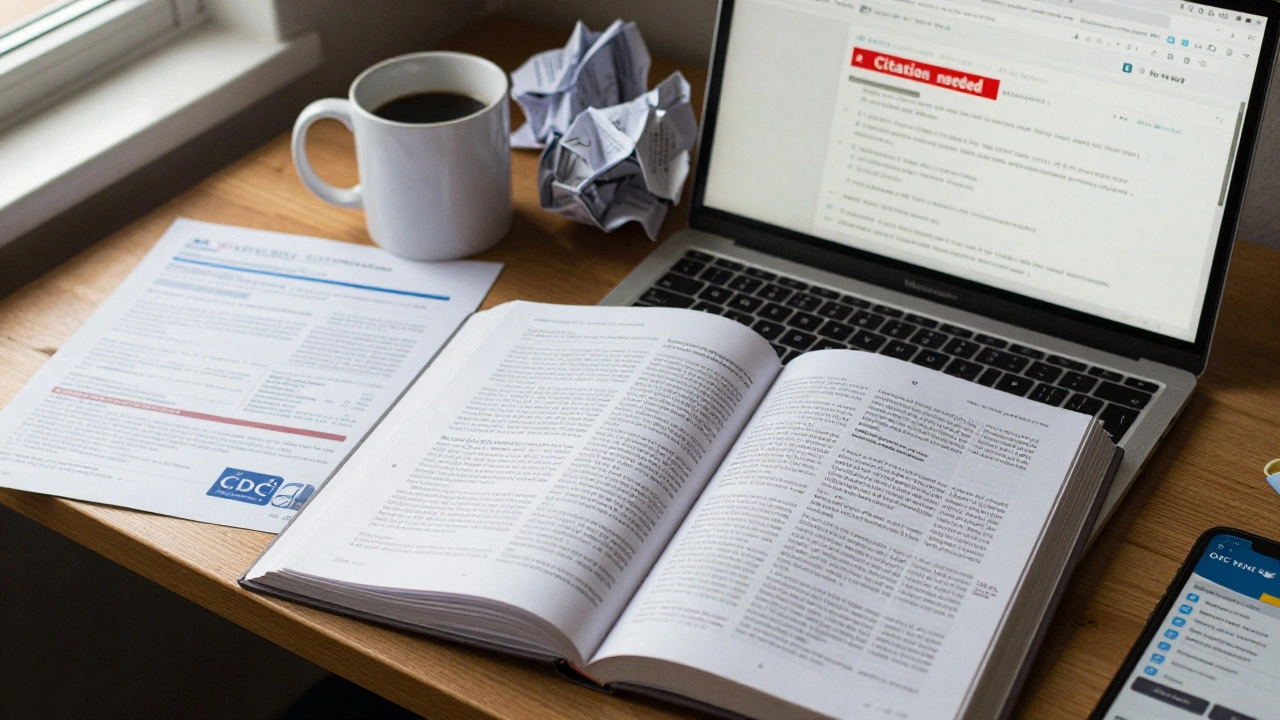
When someone adds a claim without a citation, another editor adds a tag: "Citation needed". That tag appears right next to the sentence. It’s a public challenge. The original editor then has to find a source-or the line gets removed.
Some articles have hundreds of these tags. High-profile pages, like those on politics or medicine, are monitored constantly. Editors use tools to flag unsourced content. Bots scan for repeated violations. And if someone keeps adding unsubstantiated claims? They get blocked.
There’s also the "No original research" policy, which works hand-in-hand with verifiability. You can’t synthesize data from five different papers to make a new conclusion. You can only report what’s already been published. That stops editors from becoming amateur scientists or historians.
It’s frustrating sometimes. You know something’s true-you’ve seen it on TV, read it in a magazine, heard it from your uncle. But if it’s not in a published, reliable source, it doesn’t belong on Wikipedia. That’s the trade-off.
The Real Impact: Trust Built on Transparency
Wikipedia is the fifth most visited website in the world. Over half a billion people visit it every month. And yet, it’s run by volunteers with no budget, no staff, and no corporate backing.
How does it stay credible? Because you can see the work behind every fact. Click any citation. Read the source. Judge it for yourself. That’s the power of the Verifiability Policy.
It turns Wikipedia from a collection of opinions into a living archive of evidence. It doesn’t guarantee accuracy-no human system can. But it guarantees that every claim has a trail. You can follow it. You can check it. You can dispute it.
Compare that to most other encyclopedias. Traditional ones rely on authority: "This was written by experts, so trust it." Wikipedia says: "Here’s where we got it. You decide."
That’s why researchers, journalists, and students still use it-not because it’s perfect, but because it’s transparent. And in a world full of misinformation, that’s rare.
What Happens When Sources Conflict?
Not every reliable source agrees. Climate scientists might cite different data sets. Historians might interpret the same event differently. Wikipedia doesn’t pick sides. It presents the range of published views.
For example, the article on the causes of World War I doesn’t say "Germany was to blame." It says: "Some historians argue X, others argue Y, and recent scholarship suggests Z." Each claim is backed by a source. The reader gets the full picture.
This is called "neutral point of view," and it’s only possible because of verifiability. Without sources, neutrality is just opinion. With sources, it’s a fair summary of what’s been published.
It’s not always tidy. Some articles become battlegrounds. But the policy keeps the fight grounded in evidence, not emotion.
Why This Matters Beyond Wikipedia
The Verifiability Policy isn’t just a Wikipedia rule. It’s a model for how information should be handled in the digital age.
Every time you see a viral claim on social media-"This study proves..."-you can ask: "Where’s the source? Is it peer-reviewed? Is it from a known journal?" That’s the mindset Wikipedia taught millions.
It’s why fact-checking sites like Snopes and PolitiFact use the same logic. It’s why universities teach students to cite sources. It’s why credible journalism requires attribution.
Wikipedia didn’t invent this. But it made it mainstream. And it proved that a massive, open, collaborative project can still be trustworthy-if you demand proof for everything.
What You Can Do
You don’t need to be an editor to help. If you see a claim on Wikipedia without a citation, add a "Citation needed" tag. If you find a good source for an unsourced line, edit it in. Even small actions strengthen the system.
And when you use Wikipedia for research, always check the references. Don’t stop at the summary. Go to the original source. That’s the real lesson of the Verifiability Policy: trust, but verify.
What happens if a Wikipedia article has no citations?
Articles without citations are flagged by editors and bots. They may be tagged with "Citation needed" or marked for deletion if they contain unsourced claims. Over time, unsourced content is removed unless reliable sources are added. Wikipedia does not allow original research or unsupported opinions.
Can I cite Wikipedia as a source in my research paper?
No. Wikipedia is a tertiary source-it summarizes information from other sources. Academic writing requires primary or secondary sources, like journal articles, books, or official reports. Use Wikipedia to find leads, then track down the original sources cited in its references.
Why are blogs and personal websites not allowed as sources?
Blogs and personal websites lack editorial oversight. Anyone can publish anything without review. While some experts write blogs, Wikipedia requires sources with accountability-publishers who fact-check, correct errors, and face consequences for misinformation. A blog post by a Nobel laureate might be acceptable only if it’s published on a recognized platform and clearly represents expert consensus.
Does the Verifiability Policy apply to all languages of Wikipedia?
Yes. Every language version of Wikipedia follows the same core principle: claims must be backed by reliable, published sources. However, what counts as "reliable" can vary slightly based on local publishing norms. For example, a major national newspaper in Japan may be treated as a reliable source in the Japanese Wikipedia, even if it’s not widely known in English-speaking countries.
How often is the Verifiability Policy updated?
The policy is reviewed regularly by the Wikipedia community through discussion pages and formal proposals. Major changes require broad consensus. Since its adoption in 2004, the policy has been clarified and expanded but never fundamentally changed. Updates usually focus on clarifying gray areas, like how to handle social media or corporate reports.