Key Takeaways
- Recent promotions highlight a shift toward highly specialized scientific topics and niche historical events.
- The 'Featured' status requires comprehensive coverage, reliable sourcing, and an unbiased tone.
- Community consensus remains the final hurdle, often involving rigorous peer review cycles.
- Writing for a general audience while maintaining expert-level depth is the secret to success.
What Actually Makes an Article 'Featured'?
Before we look at the winners, we need to understand what the reviewers are actually hunting for. A Wikipedia Featured Article is the highest quality grade an entry on the site can achieve, signifying it is a comprehensive, well-written, and accurately sourced piece of work. It isn't a popularity contest. You can't just write about a celebrity and hope it gets promoted. The Wikipedia Featured Articles process is more like a PhD defense than a blog post submission.
To get there, an editor has to satisfy a few brutal criteria. First, there's comprehensiveness. If you're writing about the French Revolution, you can't just mention the Bastille; you need to cover the socio-economic pressures, the key players, and the global aftermath. Then there's neutrality. The community hates bias. If you use words like "shockingly" or "brilliant," you'll be flagged immediately. Every claim must be backed by a reliable source, usually a peer-reviewed journal or a reputable news organization.
Breaking Down the Latest Promotions
In the most recent roundup, we've seen a fascinating trend. While broad historical overviews used to dominate, the latest group of promoted articles focuses on extreme specificity. For example, a recent deep dive into the 1924 Winter Olympics didn't just list the medalists. It explored the geopolitical tensions of the era and the specific architectural challenges of the Chamonix venues. This level of detail is exactly what the Featured Article Candidates (FAC) forum looks for.
Another standout was a technical piece on CRISPR-Cas9. The challenge with scientific articles is avoiding the "textbook trap." Many writers make the mistake of writing for other scientists, using jargon that leaves a regular reader confused. The promoted version of this article succeeded because it used analogies to explain gene editing-comparing the protein to a pair of molecular scissors-without stripping away the technical accuracy. It balanced the needs of a casual browser with the demands of a biologist.
The Role of WikiProjects in Quality Control
You rarely see a single person write a featured article from scratch. Most of these wins are the result of WikiProjects, which are coordinated groups of editors who focus on specific subject areas to improve the quality of related articles. For instance, WikiProject Medicine ensures that all health-related pages follow the same stylistic guidelines and use the most current medical consensus.
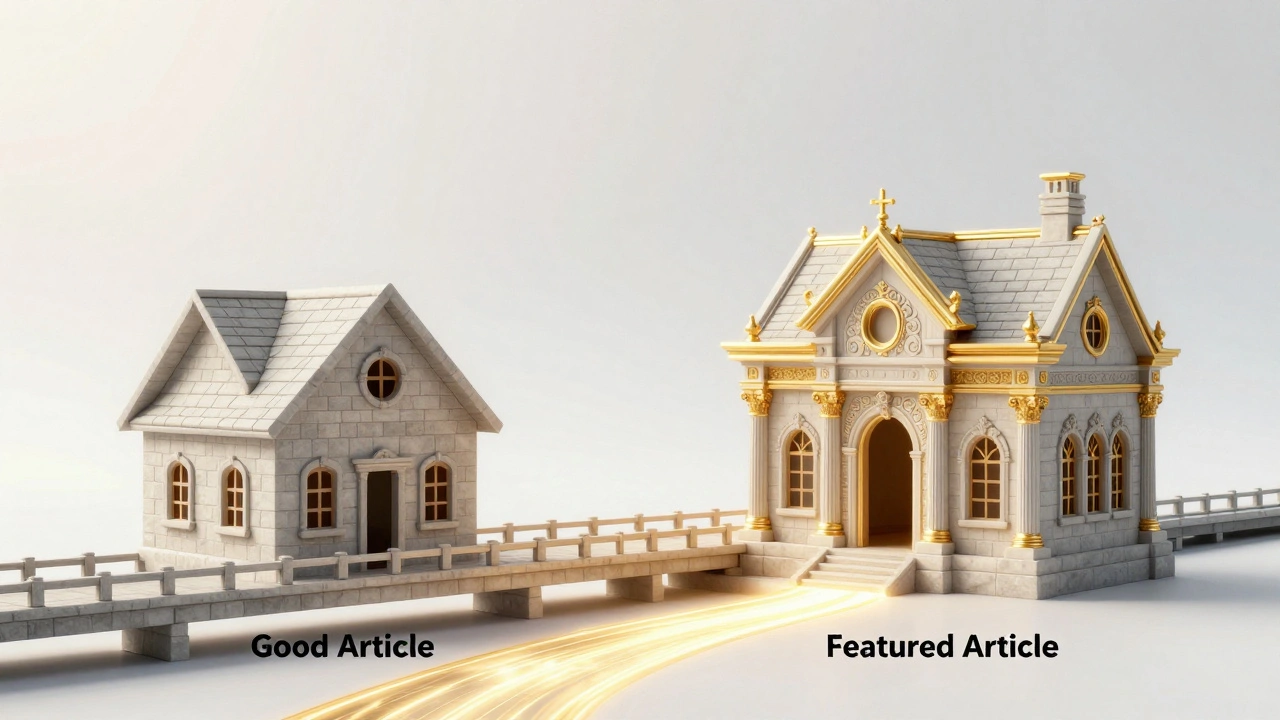
These groups act as a first layer of filtration. Before an article ever hits the formal review stage, it usually goes through a "Good Article" (GA) phase. Think of a Good Article as a "B+" student-it's solid, reliable, and clear. A Featured Article is the "A+" student. The jump from GA to FA involves filling in the last 5% of missing information and perfecting the prose. It's the difference between a house that is livable and a house that is architecturally perfect.
| Attribute | C-Class / Start-Class | Good Article (GA) | Featured Article (FA) |
|---|---|---|---|
| Sourcing | Basic or missing | Reliable and sufficient | Exhaustive and high-quality |
| Prose | Clunky or fragmented | Clear and readable | Professional and polished |
| Scope | Stubby or incomplete | Broadly comprehensive | Deeply comprehensive |
| Review Process | None/Minimal | Peer review by 1-2 editors | Rigorous community consensus |
Common Pitfalls That Kill an FA Nomination
Why do so many candidates fail? Usually, it comes down to a few specific mistakes. The most common is the "source gap." An editor might have ten great sources for the first half of the article, but the last three sections are based on a single, mediocre website. Reviewers will spot this instantly. If the quality of evidence isn't consistent across the entire page, the nomination is dead in the water.
Another killer is "over-editing." Sometimes, an editor becomes so obsessed with a specific detail that they lose the forest for the trees. If an article on the Roman Empire spends three paragraphs discussing the specific type of sandals a centurion wore but forgets to mention the collapse of the currency, it lacks the necessary balance. The Wikipedia Community Portal often warns against this "rabbit hole" effect, where the writer's passion overrides the reader's need for a cohesive narrative.

How to Use the 'Featured' Label for Your Own Research
If you're using the site for a school project or a professional report, the Featured label is your best friend. Why? Because it's a signal that the community has already done the hard work of verifying the facts. When you see the little star icon, you know that the internal contradictions have been ironed out and the most controversial points have been balanced with multiple perspectives.
However, don't treat them as infallible. Even a featured article can become outdated. A piece on Climate Change might have been featured in 2022, but by 2026, new data from the IPCC might make some of its conclusions obsolete. The best way to use these articles is to start with the featured text for the structure and then check the Talk Page to see if other editors are currently debating new updates. The talk page is where the real action happens-it's the "behind the scenes" area where you can see the struggle to maintain quality.
Can any user nominate an article for Featured status?
Yes, technically any registered user can nominate an article. However, the community generally expects the nominator to have a basic understanding of the FA criteria. If a "stub" article is nominated, it will be rejected almost instantly. It's usually better to work with a WikiProject first to ensure the article is at least "Good Article" quality before attempting a Featured nomination.
How long does the review process typically take?
It varies wildly. Some articles fly through in two weeks if they are nearly perfect. Others can languish in the FAC (Featured Article Candidates) forum for months. This usually happens when there is a disagreement between reviewers about the neutrality of a section or the reliability of a specific source. The process only ends when a consensus is reached or the nomination is withdrawn.
Does a Featured Article ever lose its status?
Yes. This is called "de-featuring." It happens if the article is heavily edited and the quality drops, or if new information emerges that makes the current version inaccurate. If a user notices that a featured article is no longer meeting the standards, they can start a discussion on the talk page to have the status removed until the article is fixed.
What is the difference between a 'Good Article' and a 'Featured Article'?
A Good Article (GA) is basically a high-quality, reliable piece of writing that covers the topic well. A Featured Article (FA) is the "gold standard." FA requires a higher level of prose, more exhaustive sourcing, and a more rigorous review process by a wider group of the community. If GA is "very good," FA is "exemplary."
Why are some popular topics not featured?
Popularity doesn't equal quality. Many high-traffic pages are actually harder to get featured because they are constant battlegrounds for "edit wars." When people are passionately arguing over politics or religion, it's incredibly difficult to achieve the absolute neutrality required for FA status. Often, these articles stay at "B-class" or "GA" because they are too volatile to ever reach a final consensus.
What to Do Next
If you're an editor looking to get your first promotion, don't start by nominating your page. Instead, head over to the Community Portal and look for articles that are "Good Article" but haven't been touched in a year. These are the lowest-hanging fruit. By updating the sources and smoothing out the prose, you can move an article toward the featured list without having to build the whole thing from zero.
For the casual reader, the best way to enjoy this is to use the "Featured Article" link on the main page every day. It's a great way to learn about something you'd never normally search for-like the history of a specific 14th-century monastery or the physics of a black hole-while knowing you're reading the most accurate version of that story available on the web.