Getting a Wikipedia article featured isn’t about luck. It’s about meeting strict, well-documented standards that separate good articles from exceptional ones. Only about 0.1% of all Wikipedia articles become Featured Articles (FAs), and they’re the gold standard - thoroughly researched, neutrally written, and meticulously cited. If you’re trying to get yours there, you’re not just writing an article. You’re building a reference piece that could be used by students, journalists, and researchers worldwide.
Start with Notability
Before you even begin writing, ask: does this topic deserve a Wikipedia page? Wikipedia doesn’t cover everything. It only covers things that have received significant coverage in reliable, independent sources. That means no self-published blogs, press releases, or social media posts.
For a person, that usually means at least two or three in-depth articles from major newspapers, magazines, or academic journals. For a company, it’s coverage in outlets like The Wall Street Journal, Bloomberg, or Forbes. For a book or film, it’s reviews from established critics and media outlets.
If you can’t find at least three solid, independent sources that discuss the subject in detail, your article won’t pass the notability test - no matter how well-written it is. Don’t waste time. Check Wikipedia’s notability guidelines for your topic type first.
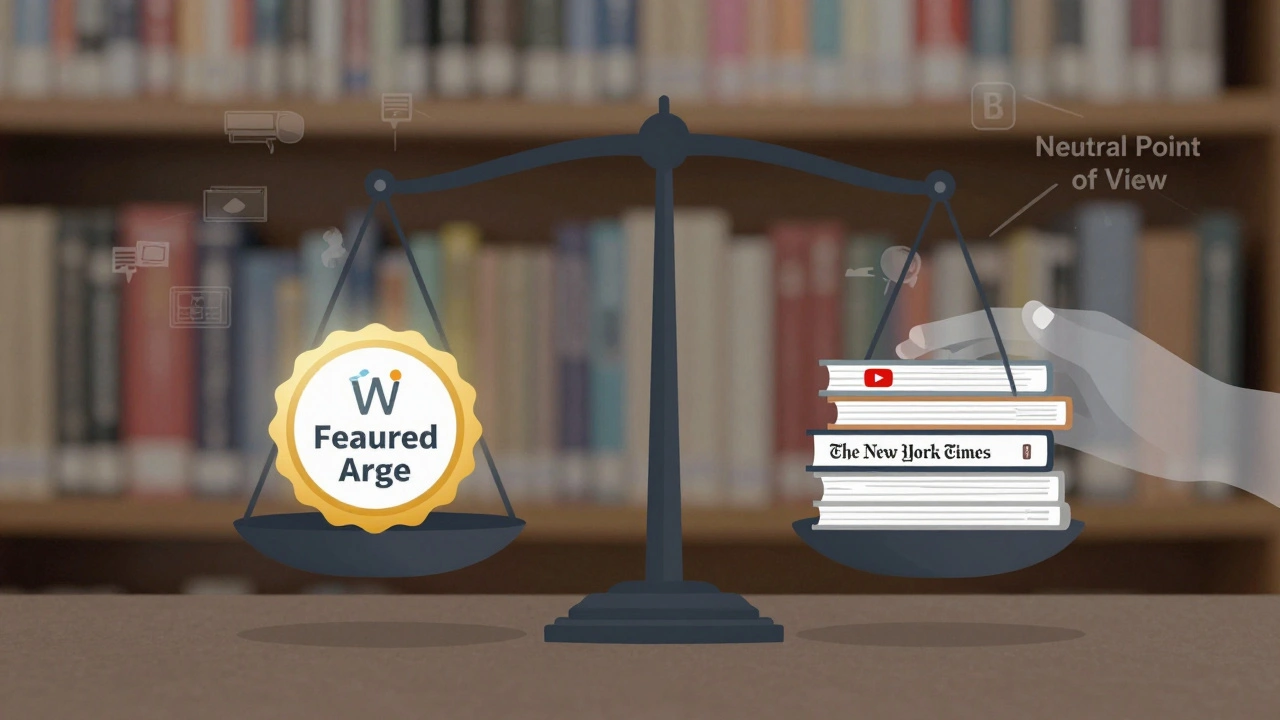
Write with Neutral Point of View
Wikipedia doesn’t allow opinion. It doesn’t allow promotion. It doesn’t allow fluff. Every sentence must be verifiable and written from a neutral perspective.
That means if you’re writing about a musician, you can’t say “They revolutionized modern pop.” Instead, say “Their 2020 album reached number one on the Billboard 200 and was cited by Rolling Stone as a turning point in genre fusion.” Then cite the Rolling Stone article.
Even small phrases like “best,” “most popular,” or “groundbreaking” need to be backed by sources. If you can’t cite a source for a claim, remove it. Wikipedia editors will remove them anyway.
One common mistake: writing like a press release. If your article sounds like marketing copy, it will be flagged. Read your draft aloud. Does it sound like someone is trying to sell you something? If yes, rewrite it.
Cite Every Fact - No Exceptions
Featured Articles require inline citations for every claim - not just statistics, but even basic facts like dates, names, and locations. A single uncited sentence can derail the entire process.
Use reliable sources: peer-reviewed journals, books from academic presses, major newspapers, government publications, and reputable magazines. Avoid Wikipedia itself, blogs, forums, and YouTube videos. Even if a YouTube video has millions of views, it’s not a reliable source.
Format citations using Wikipedia’s citation templates. For example:
{{cite news | title=The Rise of Indie Gaming | author=Jane Liu | newspaper=The New York Times | date=March 12, 2023}}{{cite book | title=Digital Culture | author=Michael Torres | publisher=MIT Press | year=2021 | isbn=978-0-262-04567-8}}
Use the Cite button in the Wikipedia editor toolbar - it auto-generates correct formatting. Don’t guess. Errors in citations are a top reason articles fail.
Structure Like a Reference Article
Featured Articles follow a standard structure: introduction, sections, and a conclusion. The introduction should summarize the entire article in one or two paragraphs. Each section should cover a distinct aspect of the topic - history, impact, controversy, legacy, etc.
Use clear headings. Don’t say “About the Artist.” Say “Early Life and Career.” Avoid vague titles like “More Information.”
Include a “See also” section with links to related articles. Add a “References” section with all your citations. Add a “Further reading” section with books or academic papers that aren’t directly cited but are useful for deeper research.
Wikipedia’s Featured Article criteria require a minimum of 3,000 words for most topics. For complex subjects like scientific discoveries or historical events, 5,000-8,000 words is common. Length isn’t everything - but depth is.
Use High-Quality Images and Media
Featured Articles often include images, maps, or diagrams. But you can’t just upload any photo. It must be freely licensed (Creative Commons or public domain) or properly attributed under fair use.
For people, use a high-resolution, official portrait. For events, use historical photos from archives. For organizations, use their official logo - but only if it’s in the public domain or licensed for reuse.
Upload media to Wikimedia Commons, not directly to Wikipedia. Add captions that describe the image and cite its source. For example: “Portrait of Dr. Elena Ruiz, 1998, courtesy of the National Institutes of Health.”
Articles with no images rarely become featured. Visuals aren’t decoration - they’re part of the reference value.
Get Feedback Before Submitting
Don’t submit your article to Featured Article candidacy without getting feedback first. Use the Articles for Creation (AfC) process to get it reviewed by experienced editors. They’ll catch citation gaps, tone issues, or structural problems you might miss.
Join the Wikipedia Teahouse or the Wikipedia:WikiProject for your topic area. Ask for a “content review.” Many editors will help you improve your draft - if you’re polite and open to feedback.
Fix every comment. If someone says, “This claim needs a source,” find one. If they say, “This section is too long,” split it. Don’t argue. Don’t defend. Improve.
Submit for Featured Article Candidacy
Once your article is polished, submit it to Wikipedia:Featured article candidates. You’ll need to write a nomination explaining why your article meets all the criteria.
Be specific. Don’t say “It’s well-written.” Say: “This article meets all seven FA criteria: it is comprehensive, well-written, neutral, stable, illustrated, cited, and follows layout guidelines. All claims are supported by reliable sources, including peer-reviewed journals and major newspapers.”
Then, wait. The review process takes 2-4 weeks. Other editors will examine every sentence. They’ll check citations, tone, structure, and even punctuation. You’ll get comments like “Page 3, paragraph 2 - source is a blog, not reliable.” Respond to every comment. If you don’t, your article will be rejected.
What Happens If It’s Rejected?
Most articles are rejected on the first try. That’s normal. Even experienced editors rarely get their first FA approved.
If your article is rejected, read the feedback carefully. The reasons are usually clear: missing citations, biased language, insufficient depth, or poor structure. Fix those issues. Wait a few weeks. Then resubmit.
Many successful Featured Articles were submitted three or four times. The key isn’t perfection on the first try - it’s persistence and responsiveness.
Why It Matters
A Featured Article isn’t just a badge. It’s a signal of trust. When a researcher cites your article, they’re citing Wikipedia - and your work is now part of global knowledge. It will appear in Google’s knowledge panels, in academic citations, and in educational materials.
It’s also a chance to correct misinformation. Many Wikipedia articles on marginalized groups, small businesses, or local history are either missing or inaccurate. A well-written FA can change that.
There’s no shortcut. No trick. No secret formula. Just hard work, attention to detail, and respect for the rules.
Can I write a Wikipedia article about myself?
Technically, yes - but it’s strongly discouraged. Wikipedia requires independence. If you’re writing about yourself, you’re not neutral. Even if your article is perfect, editors will suspect bias. It’s far better to have someone else write it, using only reliable, independent sources that mention you.
How long does it take to get a Featured Article?
It varies. A well-prepared article can be approved in as little as two weeks. But most take 4-8 weeks, especially if revisions are needed. The process moves faster if you respond quickly to feedback and fix issues without argument.
Do I need to be an expert to write a Featured Article?
No. You don’t need a PhD or a journalism degree. But you do need to be a careful researcher. Many successful FA writers are passionate amateurs - students, librarians, local historians. What matters is your ability to find reliable sources, write clearly, and follow Wikipedia’s rules.
Can I use Wikipedia’s own articles as sources?
No. Wikipedia is not a reliable source for other Wikipedia articles. You must use external, independent sources like books, academic journals, or major news outlets. Wikipedia articles can help you find those sources - but never cite them directly.
What if my topic is too niche?
Niche topics can still qualify if they have sufficient coverage in reliable sources. For example, a small indie film might qualify if it was reviewed in three major film journals and discussed in a university thesis. The key isn’t popularity - it’s verifiable significance.
Can I pay someone to write my Wikipedia article?
You can hire a writer to help, but you must disclose any paid editing under Wikipedia’s conflict of interest policy. Paid editors must not write about themselves or their clients without full transparency. Many paid editors fail because they don’t follow this rule. The article must still meet all FA criteria - regardless of who wrote it.
Next Steps
If you’re serious about getting your article featured, start today. Find three reliable sources about your topic. Open a draft in your user space. Write one section. Get feedback. Repeat.
Don’t aim for perfection. Aim for progress. Every great Featured Article started as a rough draft. The difference? The authors kept improving - and didn’t give up when it was hard.