
Imagine asking a question and getting a direct answer instead of a list of blue links. That is the shift happening right now. For two decades, Wikipedia was the default go-to for quick facts. It was free, massive, and surprisingly reliable. But today, that model faces its biggest threat yet: artificial intelligence systems that don't just point you to information-they synthesize it for you. The core problem isn't that Wikipedia is failing. It's that user behavior is changing. People no longer want to read paragraphs; they want answers. This creates a direct competitive pressure on the platform's traditional role as an encyclopedia. If an AI assistant can give you a summary of the French Revolution in three sentences, do you still need to click through to the wiki page? The answer is becoming increasingly complicated, involving a mix of convenience, trust, and the unique value of deep-dive research.
The Rise of Direct Answer Engines
The most visible competitor to Wikipedia is the modern search engine powered by large language models. Tools like Perplexity and the AI Overviews found in major search results have changed the game. These platforms use generative AI that processes natural language queries to produce conversational responses. Instead of ranking pages, they generate text based on patterns learned from billions of documents.
This approach has specific advantages over static encyclopedias. First, it handles nuance better. If you ask "Is coffee good for health?", Wikipedia gives you a balanced article with citations. An AI chatbot might say, "Moderate consumption is linked to lower risks of type 2 diabetes, but excessive intake can cause anxiety." That feels more helpful for a casual user. Second, these tools are multimodal. They can interpret images, PDFs, and even video transcripts, creating a richer context than text-only wikis.
However, there is a catch. AI answers are probabilistic, not factual. They predict the next word based on training data. This means they can hallucinate-confidently stating things that never happened. Wikipedia editors fight hard against errors because every change is logged and reviewed. In an AI response, there is no audit trail. You get the answer, but verifying it often requires going back to the source anyway, which brings us full circle to Wikipedia or similar primary sources.
Knowledge Graphs: The Structured Underpinning
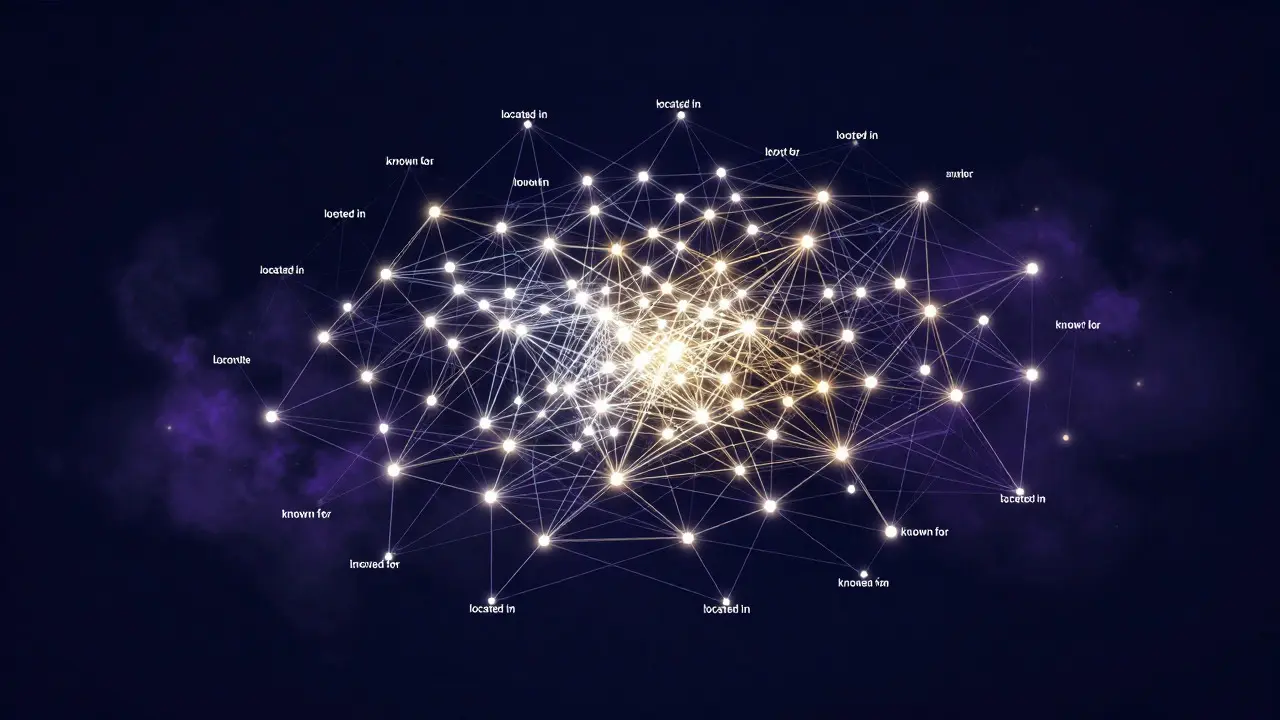
While chatbots handle the conversation, knowledge graphs are structured datasets that map relationships between entities underpins much of this technology. Think of them as the skeleton beneath the skin of AI. A knowledge graph doesn't just store that "Paris is the capital of France"; it stores that Paris is located in France, France has as capital Paris, and Paris is known for the Eiffel Tower.
Major tech companies maintain their own proprietary knowledge graphs. Google's Knowledge Graph, for instance, powers the side panels you see when searching for celebrities or historical events. These graphs allow machines to understand context without reading entire articles. For Wikipedia, this is a double-edged sword. On one hand, if a machine can pull the fact directly from a graph, the need to visit the site drops. On the other hand, many of these graphs are built using data originally sourced from open projects like Wikipedia. So, while the interface changes, the foundational data often remains rooted in collaborative human effort.
The difference lies in accessibility. A knowledge graph is rigid. It excels at precise, factual queries like "What is the atomic weight of Carbon?" It struggles with complex, subjective, or evolving topics. Wikipedia shines here. Articles on current events, political debates, or cultural movements are constantly updated by volunteers. A static graph cannot capture the nuance of a shifting political landscape as quickly as a live community of editors can.
Trust and Verification: The Human Element
Why does anyone still care about Wikipedia if AI can answer questions? Trust. In an era of deepfakes and algorithmic bias, the idea of a verifiable, cited, community-moderated resource has value. Wikipedia’s citation system, while imperfect, provides a paper trail. You can check the source. You can see who edited the page and why. With a black-box AI model, you often can't.
Consider a student writing a paper. If they use an AI answer, they risk citing a hallucinated fact. If they use Wikipedia, they get a starting point with references. This educational utility keeps Wikipedia relevant. Furthermore, Wikipedia serves as a neutral ground. AI models inherit the biases of their training data. If the internet leans toward a certain perspective, the AI will too. Wikipedia’s editorial policies aim for neutral point of view (NPOV), making it a safer bet for objective overview, even if perfection is elusive.
There is also the issue of depth. AI summaries are great for the "what" and "why," but poor for the "how" and "where" in complex technical fields. Engineers, researchers, and specialists still rely on detailed documentation, case studies, and nuanced discussions found in long-form wiki articles. The AI is the concierge; Wikipedia is the library.
Comparing the Competitive Landscape
To understand where we stand, let's look at how these platforms compare in practical use. Each serves a different part of the information journey.
| Feature | Wikipedia | AI Chatbots | Knowledge Graphs |
|---|---|---|---|
| Primary Function | Encyclopedia / Reference | Conversational Assistant | Structured Data Mapping |
| Best For | Deep dives, history, complex topics | Quick summaries, synthesis, Q&A | Precise facts, entity relationships |
| Verification Method | Citations, edit history | Probabilistic confidence (low transparency) | Source data validation |
| Update Frequency | Real-time (community driven) | Periodic model retraining | Batch updates / API feeds |
| Risk Factor | Vandalism, bias | Hallucinations, outdated info | Incompleteness, rigidity |
Notice the trade-offs. AI wins on speed and convenience. Knowledge graphs win on precision for simple facts. Wikipedia wins on depth and verifiability. The future likely involves a hybrid approach where users start with an AI summary, verify key points via a knowledge graph or direct link, and dive into Wikipedia for comprehensive understanding.
The Future of Collaborative Knowledge
Will Wikipedia disappear? Probably not. But its role will shift. It may become less of a destination and more of a data source. We are already seeing APIs that allow developers to pull wiki content into apps and AI prompts. This suggests that Wikipedia's value is moving behind the scenes. It becomes the fuel for the engines, rather than the car itself.
For users, this means the skill set required to find information is changing. You no longer just need to know how to search keywords. You need to know how to prompt an AI effectively and how to verify its output. Critical thinking is becoming a digital survival skill. The ability to distinguish between a generated summary and a verified fact is crucial.
Competitive threats are driving innovation. Wikipedia is exploring ways to integrate with AI tools, providing clean data feeds and structured extracts. Meanwhile, AI companies are realizing that raw text isn't enough; they need structured, high-quality data to reduce hallucinations. This creates a symbiotic relationship. Wikipedia provides the breadth and human verification; AI provides the interface and synthesis. Neither replaces the other entirely, but together, they redefine how we access human knowledge.
Is Wikipedia being replaced by AI?
Not entirely. While AI chatbots handle quick queries and summaries, Wikipedia remains essential for deep research, verification, and complex topics. AI often relies on data similar to what Wikipedia hosts, making them complementary rather than mutually exclusive.
Which is more accurate: Wikipedia or AI answers?
Wikipedia is generally more reliable for verifiable facts because it uses citations and peer review. AI answers are probabilistic and can contain hallucinations. However, AI can synthesize multiple sources faster, so accuracy depends on the quality of the underlying data and the specific query.
What is a knowledge graph in simple terms?
A knowledge graph is a way computers organize information by connecting related concepts. Instead of storing text, it stores relationships, like 'Person X works for Company Y.' This allows machines to understand context and answer questions about connections between people, places, and things.
Do I still need to cite Wikipedia in academic work?
It depends on your institution's guidelines. Many universities accept Wikipedia as a starting point but require you to trace the original sources cited within the wiki entry. Citing the wiki itself is often discouraged in favor of the primary sources it references.
How do AI chatbots use Wikipedia data?
Many large language models are trained on web scrapes that include Wikipedia content. Additionally, some AI tools use Retrieval-Augmented Generation (RAG) to fetch real-time wiki entries to ensure their answers are up-to-date and factually grounded before generating a response.