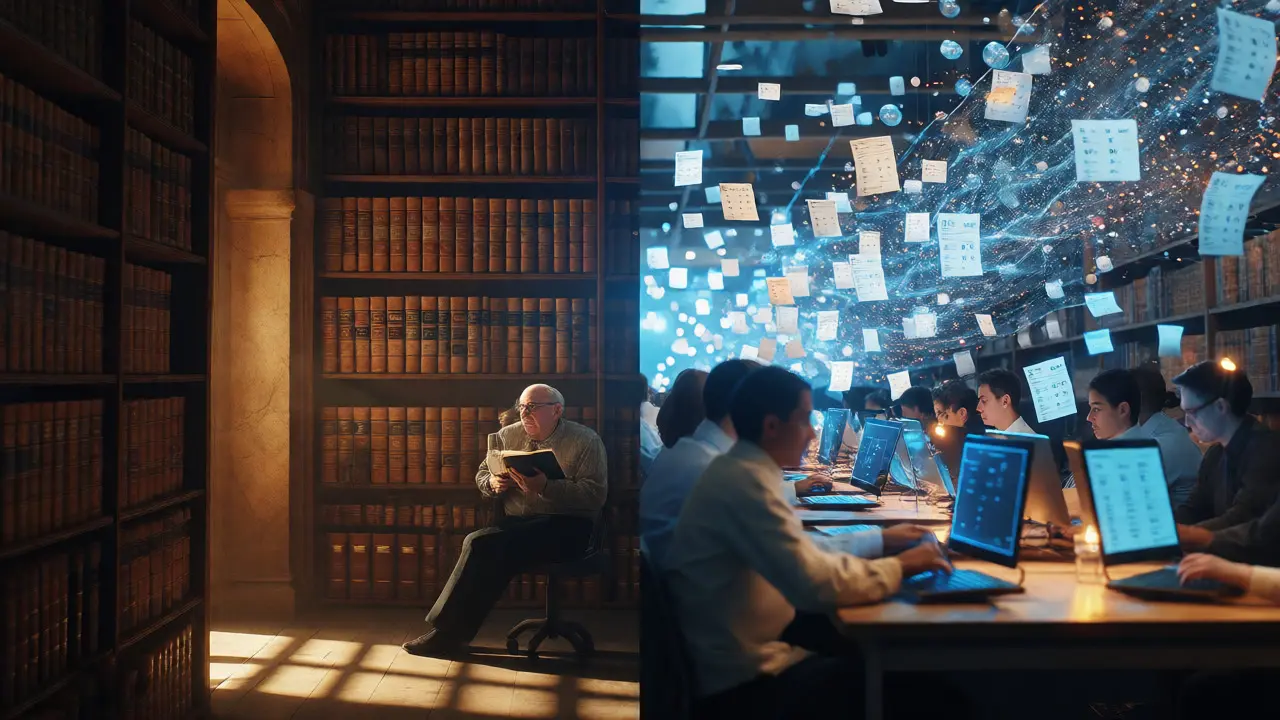
Remember the old schoolyard rule? If you couldn't find it in the Encyclopedia Britannica, it didn't happen. For decades, that multi-volume set was the gold standard of truth. Then Wikipedia showed up, free and chaotic, and suddenly everyone had an opinion on whether a volunteer in Nebraska could out-edit a paid scholar from Oxford.
The debate isn't just about nerd trivia anymore. It affects how we trust information online. Does the crowd really beat the expert? Or is the "wisdom of crowds" just a fancy way of saying "typos with confidence"? Let's break down what the data actually says about Wikipedia accuracy compared to its traditional rivals.
The Science of Fact-Checking
You might think comparing encyclopedias is subjective. But researchers have treated this like a science experiment. The most famous study came from Nature in 2005. They picked 42 random science articles from both Wikipedia and Britannica. Experts then checked them for factual errors, omissions, and misleading statements.
The result shocked many traditionalists. Wikipedia averaged 3.9 serious errors per article. Britannica averaged 2.7. Yes, Britannica was more accurate. But let's be real-both were surprisingly close. The gap wasn't the chasm people expected. In fact, for every major error Britannica made, Wikipedia often fixed it within hours due to its open-editing model. Britannica, being static, stayed wrong until the next print edition or digital update cycle.
This highlights a key attribute difference: static verification versus dynamic correction. Britannica relies on pre-publication peer review. Wikipedia relies on post-publication community policing. One prevents errors before they spread; the other fixes them after they appear. Which is better depends on how fast you need the truth.
Where Wikipedia Shines (and Fails)
Context matters hugely here. Wikipedia isn't uniformly good or bad. Its accuracy fluctuates based on topic popularity and complexity.
Pop culture topics are where Wikipedia dominates. Think recent movies, celebrity gossip, or viral internet trends. Why? Because thousands of fans are watching these pages daily. If a new Marvel movie leaks a plot twist, it hits Wikipedia before the news cycles catch up. Britannica, focused on enduring knowledge, rarely updates these fleeting subjects quickly enough to matter.
Conversely, niche scientific fields can be tricky. A page on obscure quantum physics concepts might have fewer eyes on it. Here, vandalism or subtle inaccuracies can linger longer. However, even in these cases, Wikipedia’s citation requirements force editors to link to primary sources. This transparency lets readers verify claims themselves-a feature traditional encyclopedias lack entirely.
- High Accuracy Zones: Current events, technology releases, popular history, geography.
- Mixed Accuracy Zones: Medical advice (varies by editor expertise), legal interpretations, controversial political figures.
- Lower Reliability Zones: Very niche academic theories, unverified local folklore, recently deceased individuals with sparse sources.

Britannica’s Digital Pivot
It’s unfair to judge Britannica as if it’s still a dusty bookshelf. Today, Encyclopedia Britannica Online is a subscription-based digital platform. They’ve hired professional editors and subject-matter experts to oversee content. Their model is closer to journalism than crowd-sourcing.
What does this mean for you? Britannica offers curated authority. When you read a Britannica entry on World War II, you’re reading work vetted by historians employed by the company. There’s a clear chain of accountability. If something is wrong, there’s a department to blame.
Wikipedia lacks this centralized accountability. It has administrators and policies, but no single entity owns the truth. This decentralized structure is both its superpower and its weakness. It allows for rapid expansion into new topics but struggles with consistent tone and depth across all entries.
| Feature | Wikipedia | Encyclopedia Britannica | Simple English Wikipedia |
|---|---|---|---|
| Cost | Free | Subscription (~$80/year) | Free |
| Editor Model | Volunteer-driven | Professional staff + Experts | Volunteer-driven (simplified language) |
| Update Speed | Real-time | Daily/Weekly edits | Real-time |
| Source Transparency | High (inline citations) | Medium (bibliographies only) | High (inline citations) |
| Best For | Quick facts, current events, broad overview | In-depth analysis, historical context, verified scholarship | Learners, non-native speakers, quick summaries |
Other Contenders in the Ring
While Wikipedia and Britannica get the headlines, other platforms offer different value propositions. Citizendium tried to blend the two models. Launched by Jimmy Wales (co-founder of Wikipedia) and Larry Sanger, it required contributors to use their real names and have credentials. While noble, it never gained traction. The barrier to entry was too high for casual contributors.
Scholarpedia targets a specific niche: mathematics and physics. It uses a hybrid model where articles are written by invited experts but reviewed by peers. For a graduate student needing precise technical definitions, Scholarpedia often beats both Wikipedia and Britannica. But try looking up "best pizza toppings," and you’ll hit a wall.
Then there’s Encyclopedia.com, which aggregates content from various dictionaries and encyclopedias. It’s useful for quick definitions but lacks the editorial coherence of Britannica or the community depth of Wikipedia. It’s essentially a search engine for reference texts rather than a curated encyclopedia itself.

How to Spot Bad Info Yourself
Relying on any source blindly is risky. You don’t need a PhD to assess credibility. Use these heuristics when checking any encyclopedia entry:
- Check the References: Does the article cite reputable sources? Look for links to academic journals, major news outlets, or official government reports. If the references are blogs or other Wikipedia pages, be skeptical.
- Look at the History Tab: On Wikipedia, click "View History." Are edits frequent? Is there debate between editors? Healthy conflict usually leads to better accuracy. A page untouched for five years might be outdated.
- Cross-Reference: Never trust one source. Check the same fact in Britannica, a news site, or a textbook. Discrepancies highlight areas needing deeper investigation.
- Note the Tone: Encyclopedic writing should be neutral. If you see loaded adjectives like "brilliant," "disastrous," or "heroic," the entry may be biased or poorly edited.
For medical or legal questions, treat Wikipedia as a starting point, not the final word. Always consult a licensed professional or a specialized database like PubMed for health-related queries.
The Future of Reference
We are moving away from static encyclopedias toward dynamic knowledge graphs. AI tools now pull information directly from structured data sources. This shifts the focus from "who wrote it" to "how verifiable is the data."
Wikipedia is adapting by integrating Wikidata, a structured repository of facts. This allows machines to understand relationships between entities (e.g., "Marie Curie" -> "won Nobel Prize in Physics"). Britannica is enhancing its digital interface with multimedia and interactive timelines. Both are racing to remain relevant in an age of instant answers.
The bottom line? Neither is perfect. Britannica offers curated safety; Wikipedia offers raw speed and breadth. Your best strategy is to use them together. Start with Wikipedia for the big picture and current status. Dive into Britannica for historical depth and verified scholarly consensus. And always keep your critical thinking skills sharp.
Is Wikipedia more accurate than Britannica?
Studies show they are comparable in accuracy, with Britannica having slightly fewer errors on average. However, Wikipedia corrects errors faster due to its open-editing model, while Britannica offers more consistent editorial oversight.
Why do some people distrust Wikipedia?
Critics argue that anyone can edit Wikipedia, leading to potential vandalism, bias, or lack of expertise. However, strict citation guidelines and active community moderation mitigate many of these risks.
Should I pay for Encyclopedia Britannica?
If you need reliable, curated information for academic research or deep dives into historical topics, yes. For general curiosity and current events, the free Wikipedia is usually sufficient.
Can teachers ban Wikipedia?
Many educators discourage citing Wikipedia directly because it changes constantly. Instead, they recommend using Wikipedia to find primary sources listed in the references section and citing those instead.
Which encyclopedia is best for students?
Simple English Wikipedia is great for younger students or ESL learners. For high school and college, combining Wikipedia for initial research with Britannica for verification provides a balanced approach.