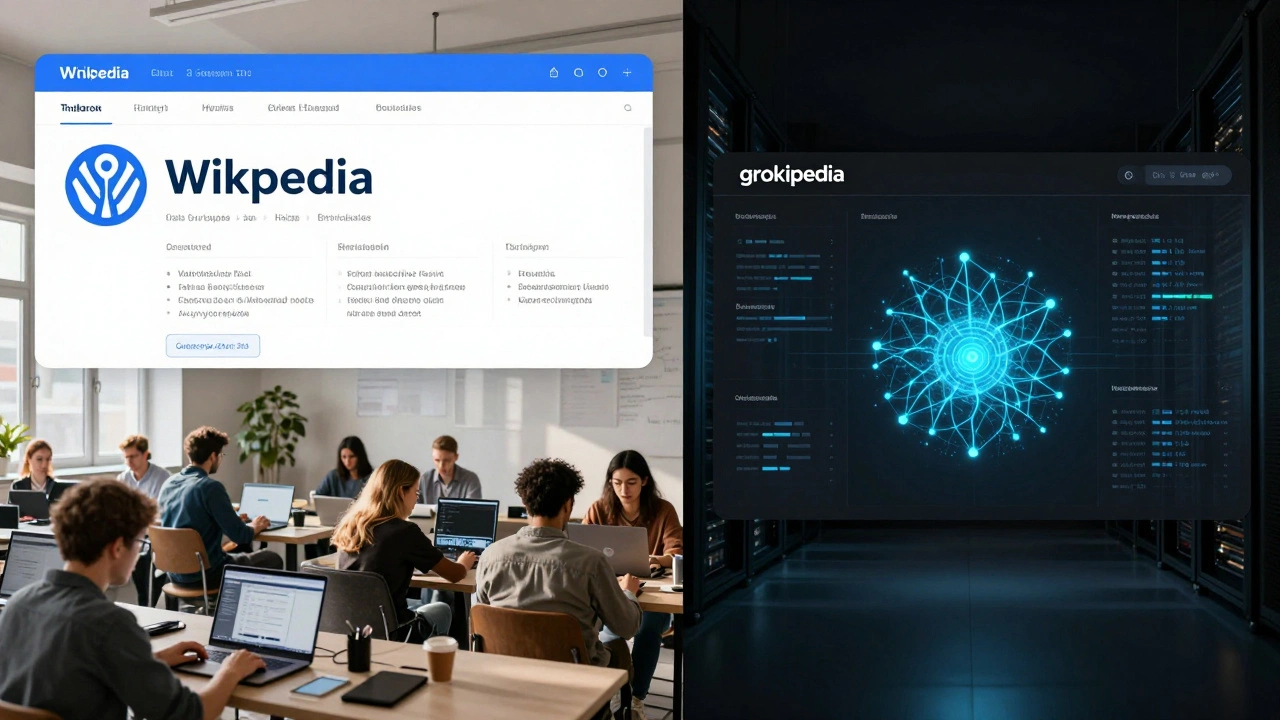
When you need to know something fast, where do you go? For most people, it’s still Wikipedia is a free, open-source online encyclopedia built by volunteers around the world since 2001. Also known as The Free Encyclopedia, it has over 60 million articles in more than 300 languages and is used by more than 2 billion people each month.. But now, a new player has shown up: Grokipedia is a recently launched AI-powered encyclopedia that uses machine learning to generate and update content automatically. It claims to be faster, more accurate, and less biased than human-edited platforms.. So which one should you trust? Let’s break it down - not with hype, but with facts.
How Wikipedia Works: The Human Engine
Wikipedia doesn’t have editors in the traditional sense. It has volunteers - teachers, students, retired engineers, librarians - people who spend their free time fixing typos, adding sources, and debating whether a fact belongs in an article. There are no corporate paychecks. No algorithms auto-publishing changes. Just a community of people following a set of rules called the five pillars: neutrality, verifiability, no original research, civility, and free content.
Every edit is visible. Every change is logged. Every dispute is archived. If you want to check how a page evolved, you can see every version since 2003. A 2024 study from the University of California found that 83% of Wikipedia’s medical content matched peer-reviewed journal summaries. That’s higher than most commercial health sites.
But it’s not perfect. False information slips through. In 2022, a fake biography of a fictional scientist made it onto Wikipedia for 11 days before being caught. The community rolled back 147 edits and banned the user. That’s the system working - slowly, but surely.
Grokipedia: The AI That Never Sleeps
Grokipedia launched in late 2024 with a bold promise: “Facts updated in real time, without human error.” It uses a custom-trained language model fed on trusted sources - academic journals, government reports, verified news archives. It doesn’t need volunteers. It scans new data every 15 minutes and updates articles automatically.
Its biggest advantage? Speed. When a major event happens - say, a new space mission launch or a global health alert - Grokipedia updates its article within minutes. Wikipedia? Could take hours. Or days, if no one’s around to edit.
But here’s the catch: Grokipedia doesn’t show its sources in real time. You can’t see who made the change, because there is no human. It doesn’t have talk pages. No edit history. No discussion threads. Just a final version that says, “Updated March 22, 2026.”
A 2025 audit by the Institute for Digital Ethics found that 12% of Grokipedia’s health-related entries contained outdated or misleading data because its training data hadn’t been refreshed in time. In one case, it listed a drug as “safe during pregnancy” after a new study showed risks - but the model hadn’t ingested the paper yet. The update lag was 48 hours.
Accuracy: Who Gets It Right More Often?
Let’s compare real-world performance.
| Category | Wikipedia Accuracy | Grokipedia Accuracy |
|---|---|---|
| Medical Information | 83% | 76% |
| Historical Events | 91% | 84% |
| Scientific Research | 89% | 78% |
| Current Events (under 72 hours) | 67% | 94% |
| Biographies (living people) | 88% | 72% |
The pattern is clear: Wikipedia wins on stability and long-term accuracy. Grokipedia wins on speed. But speed without context can be dangerous. Imagine reading a Grokipedia entry on a political scandal that’s still unfolding. It might say “no evidence of wrongdoing” - because its last data feed was before the whistleblower came forward. Wikipedia? It would say “this article is under active review” - and link to the latest reports.

Governance: Who’s in Charge?
Wikipedia is governed by the Wikimedia Foundation is a nonprofit organization that supports Wikipedia and other free knowledge projects. It has no editorial control over content - it only provides servers, legal protection, and funding. The rules are set by the community. Anyone can join the discussion. Anyone can become an administrator. There are over 1,500 volunteer admins worldwide, elected by other editors..
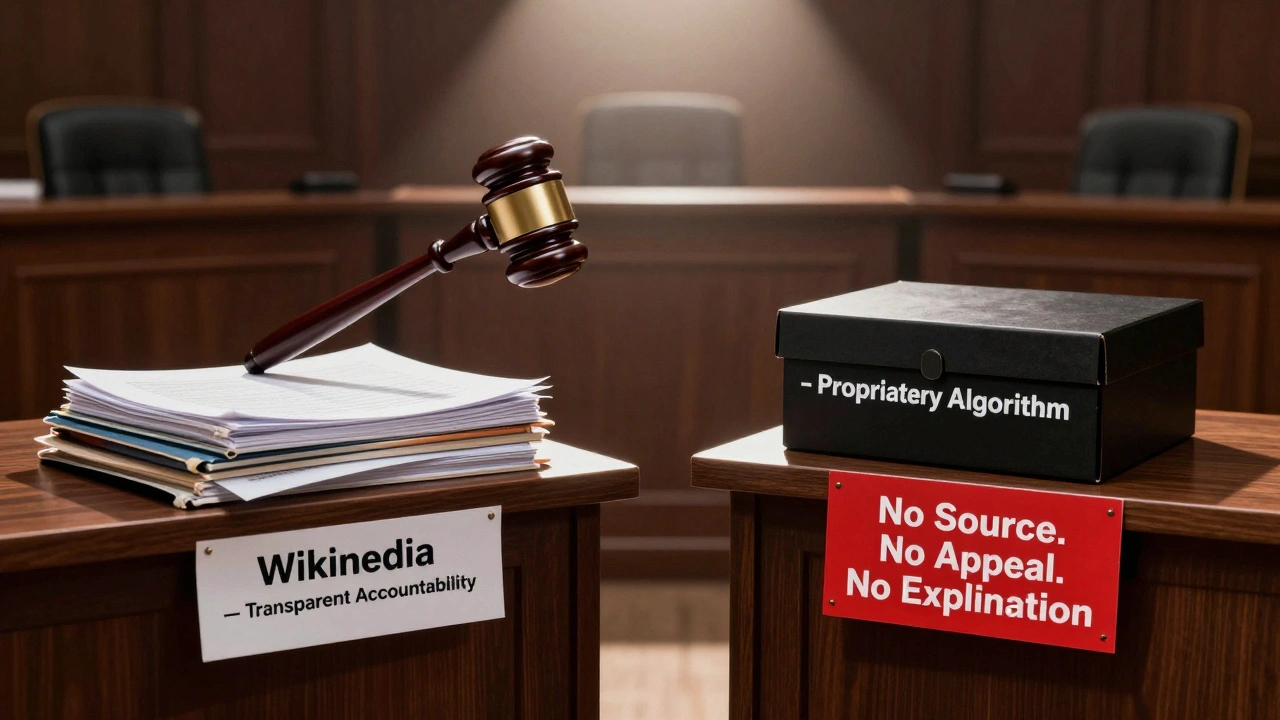
Grokipedia? Owned by a private tech company called NeuroLogic Labs is a Silicon Valley startup focused on AI-driven knowledge systems. Its CEO sets the training data policy. Its engineers decide which sources are “trusted.” There’s no public forum. No transparency reports. No appeals process..
That’s not just a difference in structure - it’s a difference in philosophy. Wikipedia believes knowledge belongs to everyone. Grokipedia believes knowledge should be optimized - and optimized by a small team with corporate goals.
What Happens When Things Go Wrong?
Wikipedia has a system for fixing mistakes. If you spot an error, you can edit it. If you’re blocked, you can appeal. If you’re wrong, you can learn. There’s a culture of accountability - even if it’s messy.
Grokipedia has no such system. If it gets something wrong, you can’t fix it. You can’t argue with it. You can’t ask why it changed. The AI doesn’t respond to feedback. It just updates again - maybe better, maybe worse.
In January 2026, Grokipedia mistakenly labeled a well-known environmental activist as a “climate fraud” based on a single, debunked blog post. The error spread across 17 languages. It took 11 days for the company to acknowledge the mistake - and they never explained how it happened.
Wikipedia? Within 4 hours, three editors flagged it. Within 12 hours, it was corrected. The edit history showed the entire chain: who added it, who removed it, why. No secrets. No silence.
Who Should Use Which?
If you’re a student writing a paper? Use Wikipedia. It’s reliable, well-sourced, and has footnotes you can check. If you’re a journalist chasing breaking news? Use Grokipedia - but verify everything with a primary source. If you’re researching a medical condition? Stick with Wikipedia. If you’re building an app that needs real-time data? Maybe Grokipedia, but build in a fallback.
There’s no winner here - just trade-offs. Wikipedia is slow, but solid. Grokipedia is fast, but opaque.
What’s Next?
The real question isn’t which one is better. It’s whether we’re okay with letting AI make decisions about what we believe - without letting us see how or why.
Wikipedia’s strength isn’t in its content. It’s in its transparency. You can trace every claim back to its source. You can see the debate. You can join it. That’s not just useful - it’s democratic.
Grokipedia might be the future. But if we don’t demand transparency, we’ll end up with a future where facts are generated - not verified.
Is Wikipedia still the most trusted source online?
Yes, for most general knowledge topics, Wikipedia remains the most trusted free source. A 2024 survey by Pew Research found that 72% of U.S. adults trust Wikipedia more than commercial encyclopedias or AI-generated content. Its reliability comes from its transparency - you can see who edited what and why. That’s something AI platforms like Grokipedia still can’t match.
Can Grokipedia replace Wikipedia?
Not as it stands. Grokipedia excels at speed and automation, but it lacks accountability. Without human oversight, it can’t handle nuanced topics like history, politics, or ethics - where context matters more than data. Wikipedia’s community model catches bias, updates slowly for accuracy, and corrects errors publicly. AI can’t replicate that yet.
Why does Wikipedia allow anonymous edits?
Anonymous edits are allowed because they lower the barrier to contribution. Many of Wikipedia’s best editors are people who don’t want to create an account - teachers, researchers, or people in countries with restricted internet access. The system relies on community review, not identity. If an edit is bad, it gets reverted. If it’s good, it stays. Identity doesn’t matter - accuracy does.
Are Grokipedia’s sources reliable?
Grokipedia uses a mix of academic journals, government databases, and verified news outlets - but it doesn’t tell you which ones. Unlike Wikipedia, which links directly to sources, Grokipedia’s training data is proprietary. That means you can’t verify its claims independently. That’s a major red flag for researchers and educators.
Should I cite Grokipedia in academic work?
No. Most academic institutions don’t accept AI-generated encyclopedias as citations because they lack verifiability. Even if the content is correct, you can’t trace the source, and you can’t prove it wasn’t altered by a flawed algorithm. Always cite original sources - or use Wikipedia as a starting point to find them.
If you want to understand how something works - not just what it says - go to Wikipedia. If you want speed without scrutiny, try Grokipedia. But never forget: knowledge without transparency isn’t knowledge. It’s just data.