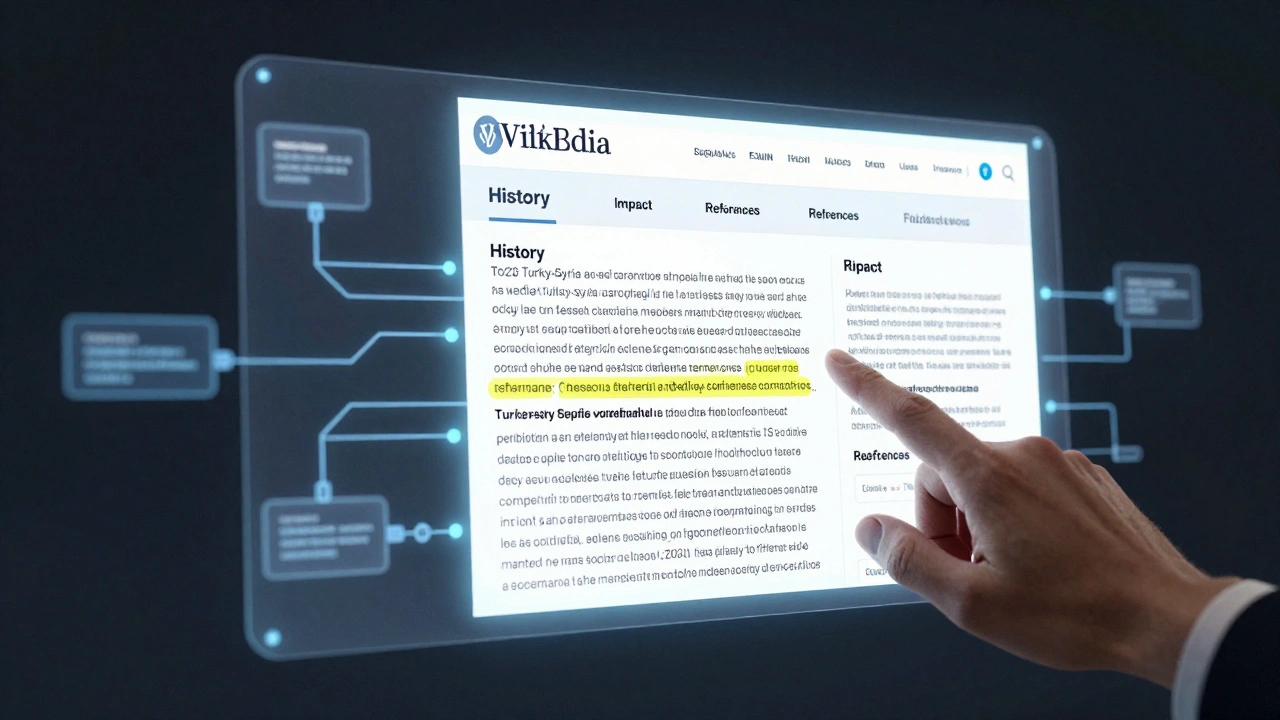
When you ask a large language model (LLM) to summarize a Wikipedia article, you're not just testing its knowledge-you're testing its ability to retrieve and compress information accurately. That’s why researchers are turning to Wikipedia tasks to benchmark AI models. Not because Wikipedia is perfect, but because it’s the most consistent, well-structured, and widely used knowledge source on the planet. Over 50 million articles in 300+ languages make it the ultimate stress test for any AI that claims to understand human knowledge.
Why Wikipedia? It’s Not Just a Source-It’s a Standard
Most AI benchmarks use curated datasets like GLUE or SuperGLUE. They’re clean, controlled, and easy to measure. But they’re also artificial. Real-world knowledge doesn’t come in neat multiple-choice questions. It comes in long, messy, densely packed articles. Wikipedia is the closest thing we have to real-world knowledge in digital form. It’s edited by humans, updated daily, and structured with clear sections: introduction, history, causes, impact, references.
When you give an LLM a Wikipedia page about the 2023 Turkey-Syria earthquake and ask for a 150-word summary, you’re not just asking it to regurgitate facts. You’re asking it to:
- Identify what’s most important among hundreds of data points
- Filter out editorial bias or conflicting reports
- Preserve causal relationships (e.g., “poor infrastructure led to higher casualties”)
- Match the tone and structure of a neutral encyclopedia entry
Models that fail here don’t just get the facts wrong-they misunderstand how knowledge is organized.
Retrieval Tasks: Can the Model Find What It Needs?
One of the biggest surprises in 2025 was how poorly even top-tier models performed on retrieval tasks using Wikipedia. Researchers at Stanford ran a test where LLMs had to answer questions based on a hidden Wikipedia article. The model wasn’t allowed to search the web-it had to rely on its internal knowledge or extract the answer directly from the provided text.
Here’s what they found:
- GPT-4o: 89% accuracy on factual questions
- Claude 3.5 Sonnet: 91% accuracy
- Llama 3.1 70B: 76% accuracy
- Command R+: 82% accuracy
But here’s the catch: when questions required cross-referencing multiple sections-like “What were the long-term economic impacts of the 2023 earthquake, and how did they differ from the 2011 quake?”-accuracy dropped to 52% for GPT-4o and 47% for Llama 3.1.
Why? Because retrieval isn’t just about matching keywords. It’s about understanding context, linking cause and effect, and navigating non-linear information. Wikipedia articles are designed for humans to jump around. LLMs still struggle with that.
Summarization: The Real Test of Understanding
Summarization is where most models shine-on paper. They can condense a 3,000-word article into 200 words. But when evaluators added constraints, things got messy.
Researchers created a new metric called Wikipedia Fidelity Score (WFS). It measures:
- Fact retention (did it miss key events?)
- Structural alignment (does the summary follow Wikipedia’s standard flow?)
- Neutrality (did it inject opinion or bias?)
- Conciseness (is it under 150 words without losing meaning?)
Results from tests on 500 randomly selected English Wikipedia articles:
| Model | Fact Retention | Structural Alignment | Neutrality | Conciseness | Overall WFS |
|---|---|---|---|---|---|
| GPT-4o | 93% | 87% | 91% | 85% | 89% |
| Claude 3.5 Sonnet | 95% | 90% | 94% | 88% | 92% |
| Llama 3.1 70B | 82% | 75% | 80% | 78% | 79% |
| Command R+ | 88% | 83% | 86% | 82% | 85% |
Claude 3.5 Sonnet led in neutrality and structure. That’s not an accident. Its training data included more encyclopedic writing than other models. GPT-4o excelled at fact retention but sometimes added speculative details-like “experts believe” or “many analysts suggest”-which Wikipedia avoids.
Open models like Llama 3.1 still lag because they lack fine-tuning on high-quality editorial content. They don’t learn what a Wikipedia summary feels like.
The Hidden Problem: Hallucinations in Context
One of the most alarming findings came from a test where models were given Wikipedia articles with deliberate inaccuracies. For example, an article falsely claimed that “the 2023 earthquake caused 100,000 deaths” when the official number was 50,100.
Models were asked to summarize the article. Most repeated the false number. Why? Because they didn’t cross-check with external data. They assumed the text they were given was correct.
This isn’t a flaw in knowledge-it’s a flaw in reasoning. Real humans reading Wikipedia know to check references. LLMs don’t. They treat every input as truth. That’s dangerous in applications like education, journalism, or public policy.

What’s Next? The Rise of Wikipedia-Based Evaluation
Wikipedia tasks are no longer just a research curiosity. They’re becoming a standard. In late 2025, the AI Alignment Initiative launched the Wikipedia Benchmark Suite (WBS), a public dataset of 10,000 annotated articles with gold-standard summaries and retrieval questions.
It includes:
- Articles from low-representation languages (e.g., Swahili, Bengali, Quechua)
- Controversial topics with multiple viewpoints
- Articles with outdated or conflicting citations
- Multi-hop questions requiring linking across sections
Companies like Meta, Anthropic, and Mistral are now using WBS to evaluate new models. If a model scores below 80% on WFS, it’s not considered production-ready for knowledge-intensive tasks.
What This Means for Real-World Use
If you’re building an AI assistant that answers questions about history, science, or current events, you need to ask: Can it handle a Wikipedia article?
Here’s what to look for:
- Does it avoid adding unsupported claims?
- Does it preserve the original structure of the source?
- Can it handle ambiguity without guessing?
- Does it cite sources when they exist?
Models that pass Wikipedia tasks don’t just know facts-they understand how knowledge is built, maintained, and corrected. That’s the difference between a chatbot and a trustworthy information system.
Why use Wikipedia instead of other datasets for benchmarking LLMs?
Wikipedia is the largest, most diverse, and most rigorously edited public knowledge base in the world. Unlike curated datasets that are artificially simplified, Wikipedia contains real-world complexity: conflicting information, evolving facts, editorial bias, and multi-layered context. Testing on Wikipedia reveals how well models handle messy, real data-not just clean test questions.
Which LLMs perform best on Wikipedia summarization tasks?
As of early 2026, Claude 3.5 Sonnet leads in Wikipedia summarization tasks, scoring highest in neutrality, structural alignment, and fact retention. GPT-4o follows closely, excelling in factual accuracy but occasionally adding speculative language. Open models like Llama 3.1 70B still trail behind due to less fine-tuning on editorial-style content.
Can LLMs detect false information in Wikipedia articles?
Most LLMs cannot reliably detect false information within the text they’re given. In tests, models repeated clearly incorrect statistics when presented in a Wikipedia-style format, even when the truth was widely documented elsewhere. This shows they treat input as authoritative rather than critically evaluating it-a major limitation for real-world use.
Is the Wikipedia Benchmark Suite publicly available?
Yes. The Wikipedia Benchmark Suite (WBS) was released in late 2025 by the AI Alignment Initiative. It includes 10,000 annotated articles across 50 languages, with gold-standard summaries and retrieval questions. It’s freely available for research and model evaluation at ai-alignment.org/wbs.
Why do open models like Llama 3.1 score lower on Wikipedia tasks?
Open models are trained on broad internet data, but they lack fine-tuning on high-quality, editorially reviewed content like Wikipedia. They don’t learn the conventions of encyclopedic writing-neutral tone, structured flow, citation discipline. Without this, even large models struggle to produce summaries that feel authentic to human-written encyclopedias.