Wikipedia is the first place most students and researchers go when they need a quick explanation of a concept. But when it comes time to write a real paper, do they actually cite it? The answer isn’t what you might expect.
Wikipedia Is Read More Than Cited
A 2023 study by researchers at the University of Minnesota tracked over 1.2 million academic papers published between 2015 and 2023. They found that while nearly 70% of those papers referenced Wikipedia at least once during the drafting process, only 0.04% included it as a formal citation in their reference list. That’s about 500 papers out of a million. Most writers use Wikipedia to get a basic understanding of a topic, then move on to peer-reviewed journals, books, or government reports for their actual sources.
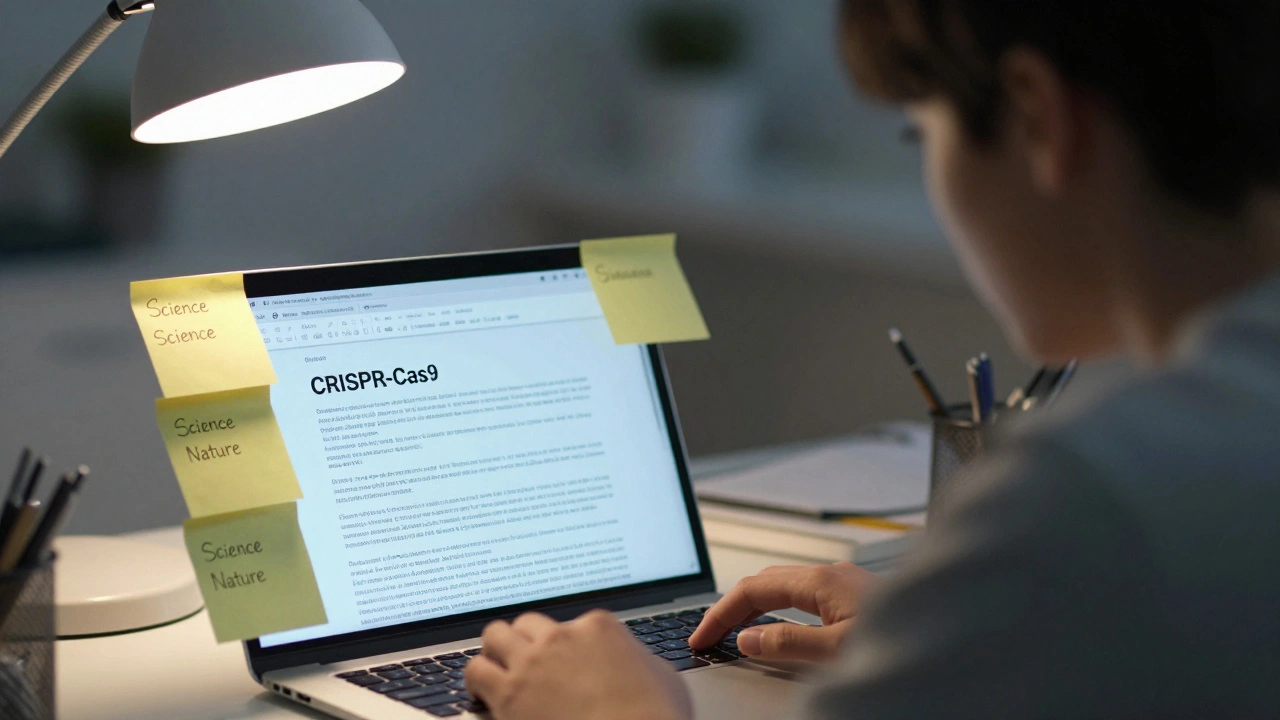
This isn’t laziness. It’s strategy. Wikipedia excels at summarizing complex topics in plain language. A biology student looking up ‘CRISPR-Cas9’ will find a clear breakdown of the mechanism, history, and ethical debates-all in minutes. But the paper they write needs to cite the original 2012 Science paper by Doudna and Charpentier, not the Wikipedia summary. The encyclopedia acts as a gateway, not a destination.
Why Academics Avoid Citing Wikipedia
The reasons are simple and well-known in academic circles. First, Wikipedia is editable by anyone. That means content can change without notice. A sentence you cite today might be rewritten tomorrow by a well-meaning but uninformed editor. Second, Wikipedia doesn’t have peer review. While many articles are well-maintained and heavily monitored, there’s no guarantee the information has been vetted by experts in the field.
Third, academic publishing values original sources. When you cite a journal article, you’re pointing readers to the primary evidence. Citing Wikipedia is like citing a textbook summary of a novel instead of the novel itself. It adds a layer of distance between your argument and the original data. Journals like Nature, The Lancet, and the American Psychological Association explicitly ban Wikipedia citations in their guidelines.
One exception is in fields where Wikipedia is the most accessible record of public knowledge-like cultural studies, digital humanities, or media analysis. A paper studying how gender is portrayed in online encyclopedias might legitimately cite Wikipedia as a source of data. But even then, researchers usually specify which version of the page they used, often by linking to a specific revision ID to ensure reproducibility.
What Do the Numbers Really Show?
Let’s look at the data more closely. In the same Minnesota study, citation rates varied wildly by discipline. Engineering and computer science papers cited Wikipedia least often-under 0.01%. In contrast, social sciences and education papers cited it slightly more, around 0.07%. Why? Because those fields often deal with public perceptions, policy debates, and emerging topics where Wikipedia serves as a proxy for collective knowledge.
Medical papers were the most cautious. Only 0.008% cited Wikipedia. That’s not because doctors don’t use it-they do. A 2021 survey of 1,500 practicing physicians found that 82% used Wikipedia to quickly check a diagnosis or drug interaction. But when writing a research paper, they turned to PubMed, Cochrane Reviews, or clinical trial registries. The stakes are too high to rely on crowd-sourced content.
Even in disciplines where Wikipedia is used more, the citations are often hidden. Some researchers paraphrase Wikipedia content without attribution, treating it as common knowledge. Others cite the original source that Wikipedia itself cited, making the encyclopedia invisible in the final reference list. This creates a gap between usage and formal citation.
Wikipedia’s Role in Research Is Changing
Wikipedia isn’t static. It’s become more structured over the last decade. Articles now often include standardized citation templates, references to primary literature, and even links to datasets. Some universities, like MIT and Stanford, now include Wikipedia editing assignments in their undergraduate courses-not to cite it, but to teach students how to evaluate sources critically.
Tools like Wikidata and Citation Hunt are helping bridge the gap. Wikidata provides structured data that researchers can pull into their analyses. Citation Hunt automatically flags Wikipedia articles that need better references, encouraging academics to contribute. In 2024, over 12,000 scholars registered as Wikipedia editors through academic outreach programs. Many of them improved articles in their own fields-adding peer-reviewed citations, correcting outdated stats, or expanding underrepresented topics.
This shift means Wikipedia is slowly becoming a tool for researchers, not just a shortcut. It’s no longer just a place to look up facts-it’s becoming a platform for disseminating verified knowledge, with academics playing an active role.
What Should Students and Early-Career Researchers Do?
If you’re writing your first research paper, here’s what you should do:
- Use Wikipedia to start-get the big picture, find keywords, and identify key authors or studies.
- Follow the references-click on the citations in Wikipedia’s footnotes. These lead to real academic sources.
- Never cite Wikipedia directly unless your field explicitly allows it (and even then, check your journal’s policy).
- Track your sources-keep a running list of every paper or book you find through Wikipedia. You’ll need them later.
- Consider editing-if you find a Wikipedia article that’s incomplete or inaccurate in your area of expertise, fix it. It’s one of the most direct ways to improve academic knowledge sharing.
There’s no shame in using Wikipedia. The problem isn’t the tool-it’s treating it as a final source. The best researchers use it like a map: not the destination, but the path to something more reliable.
Is Wikipedia a Valid Academic Source? The Bottom Line
Wikipedia is not a scholarly source. It doesn’t meet the criteria for peer review, permanence, or authority that academic publishing demands. But dismissing it entirely misses the point. It’s the most comprehensive, up-to-date, and accessible summary of human knowledge ever created. Its value isn’t in being cited-it’s in being used well.
Academics don’t cite Wikipedia because they don’t need to. They cite the sources Wikipedia cites. The real story isn’t about whether Wikipedia is trusted-it’s about how it’s helping researchers find what’s truly trustworthy.
Can I cite Wikipedia in my thesis or dissertation?
Most universities and academic programs discourage or prohibit citing Wikipedia in theses and dissertations. Your advisor or department’s style guide will likely require you to cite primary sources. If you used Wikipedia to understand a concept, cite the original journal article, book, or report you found through it. Some programs may allow Wikipedia citations in the introduction or background section if you’re analyzing how knowledge is presented online-but this is rare and must be approved in advance.
Why do some professors say it’s okay to cite Wikipedia?
Some professors allow Wikipedia citations in early drafts or informal assignments to help students get started. But this is almost always a teaching tool, not a policy. Once students move into formal research writing, they’re expected to replace Wikipedia references with scholarly sources. A few fields, like digital media studies or information science, may treat Wikipedia as a legitimate object of study-but even then, it’s cited as a cultural artifact, not a factual authority.
Does Wikipedia have any academic credibility at all?
Wikipedia doesn’t have academic credibility as a source, but it does have credibility as a tool. Studies show that Wikipedia articles in science and medicine are as accurate as Encyclopaedia Britannica in over 90% of cases. The difference is not in accuracy-it’s in process. Wikipedia’s strength is its speed and breadth. Its weakness is its lack of formal validation. For research, you need both accuracy and accountability. That’s why you go past Wikipedia to the original sources.
Can I use Wikipedia to find journal articles?
Yes, and you should. Wikipedia articles often include high-quality references at the bottom. Look for citations labeled with [1], [2], etc. Click on them. Many lead directly to peer-reviewed papers, books, or official reports. Tools like Google Scholar can then help you find full-text versions. This is one of the most efficient ways to begin a literature review-especially if you’re new to a topic.
Are there any journals that accept Wikipedia citations?
Very few. The only journals that might accept Wikipedia citations are those focused on digital culture, online communities, or information science-where Wikipedia itself is the subject of study. For example, a paper analyzing how Wikipedia handles climate change misinformation might cite specific article revisions. In all other cases, citing Wikipedia will likely result in your paper being rejected or returned for revision.
If you’re serious about research, treat Wikipedia like a flashlight-not the destination. It helps you see the path. But you still have to walk it yourself.