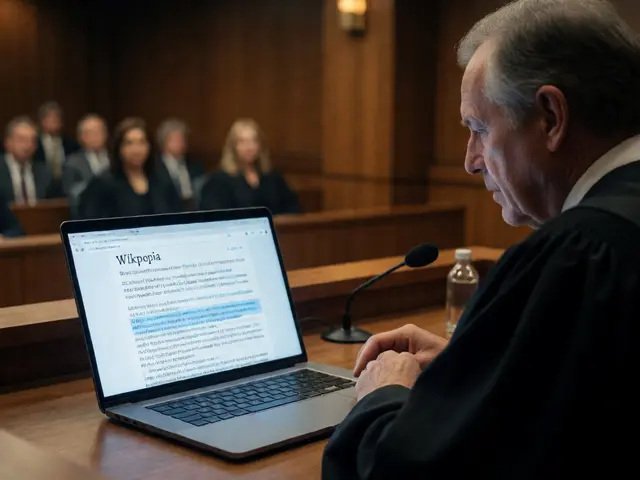
You probably trust Wikipedia more than you realize. It’s the first place most of us turn to when we need a quick fact check, a biography summary, or a definition. But here’s the kicker: anyone can edit it. That open-door policy is both its greatest strength and its biggest vulnerability. From fake biographies of non-existent people to decades-long pranks that fooled journalists, false information incidents on Wikipedia are not just funny anecdotes-they’re case studies in how crowdsourced knowledge handles errors.
Why does this matter? Because when a hoax sticks, it bleeds into news articles, school papers, and even court documents. Understanding how these errors happen-and more importantly, how they get fixed-gives you a better sense of what to trust online. We aren’t talking about minor typos here. We’re talking about elaborate deceptions that survived for years, sometimes decades, before being caught by vigilant editors or bored students.
The Anatomy of a Wiki Hoax
A wiki hoax is a deliberate insertion of false content into a Wikipedia article, often intended as a prank or satire. Unlike accidental errors, which are usually corrected within hours, hoaxes are designed to persist. They rely on specific traits: plausibility, lack of immediate verification, and the sheer volume of content that makes human review impossible.
Think of it like playing whack-a-mole with a sledgehammer. There are over six million articles in English Wikipedia alone. Editors can’t read every change. So, if you add a fake detail about a obscure historical figure or a minor celebrity, who’s going to notice? The answer is: eventually, someone will. But "eventually" can mean five years.
The most successful hoaxes share a few characteristics:
- Obscurity: Targeting subjects with few existing sources.
- Plausibility: Using academic-sounding language or citing non-existent but realistic-looking references.
- Low Traffic: Articles that don’t get edited often fly under the radar.
Legends of the Deception: Famous Cases
Some hoaxes have become legendary in internet culture. Take the story of Essjay. In 2006, a user named Essjay claimed to be a theology professor with a Ph.D. He was cited by major newspapers, including The New York Times, as an expert source. The catch? Essjay was actually Ryan Jordan, a 24-year-old community college dropout from Kentucky. He had no degree. The incident sparked a massive debate about credentials versus contributions. Does it matter who you are if your edits are good? Wikipedia decided it did, at least for public-facing credibility.
Then there’s the Citizendium fork, which emerged partly because of controversies like Essjay’s. But let’s look at a pure content hoax. For years, the article on Elephant Seals included a section claiming they could swim across the Atlantic Ocean in a single day. It was absurd, physically impossible, yet it sat there for months. Why? Because it sounded scientific enough to pass a casual glance.
One of the longest-running hoaxes involved a fictional person named Barnard Ellis. Created in 2007, Barnard was described as a prominent American businessman and philanthropist. His page listed detailed career milestones, awards, and charitable works. It took until 2015 for editors to confirm he never existed. During those eight years, his name appeared in other articles and external blogs. This demonstrates the "citation cascade" effect: once a fake entity appears in one trusted source (Wikipedia), others cite it without checking the original.

How Corrections Actually Happen
So, how do these lies die? It’s rarely a single hero. It’s usually a combination of automated bots, suspicious editors, and outside pressure. ClueBot NG is a popular anti-vandalism bot that uses machine learning to detect obvious vandalism. If someone changes "George Washington" to "George Banana," ClueBot reverts it instantly. But sophisticated hoaxes slip past bots because they don’t look like vandalism; they look like additions.
Human intervention comes in through patrols. Experienced editors watch recent changes on topics they care about. If you’re a history buff, you might notice that a new claim about Abraham Lincoln has no citation. You tag it with {{citation needed}}. If nobody provides a source within a certain timeframe, the claim gets removed.
External scrutiny plays a huge role too. When a journalist cites Wikipedia, they sometimes double-check. If they find an error, they report it. Sometimes, the subject of the hoax reports it themselves. Imagine waking up to find out you’ve been declared dead on Wikipedia three times in one week. You’d log in and fix it.
| Error Type | Intent | Detection Method | Average Lifespan |
|---|---|---|---|
| Vandalism | Malicious or humorous disruption | Automated Bots (e.g., ClueBot) | Minutes to Hours |
| Accidental Error | Misunderstanding or typo | Editor Patrols / Readers | Days to Weeks |
| Sophisticated Hoax | Deception / Prank | Deep Dive Research / External Media | Months to Years |
| Bias | Systematic slant | Community Debate / RfC | Infinite (Contested) |
The Role of Citations and Verifiability
Wikipedia’s core policy is verifiability: material challenged or likely to be challenged must be attributed to a reliable published source. This is the primary weapon against false information. If you add a claim, you must provide a link to a book, newspaper, or journal that backs it up.
Hoaxes often fail because they can’t produce real citations. Early hoaxes used fake ISBN numbers or linked to dead websites. Modern editors are savvier. They click the links. If a citation leads to a blog post written by the same anonymous editor, it gets flagged. This creates a high barrier to entry for long-term deception.
However, circular referencing remains a problem. If a news outlet cites Wikipedia, and then Wikipedia cites the news outlet, the loop closes. Breaking this cycle requires finding the original source. Often, the original source doesn’t exist. That’s when the "citation needed" tag becomes a death sentence for the claim.

When Truth Is Stranger Than Fiction
Not all false information is malicious. Some errors arise from genuine confusion. A classic example involves misidentified images. For years, a photo labeled "Nikola Tesla" was actually of a different inventor. Editors swapped them back and forth multiple times. These image caption errors are hard to spot because the image looks plausible, and few readers know what Tesla looked like in every decade of his life.
Another tricky area is living persons. Biographies of living people are held to higher standards due to privacy concerns. Errors here can have legal implications. If a false statement about a politician’s health stays on their page for a month, it can influence public perception. Corrections here happen faster because the subject’s team monitors the page closely.
Lessons for the Digital Reader
What should you take away from this? First, treat Wikipedia as a starting point, not an endpoint. Use it to find sources, then go to the sources. Second, look for red flags. Are there lots of {{citation needed}} tags? Is the tone overly promotional? Does the article have very few contributors?
Third, understand that correction is a process, not an event. An error might sit for weeks, but the system is self-correcting. The sheer number of eyes watching the platform means that persistent lies are rare. Most false info is cleaned up quickly. The famous hoaxes are famous precisely because they were exceptions, not the rule.
Finally, appreciate the effort behind the scenes. Thousands of volunteers spend hours debating neutrality, checking sources, and reverting bad edits. When you see a clean, well-cited article, remember that it survived a gauntlet of scrutiny. False information incidents remind us that truth is fragile in the digital age, but also resilient when communities care enough to protect it.
Can anyone really edit any Wikipedia article?
Yes, generally speaking. However, some pages are protected. Semi-protected pages require users to have an account and a certain number of edits. Fully protected pages can only be edited by administrators. This helps prevent vandalism during heated disputes or breaking news events.
How long did the longest Wikipedia hoax last?
The Barnard Ellis hoax lasted approximately eight years (2007-2015). Another notable one, involving a fake species of bird, lasted several years. The duration depends on the obscurity of the topic and the diligence of the editing community monitoring that specific field.
Does Wikipedia delete articles that contain hoaxes?
Usually, they delete the specific false content, not the whole article. If the entire article is based on a hoax (like a biography of a non-existent person), the whole page is deleted via a process called "speedy deletion" or a consensus discussion known as "Articles for Deletion" (AfD).
What is the 'citation needed' template?
It is a maintenance template added to statements that lack a verifiable source. It signals to other editors that the claim needs backing up. If a source isn't provided within a reasonable time, the statement may be removed. It's a key tool for maintaining accuracy.
Are Wikipedia editors paid?
Most are volunteers. However, there are paid editing programs where companies or individuals hire editors to improve articles about themselves. These paid editors are required to disclose their relationship on the talk page to maintain transparency and avoid conflicts of interest.