Wikipedia isn’t just a website with articles. It’s a living system built by millions of people who follow a simple but powerful set of rules. If you’re new to editing, those rules can feel overwhelming. But they’re not meant to lock you out-they’re meant to keep the whole thing working. These rules are called the Five Pillars of Wikipedia. They’re the foundation of everything you’ll do here. Learn them, and you’ll stop guessing what’s allowed and start contributing with confidence.
Wikipedia is an encyclopedia
First and foremost, Wikipedia is not a blog, a forum, a social media page, or a personal website. It’s an encyclopedia. That means every article must be about something notable, verifiable, and of general interest. You can’t write about your favorite local café unless it’s been covered by independent news sources. You can’t post opinion pieces, how-to guides for your hobby, or promotional content for your business.
Think of it like a library catalog. Libraries don’t stock every book ever printed-they pick ones that have stood the test of time, been reviewed by experts, or reached enough people to matter. Wikipedia does the same. If you’re unsure whether a topic belongs, ask: Would a printed encyclopedia include this? If the answer is no, it’s probably not Wikipedia material.
This pillar filters out noise. It’s why you won’t find pages for random YouTube videos, personal Instagram accounts, or unpublished fan fiction. It’s also why articles about scientists, historical events, cities, and well-known companies are so detailed-they’ve been documented elsewhere, and that documentation is what makes them eligible.
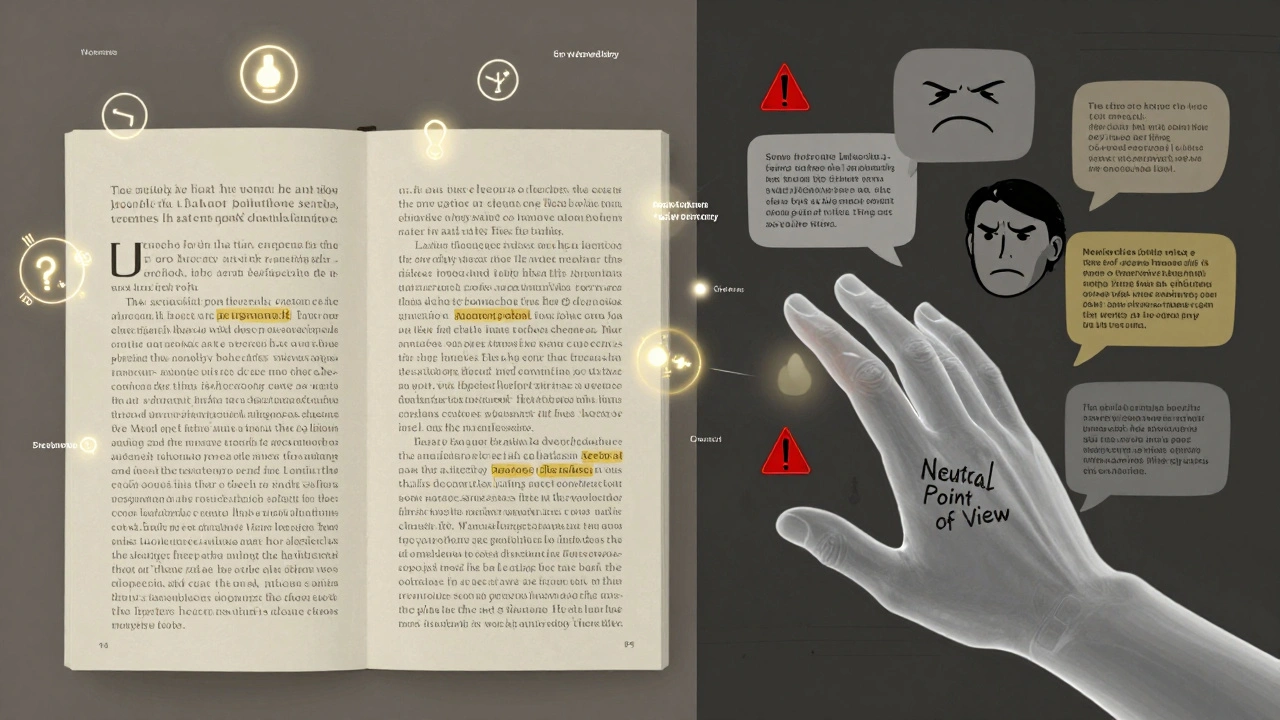
Wikipedia is written from a neutral point of view
Wikipedia doesn’t take sides. It doesn’t matter if you think climate change is real or a hoax, if you love or hate a political leader, or if you believe a certain brand is the best. Your job as an editor is to present what reliable sources say, not what you believe.
This isn’t about being boring. It’s about being fair. If one source says a company’s CEO is a genius and another calls them a fraud, you don’t pick one. You report both, and you cite each. You use phrases like “according to,” “some critics argue,” or “a 2023 study found.” That way, readers get the full picture, not your version of it.
Many new editors try to “fix” articles to match their views. That’s the biggest mistake you can make. Instead, look at the references. If the article lacks sources, find them. If it’s one-sided, add the missing perspective. Neutral doesn’t mean silent-it means balanced.
Wikipedia is free content that anyone can use, edit, and distribute
Everything on Wikipedia belongs to everyone. That means you can’t copy text from a copyrighted book, magazine, or website and paste it here-even if you credit the source. Copyright doesn’t vanish just because you’re not selling it. The same goes for images. If you didn’t take the photo, write the text, or create the diagram yourself, you probably can’t use it.
Instead, use only content that’s licensed under Creative Commons or in the public domain. Wikipedia’s own text is released under CC BY-SA 3.0, which means others can reuse it as long as they give credit and share it the same way. That’s why you’ll see citations everywhere. They’re not just for show-they’re legal requirements.
When you edit, you’re agreeing to this rule too. Anything you add becomes free for anyone to use, even companies or schools. That’s the trade-off: you give up control so the whole project stays open and alive.
Wikipedia editors should treat each other with respect and civility
Wikipedia is run by volunteers. Real people. Some are experts. Some are students. Some are retired teachers. Some are just curious. They all come with different opinions, languages, and backgrounds. And yes-some of them will annoy you.
But here’s the rule: no personal attacks. No calling people idiots, trolls, or liars. No editing wars where you keep undoing someone’s changes just to win. If you disagree with an edit, talk about it on the article’s talk page. Ask questions. Cite policy. Explain why you think something should change. Be patient. Most editors want the same thing you do: better articles.
There’s a reason Wikipedia has a “assume good faith” policy. If someone adds something wrong, they probably didn’t know better. If they undo your edit, they might have a good reason. Don’t assume malice. Assume someone just needs help understanding the rules. That’s how you turn conflict into collaboration.
And if someone is truly hostile? Report it. Don’t fight back. The system works when people follow the rules, not when they retaliate.
Wikipedia has no firm rules
This one sounds weird, but it’s the most important. Wikipedia doesn’t have a rigid rulebook. The Five Pillars are guidelines, not laws. If following a rule makes Wikipedia worse, ignore it.
For example, there’s a rule that says articles shouldn’t be too short. But if you’re writing about a tiny village that only has three sentences of reliable information, forcing it into a 500-word article would be dishonest. Better to keep it short and accurate than pad it with fluff.
Another example: the rule against original research. Normally, you can’t add your own analysis or conclusions. But if you’re summarizing a dozen peer-reviewed studies on a medical topic and drawing a clear, evidence-based conclusion that all the sources support? That’s not original research-it’s synthesis. And it’s allowed.
Rules are there to help, not to trap you. If you’re ever stuck, ask yourself: “Will this make Wikipedia more useful?” If the answer is yes, go ahead-even if it bends a guideline. The real rule is: serve the reader.
What happens when you break a pillar?
Most of the time, nothing dramatic. Someone will revert your edit, leave a polite note, and explain why. You’ll get a message like, “This looks like original research-can you add a source?” That’s not a punishment. It’s a teaching moment.
Repeat violations? You might get a warning. A temporary block. But even then, it’s not personal. Wikipedia’s goal isn’t to punish editors. It’s to protect the quality of the content. Most editors who get blocked come back after learning the rules.
Don’t let fear stop you. The worst thing you can do is not edit at all. Start small. Fix a typo. Add a citation. Clean up formatting. You don’t need to write a 10,000-word article on day one. Just follow the pillars, and you’ll be contributing better than 90% of new editors.
How to start using the pillars
Here’s a simple checklist you can use every time you edit:
- Is this topic notable enough for an encyclopedia? (Pillar 1)
- Am I presenting facts from reliable sources, not my opinion? (Pillar 2)
- Did I write this myself or use only free-content material? (Pillar 3)
- Am I being respectful, even if someone disagrees with me? (Pillar 4)
- Will this edit make the article more accurate and helpful? (Pillar 5)
If you can answer yes to all five, you’re good to go. If one answer is no, pause. Ask. Research. Fix.
Common mistakes new editors make
- Writing about themselves or their company-Wikipedia isn’t a resume or ad platform.
- Adding personal opinions as facts-“I think this movie is great” doesn’t belong.
- Copying text from other websites-even if it’s public.
- Editing in anger after a disagreement-take a break, then come back.
- Trying to make every article perfect on the first try-edit incrementally.
These aren’t sins. They’re learning steps. Every experienced editor made them. The key is to notice them, learn from them, and move on.
What to read next
Once you’re comfortable with the Five Pillars, explore:
- Wikipedia:Verifiability - how to find and use reliable sources
- Wikipedia:No original research - what counts as analysis versus summary
- Wikipedia:Assume good faith - how to respond to conflict
- Wikipedia:Manual of Style - formatting standards for consistency
You don’t need to memorize them all. Just keep the Five Pillars in mind. They’re your compass. Everything else is detail.
Can I edit Wikipedia if I’m not an expert?
Yes. You don’t need a degree or official credentials to edit Wikipedia. Many of the best edits come from people who aren’t experts-like students, hobbyists, or local residents who know details not in books. What matters is using reliable sources and following the Five Pillars. You’re not expected to know everything. You’re expected to help make the information accurate and clear.
What if I make a mistake?
Mistakes are normal. Someone will likely fix them quickly. You can check your edit history to see what was changed and why. Don’t delete your edits out of embarrassment-learn from them. Many editors keep a personal sandbox to practice before editing live articles. Use it. It’s safe, and no one will judge you there.
Why do some edits get deleted so fast?
Edits that break the Five Pillars-like adding opinion, copying copyrighted material, or promoting something-are removed quickly because they harm the encyclopedia’s credibility. It’s not personal. It’s about protecting the integrity of the whole project. If your edit was deleted, read the reason, fix it, and try again. Most reverts are corrections, not rejections.
Can I write about my town or local business?
Only if it has been covered by independent, reliable sources like newspapers, academic journals, or official reports. A Yelp review or your own website doesn’t count. If your town has been mentioned in a regional news article or has a documented history in a government archive, then yes. If not, it’s not notable enough. Don’t create articles just because you care about something-Wikipedia needs broader relevance.
How long does it take to become a good Wikipedia editor?
It varies. Some people get the hang of it in a week. Others take months. The key isn’t speed-it’s consistency. Focus on small, accurate edits. Learn one rule at a time. Ask questions on talk pages. Read feedback. After 10-20 edits, you’ll start seeing patterns. After 100, you’ll feel confident. There’s no test. You become good by doing good work, not by passing a quiz.