Ever wonder how a fact about the Eiffel Tower in English Wikipedia shows up almost instantly in Japanese, Arabic, or Swahili Wikipedia? It’s not magic. It’s Wikidata.
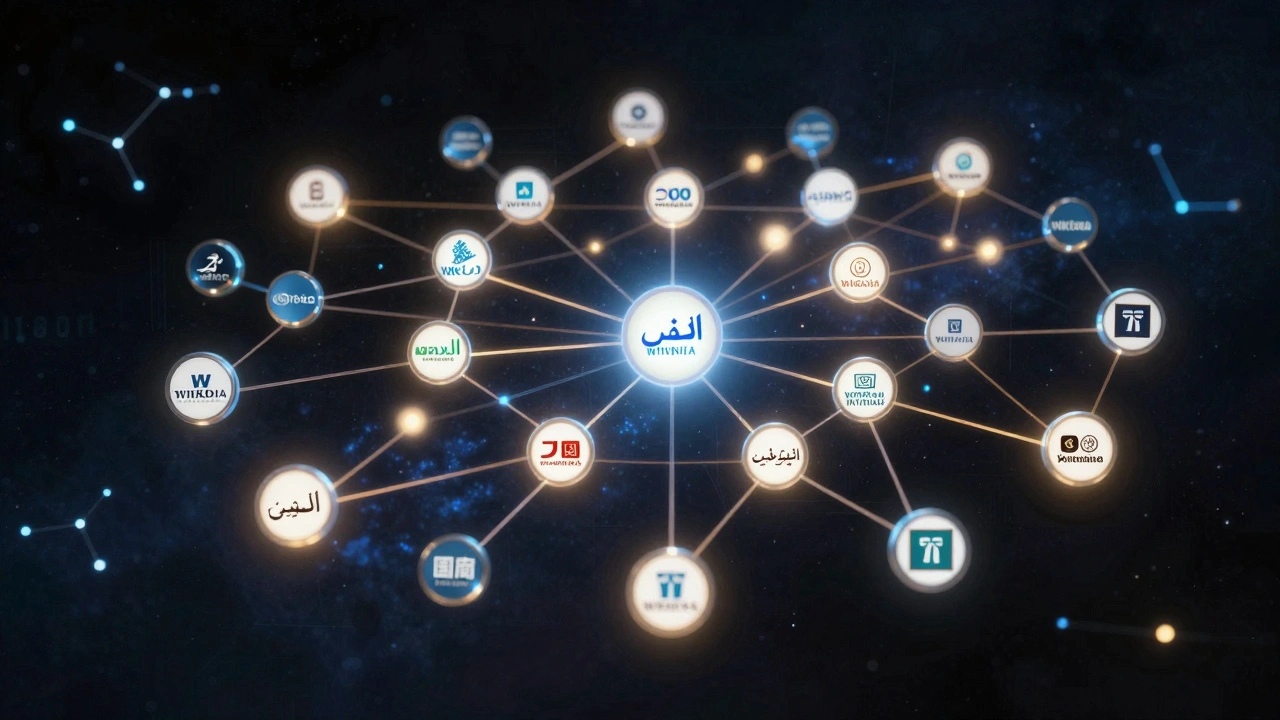
Wikidata isn’t another Wikipedia. It doesn’t have articles you read. Instead, it’s the silent backbone holding together over 300 language versions of Wikipedia. Think of it as a giant, living database where facts are stored once and reused everywhere. When someone updates the height of Mount Everest in English, that change ripples across every other Wikipedia language that pulls its Everest data from Wikidata. No manual copying. No mistakes from translation drift. Just clean, consistent data flowing between languages.
How Wikidata Solves the Multilingual Problem
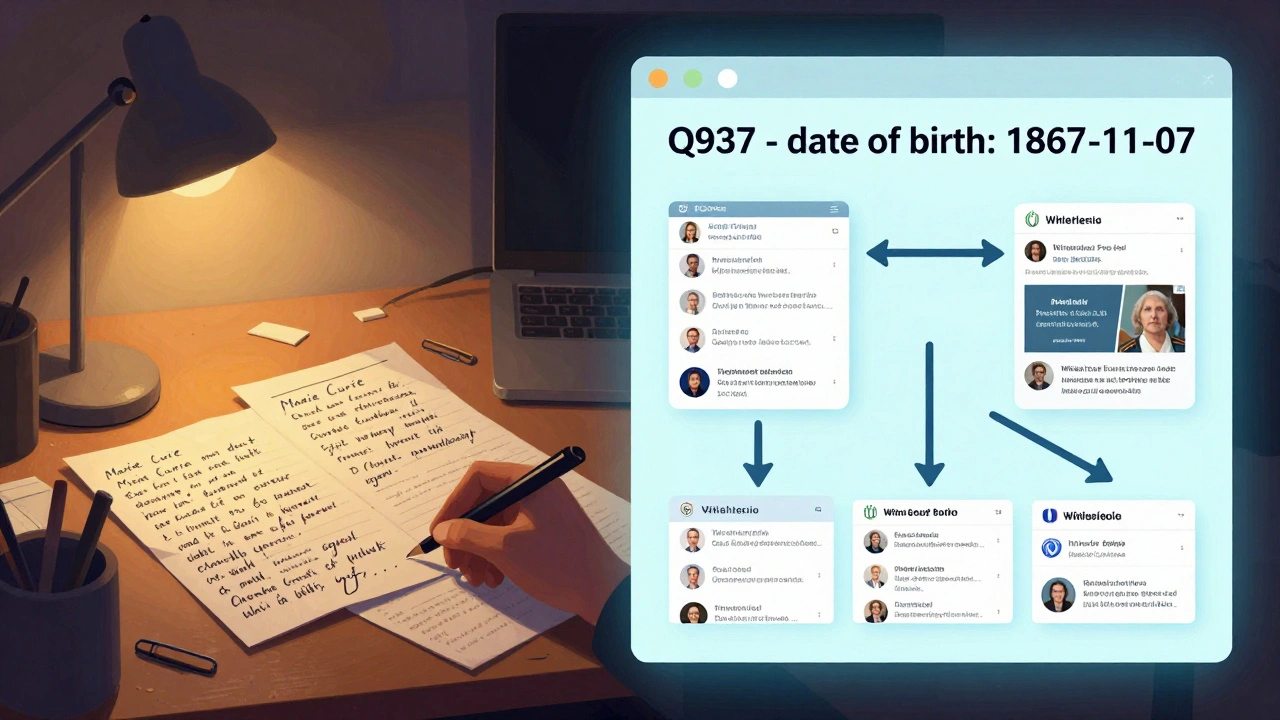
Before Wikidata, each Wikipedia language edition was its own island. If you edited the birthdate of Marie Curie in German Wikipedia, you had to remember to update it in French, Russian, and 297 other editions. Most editors didn’t. That led to conflicting info. One version said she was born in 1867. Another said 1868. Who was right? Nobody knew for sure.
Wikidata fixed that by making facts central. Instead of storing "Marie Curie - born 1867" in every language’s article, Wikidata stores it once as a structured statement: Marie Curie - date of birth - 1867-11-07. Every Wikipedia article pulls that date from Wikidata. If someone corrects it to 1867-11-07 in Wikidata, every Wikipedia language updates automatically. No one has to edit 300 articles. Just one.
This isn’t just about dates. It’s about names, locations, population figures, Nobel Prize winners, movie release years, even chemical formulas. All of it lives in Wikidata. Wikipedia articles become lightweight wrappers that display this data, translated into the reader’s language. The structure stays the same. The facts stay synced.
What Kind of Data Lives in Wikidata?
Wikidata doesn’t store paragraphs. It stores atomic facts called "statements." Each statement has three parts: an entity, a property, and a value.
- Entity: The thing you’re describing - like "Q937" (the unique ID for the Eiffel Tower).
- Property: The attribute you’re describing - like "P1813" (official name in the original language).
- Value: The actual data - like "Tour Eiffel".
These statements can be as simple as "Paris - located in - France" or as complex as "Pablo Picasso - influenced by - Paul Cézanne" with qualifiers like "time period: 1900-1905". Wikidata even handles relationships between entities. For example, "Barack Obama - spouse - Michelle Obama" links two people directly.
Values can be text, numbers, dates, coordinates, or even links to other Wikidata items. This flexibility lets it hold everything from the population of a village in Nepal to the ISBN of a book translated into 12 languages.
Each item in Wikidata has a unique identifier - like Q12345 - that never changes, no matter what language you use. That’s the secret. The ID stays the same. The labels change. In English, Q937 is "Eiffel Tower". In Japanese, it’s "エッフェル塔". In Hausa, it’s "Towa Eiffel". But behind the scenes, they’re all the same thing.
How Wikipedia Uses Wikidata
Wikipedia articles don’t just copy-paste from Wikidata. They use smart templates called "infoboxes" that pull data automatically. When you see a box on the right side of a Wikipedia page with details like "Population: 2.1 million" or "Director: Christopher Nolan", that’s not typed by hand. It’s pulled live from Wikidata.
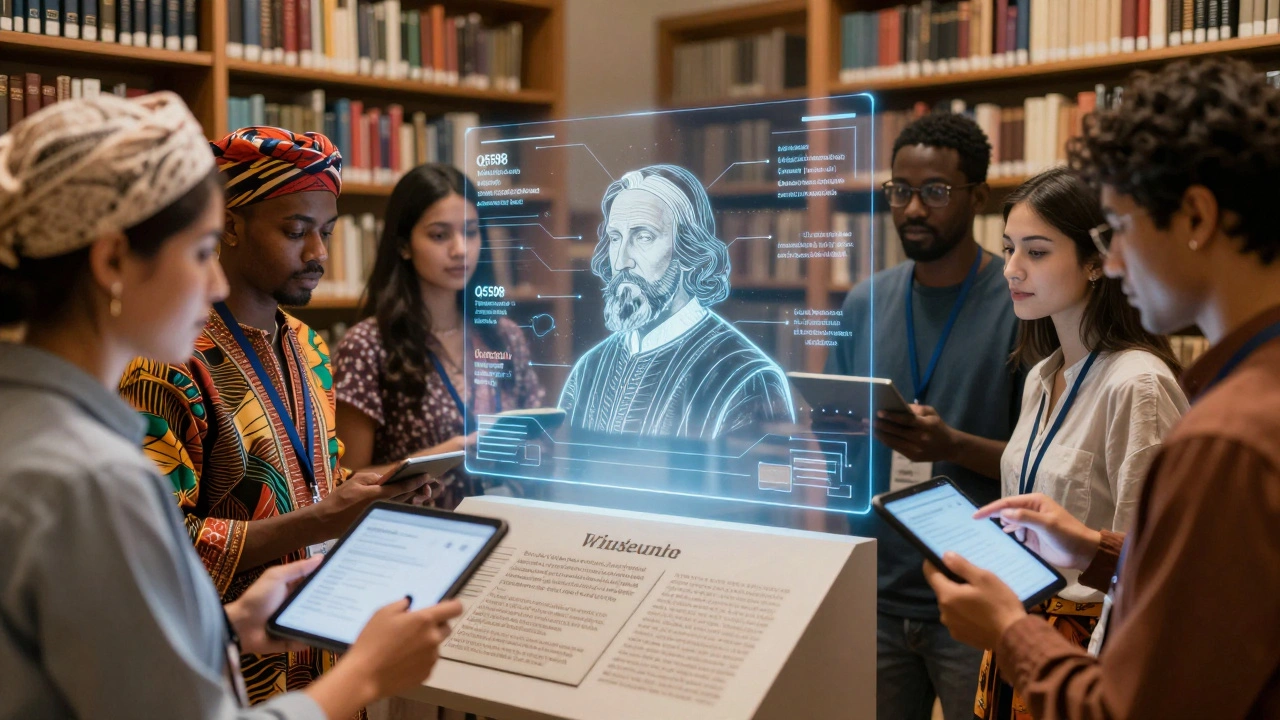
For example, the English Wikipedia article for "Leonardo da Vinci" uses a template that asks Wikidata: "What’s the birth date of Q5598?" Wikidata answers: "1452-04-15". The template then displays it as "April 15, 1452" in English. The Spanish article for "Leonardo da Vinci" uses the same template, but displays it as "15 de abril de 1452" in Spanish. Same data. Different language.
This system lets editors in small-language Wikipedias - like Basque or Quechua - build rich, detailed articles without having to manually collect every fact. They can use data from English, German, or French Wikipedias, all pulled through Wikidata. A Quechua editor doesn’t need to know the exact year the Panama Canal opened. They just add a template that says "show the opening date from Wikidata," and it appears in Quechua.
It also helps fix errors. If someone adds the wrong birth year for a scientist in the English Wikipedia, but the correct year is already in Wikidata, the edit gets flagged. The system notices the conflict. Editors get notified. The mistake gets corrected faster.
Who Builds and Maintains Wikidata?
Wikidata is built by volunteers - just like Wikipedia. But instead of writing essays, they’re entering facts into a structured form. Some people add data about movies. Others focus on mountains, animals, or historical events. There are even bots that automatically import data from trusted sources like the U.S. Census Bureau or the British Museum’s online collection.
One major source is the Wikipedia Infoboxes themselves. When editors clean up a Wikipedia article, they often migrate its data into Wikidata first. That way, the same fact can be reused by other languages. This process is called "Wikidata-ification." It’s become a standard practice in large Wikipedia communities like English and German.
Organizations also contribute. The European Union, the Smithsonian, and the Library of Congress have all uploaded datasets into Wikidata. These aren’t random entries - they’re high-quality, verified records that help fill gaps in smaller language editions.
Because Wikidata is open and machine-readable, researchers and developers use it too. Apps that show historical timelines, tools that translate museum labels, and even AI training datasets rely on Wikidata as a trusted source of structured knowledge.
Why This Matters for Global Knowledge
Most people think of Wikipedia as a collection of articles. But it’s really a network - and Wikidata is the wiring. Without it, knowledge would be trapped in language silos. A fact known in English might never reach a speaker of Tamil or Swahili. Or worse - it might be copied incorrectly, and the error spreads.
Wikidata breaks those barriers. It lets speakers of minority languages access the same depth of information as speakers of English or Mandarin. It lets researchers compare data across cultures without manually translating hundreds of pages. It lets students in rural India or remote Kenya learn about the same historical events, scientific discoveries, and cultural figures - with accurate, consistent data.
It also helps preserve knowledge. When a language is at risk of disappearing, Wikidata can still hold its terms. The Quechua name for the Andes, the Yoruba word for democracy, the Ainu name for a mountain - all of these can be stored in Wikidata as labels, even if no one writes a full Wikipedia article in that language yet.
This isn’t just about convenience. It’s about equity. Knowledge shouldn’t belong only to those who speak the most common languages. Wikidata makes it possible for everyone to contribute to and access the sum of human knowledge - regardless of what language they speak.
What’s Next for Wikidata?
Wikidata is still growing. In 2025, it holds over 110 million items and 1.4 billion statements. That’s more than double what it had in 2020. The growth isn’t slowing. More tools are being built to make data entry easier - like mobile apps that let you scan a museum plaque and instantly add the info to Wikidata.
New features are coming too. Soon, you’ll be able to ask Wikidata questions in plain language - like "Which countries have more than 100 UNESCO sites?" - and get answers directly. AI assistants will pull from Wikidata to give accurate, sourced answers instead of guessing.
And as more libraries, archives, and governments open their data, Wikidata will become even more powerful. Imagine a world where every historical document, every scientific dataset, every cultural artifact is linked through a single, open knowledge graph. That’s the vision. And Wikidata is already building it.
How is Wikidata different from Wikipedia?
Wikipedia is for reading articles written in natural language. Wikidata is for storing structured facts that can be reused across languages and applications. Wikipedia has paragraphs. Wikidata has statements like "Eiffel Tower - height - 300 meters".
Can anyone edit Wikidata?
Yes. Like Wikipedia, Wikidata is open for anyone to edit. But edits are checked by bots and experienced editors. Incorrect or spammy entries get reverted quickly. You don’t need to be a programmer - just careful and accurate.
Does Wikidata work with non-Latin scripts?
Absolutely. Wikidata supports all writing systems - Arabic, Cyrillic, Chinese characters, Devanagari, and more. Each item can have labels, descriptions, and aliases in dozens of languages, including those with right-to-left or complex scripts.
Why don’t all Wikipedia languages use Wikidata?
Most do - over 300 languages use it for infoboxes. But some smaller editions haven’t yet set up the technical tools to pull data. It’s not a lack of willingness - it’s often a lack of technical support or volunteers who know how to configure the templates.
Is Wikidata used outside of Wikipedia?
Yes. Google, Bing, Apple, and other search engines use Wikidata to power knowledge panels. Museums use it to link artifact records. Researchers use it to train AI models. Even apps that help you identify birds or plants pull species data from Wikidata.